
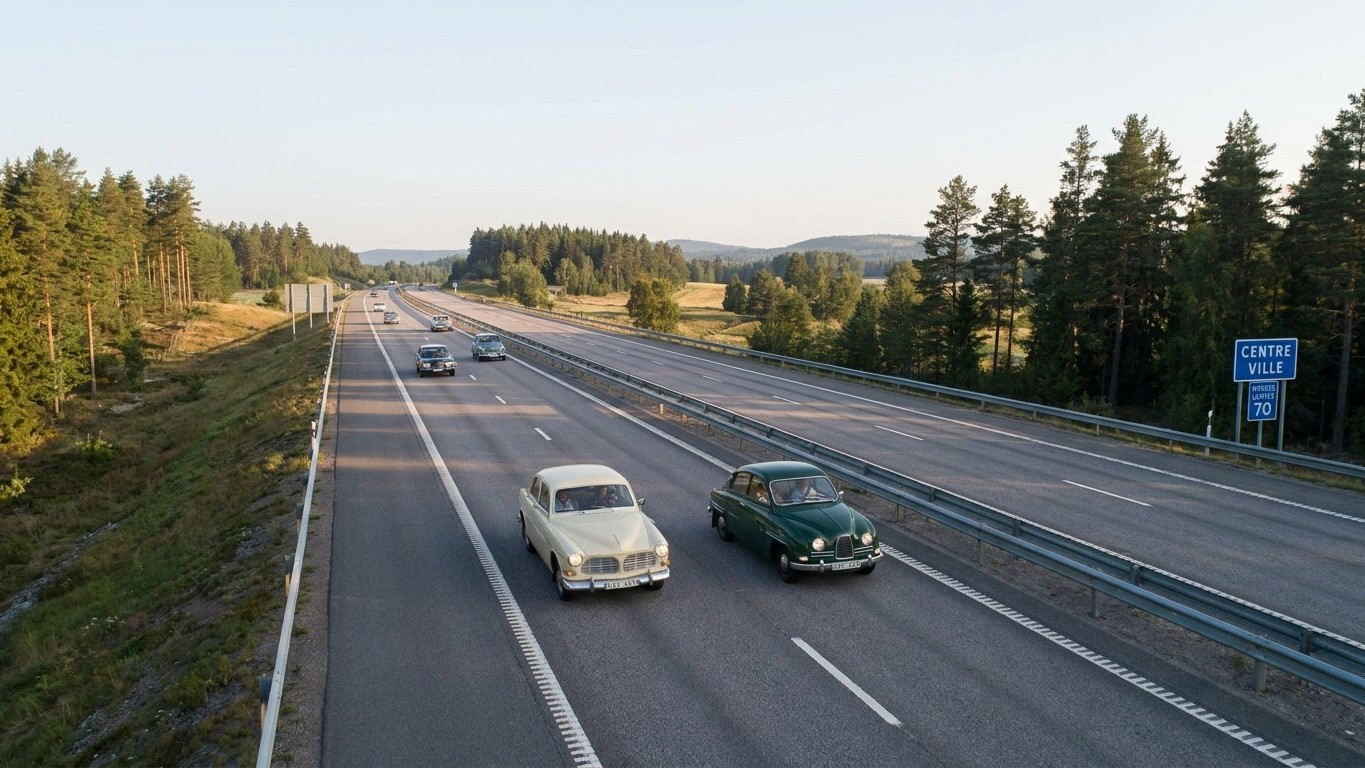
On September 3, 1967, at five o’clock in the morning, the whole of Sweden abruptly changed sides of the road in ten minutes flat. The country that had driven on the left for as long as anyone could remember swung to the right, and contrary to the authorities’ fears, the weeks that followed saw the number of accidents fall rather than explode.
Key takeaways
- An entire country switches sides of the road in a single night: how is that even possible?
- Experts predicted chaos, but the numbers tell a very different story
- A dramatic but temporary improvement that reveals an unexpected truth about human behavior
A nation unwilling to change
The story begins with popular repudiation. In 1955, a referendum was held to decide the question of traffic direction. The turnout was low, but it revealed an overwhelming unpopularity of the measure, with 82.9% of voters wanting to keep left-hand traffic. The message was clear: Swedes did not want to change their habits.
Yet the Swedish Parliament went ahead. In 1963, it decided to adopt Högertrafik, driving on the right. The reason lay less in safety than in geographic and mechanical logic. All of Sweden’s neighbors—Norway and Finland, with whom it shares a land border—already drove on the right, with five million vehicles crossing those borders each year. Even more striking: about 90% of Swedes were already driving vehicles with the steering wheel on the left, configured to travel on the right. Millions of drivers were driving on the left side of the road while sitting on the left side of the vehicle, a setup that made overtaking awkward and multiplied head-on collisions.
Four years of preparation for ten minutes of shift
In the four years leading up to Day D, the Swedish motoring landscape underwent a sweeping transformation: new signs wrapped in black plastic were installed, and a new white road-marking scheme replaced the yellow one. Across the country, over 360,000 new signs and traffic signals were installed along the roads, all covered in black plastic awaiting unveiling on the big day. It was a logistical feat never before seen in the history of the realm, since Dagen H stands by far as the largest logistical operation ever organized in Sweden.
The public transport network followed the same path. Trams were replaced by buses, and more than a thousand buses were themselves replaced by models with doors on the right-hand side. To hammer the message into the population, authorities distributed twelve million reminders to citizens before Day H, and deployed 130,000 signs bearing a slanted “H” along the roads. A mass pedagogy—almost obsessive—for a population that had not asked for this change.
Finally came the night of the shift. On Sunday, September 3, 1967, all nonessential traffic was banned from 1:00 a.m. to 6:00 a.m.; vehicles still on the road had to stop completely at 4:50 a.m., then move cautiously to the right and stop again before being allowed to proceed at 5:00. In the two largest cities, Stockholm and Malmö, the ban lasted longer, from 10:00 a.m. on Saturday until 3:00 p.m. on Sunday, to allow time for reconfiguring intersections. More than ten thousand agents were mobilized to supervise this collective switch—a figure that illustrates the government’s anxieties as the big day approached.
What everyone feared never happened
Catastrophe scenarios had circulated for months: pileups in rapid succession, roads turned into battlefields. The reality, however, told a different story. On the day of the switch, 157 car accidents were reported—fewer than a typical Sunday in Sweden. Of these incidents, only 32 involved injuries, with only a handful considered serious.
The real test arrived the following day, when people returned to work. On Monday, September 4, 125 traffic accidents were recorded nationwide, compared with 130 to 198 on other Mondays. And most importantly, no fatal accident could be attributed to the change. Experts offered a fairly straightforward explanation: the sense of danger prompted everyone to exercise extra caution. The number of insurance claims filed in the days following the shift even fell by about 40%.
This initial improvement was not a durable miracle, and the story grew more nuanced than a simple success tale. Those early gains did not last: the rate of accidents returned to normal within six weeks, and by 1969, the accident rate had returned to its pre-change level. The collective caution, as spectacular as it was, faded as people settled back into routine.
The switch came with a human cost as well: some elderly people chose to stop driving rather than adapt to the new traffic direction. A quiet renunciation, far from the spotlight, but revealing the scale of upheaval for a generation that had learned to drive on one side of the road since childhood.
The Swedish episode did not remain isolated for long. Less than a year later, Iceland also switched to driving on the right, mirroring its Nordic neighbor. Today, almost the entire continent of Europe drives on the same side, with the notable exceptions of the British Isles, Ireland, Cyprus, and Malta, which chose to preserve their distinctive road rules.
Sources: vacancesweb.be | volvocars-news.ch | autocult.fr
