
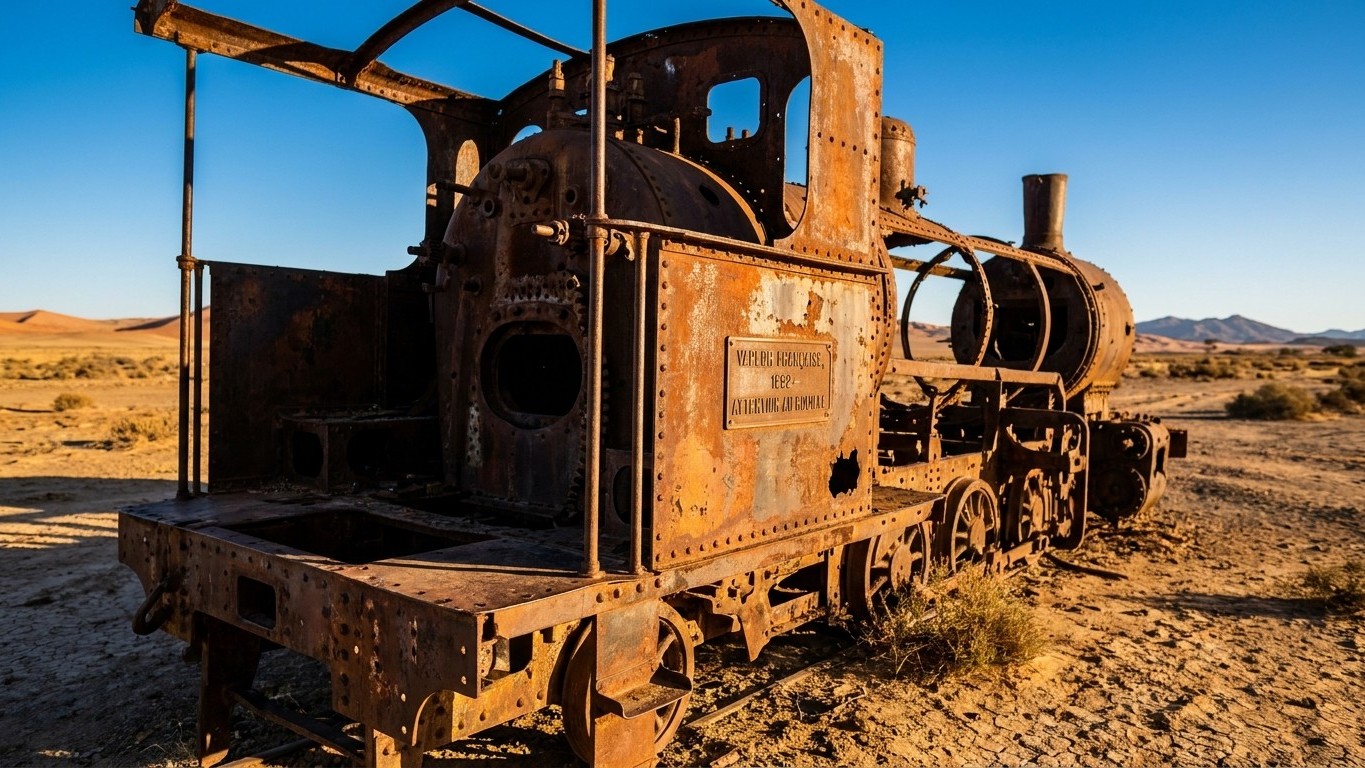
Three kilometers from Uyuni’s railway station, in the south of Bolivia, iron carcasses gnawed by salt line up on the sand like a frozen herd. Uyuni sits at an altitude of 3,656 meters above sea level, in the Andes. On this open, fence-free, guardian-less plain at around 3,700 meters, more than a hundred trains, wagons and locomotives have been abandoned for decades, waiting for someone to come reclaim them. No one has ever come.
À retenir
- How did more than 100 British locomotives end up fossilized in the Bolivian desert?
- A 1940s recycling project stuck as a carcass: the true story of Uyuni’s cemetery
- The Salar salt finishes what administrative neglect began: the slow corrosion of the railway empire
A railway empire built by English engineers
The story begins at the tail end of the 19th century, when Bolivia still dreamed of direct access to the Pacific Ocean. The railway lines, built between 1888 and 1892, were erected by British engineers invited by the Antofagasta and Bolivia railway companies, financed by English capital. The Bolivian president of the time, Aniceto Arce, saw it as a lever for the country’s total modernization: railway facilities were among the government’s priorities from September 1888 onward, and almost all national tax revenues were allocated to these works.
November 20, 1890 marks a turning point. The first Bolivian railway line connects Antofagasta to Uyuni, which hosts its first train on that day. Uyuni becomes a strategic hub. President Arce aims to equip Bolivia with a state-of-the-art railway network, with Uyuni as the main hub, and the Bolivian Railway Company invites engineers from England to build these lines. Four axes eventually converge on the town: toward La Paz, toward the Chilean port of Antofagasta, toward Potosí and its legendary silver mountain Cerro Rico, and toward Villazón, at the Argentine border.
These steam locomotives, heavy riveted machines designed to run in the British rain, transport then the silver and tin extracted from the mines of the Altiplano. The railway line between Pulacayo and Uyuni serves as a vital artery for regional mining: loaded with silver, tin and other ores, trains traverse the arid landscapes to reach global markets via the port of Antofagasta. In the 1930s, the town experiences its golden age: Uyuni thrives as a critical railway hub, its machines proudly billowing smoke across the altiplano.
The mining collapse that froze everything
Then everything stops, almost overnight. Bolivia had already lost its access to the sea after the War of the Pacific against Chile, but it was the depletion of the ore deposits that dealt the fatal blow. During the 1940s, the mining industry collapses, partly because of ore depletion, and many trains are abandoned on the outskirts of Uyuni, forming this vast cemetery. It wasn’t a planned decision; it was default abandonment: the line’s administrators thought to create a simple spare-parts depot, waiting to recycle the damaged machines. The administrators of the line between Antofagasta, which had become Chilean, and Uyuni wanted to create a depot with the rejected machines in order to recycle their parts later, but the project was neglected and the site looted systematically.
Result: entire machines, tender included, remained where they were parked one day, with no official dismantling project ever materializing. A museum was indeed proposed several times to preserve these relics from the early 20th century, a museum project to protect these relics from the late 19th and early 20th centuries was suggested, but it never came to fruition. Seventy years later, the same administrative void persists.
Salt and wind, more effective than any demolisher
What humans failed to do, the climate took care of. The proximity to the world’s largest salt desert, the Salar de Uyuni, turns every gust of wind into a corrosive agent. The high salt content of the air accelerates the corrosion of the trains, making them even more eroded by time. Ironically, these Victorian locomotives had been designed to withstand British rain and cold, not this cocktail of altitude, dryness and saline particles. The corrosive effect of salty winds coming from the neighboring salt flats did its work, and with the merciless sun and thick dust storms, the trains never stood a chance against the elements.
The complete lack of supervision opened the door to another, more prosaic phenomenon: looting. Many metal parts were stolen, for lack of fencing or guards. Eviscerated boilers, wheelsets ripped off, twisted metal plates litter the ground amid the wrecks. There is even a stubborn local legend: according to oral tradition, one of these locomotives was once attacked by the famous outlaws Butch Cassidy and Sundance Kid, who are known to have roamed this Andean region at the turn of the last century.
An open-air site, with no ticket or barrier
Today, this railway no-man’s land draws a crowd its British designers could never have imagined: tourists. You can explore the train cemetery, without gate or security, for free and at any time of day. The vast majority of agencies that organize excursions to the Salar de Uyuni make a stop here at the opening of their circuit, early in the morning or late in the day to enjoy the soft light grazing the rust.
Climbing on the wrecks, posing for a photo atop a century-old tender, scratching a graffiti already layered with dozens of others: nothing is forbidden, precisely because there is no guard. Between a forgotten industrial past and a cult photo spot, this ghostly place attracts thousands of curious visitors, dreamers, photographers and travelers each year, and it surely deserves the detour. One question remains, however, that few visitors ask as they snap the horizon with their phones: how many of these metal skeletons will still stand in twenty years, when the salt has gnawed to the last bolt?
Sources: destination-bolivie.com | nomadays.fr
