
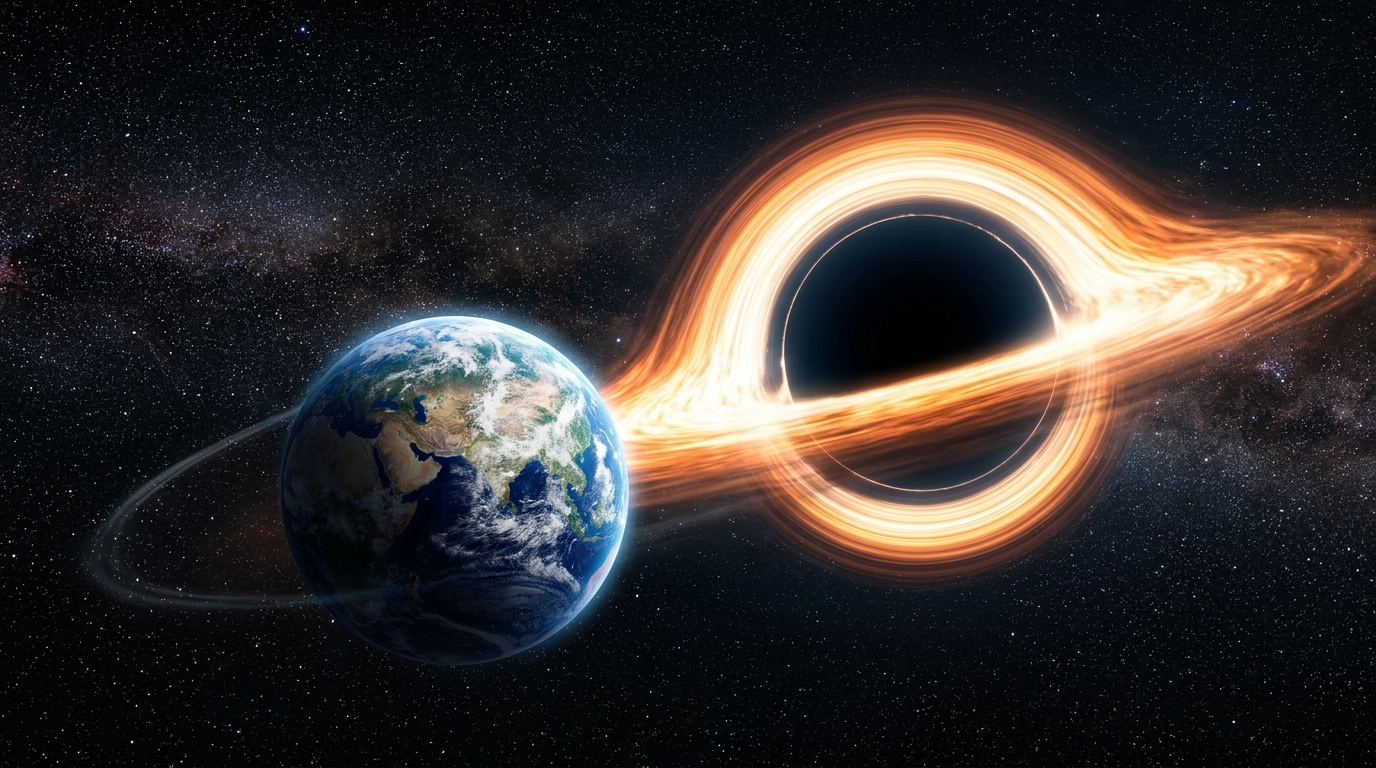
Here is a scenario that, logically, should condemn our planet to a dizzying and irretrievable plunge into darkness: replace the Sun with a black hole. Yet the physical reality of this thought experiment holds a major surprise. If our star were to disappear suddenly to make way for this gravitational monster, the Earth would continue along its path on exactly the same orbit, not deviating by a single kilometer. A result that seems counterintuitive, but which finds a clear explanation as soon as we focus on the true laws that govern gravitation. A reason to revisit in depth our often flawed view of these fascinating objects that are black holes.
- Only the mass of a celestial body determines its gravitational attraction, not its nature or appearance, so a black hole is not a “cosmic vacuum cleaner” more powerful than a star of the same mass
- In transforming into a black hole, the Sun would go from a radius of about 700,000 kilometers to just 3 kilometers, without affecting Earth’s orbit
- This scenario remains purely theoretical because the Sun does not have enough mass to become a black hole; it will become a red giant and then a white dwarf in about five billion years
- The myth of the cosmic vacuum cleaner collapses
- Same mass, same gravity: the equation that changes everything
- A 3-kilometer object in place of a 700,000-kilometer furnace
- What our solar system would really become
The Myth of the Cosmic Vacuum Cleaner Collapses
In the collective imagination, the black hole holds a special place: that of the great cosmic devourer, ready to swallow anything that comes within reach. This image isn’t completely false, since these objects do indeed possess a gravitational pull so intense that light cannot cross their event horizon. They move through space, sometimes drawing in surrounding gas and dust, slowly growing over time.
But this reputation as an universal vacuum cleaner rests on a misunderstanding. A black hole does not possess a gravitational force greater than what its mass naturally warrants. Its spectacular attraction stems solely from the fact that it formed through the collapse of gigantic stars with colossal masses. In other words, it is not the nature of the object that dictates its gravity, but rather the amount of matter it concentrates. A black hole formed from a star as massive as our Sun would thus have nothing of a monster capable of sucking in more than what the Sun already attracts today.
Same Mass, Same Gravity: The Equation That Changes Everything
That is where the subtlety of this thought experiment lies. If the Sun were to transform into a black hole, which will never happen in reality, it would retain exactly the same mass as our current star. Yet in physics, it is precisely this mass, and this mass alone, that determines the strength of the gravitational attraction exerted on nearby objects, at equal distances.
NASA sums up this idea perfectly by explaining that, contrary to popular belief, a black hole is not a cosmic vacuum cleaner. If our Sun were suddenly replaced by a black hole of the same mass, Earth’s orbit around the Sun would remain unchanged. In other words, our planet would continue to trace exactly the same elliptical trajectory, at the same distance, with the same speed. Gravity hardly cares about the shape or the nature of the object that exerts it: only the mass matters in this equation.
A 3-Kilometer-Wide Body in Place of a 700,000-Kilometer Furnace
If Earth’s orbit stayed fixed, everything else would change at a meteoric pace. The contrast in size is dizzying: our current Sun has a radius of about 700,000 kilometers. By transforming into a black hole of the same mass, this star would collapse to a radius of only 3 kilometers. A phenomenal reduction, illustrating just how densely packed a black hole is beyond anything we can imagine.
To picture the thing, imagine a furnace whose light and heat bathe every corner of the solar system, suddenly replaced by a sphere barely larger than a small town, invisible and cold. This radical, as brutal as it is silent, would not alter the celestial mechanics governing orbits, but would utterly overturn the immediate environment around our planet.
What Our Solar System Would Really Become
Staying on the same orbit would not, for all that, mean continuing a normal existence. The disappearance of the Sun in its current form would cause the immediate extinction of the main source of heat and light for the solar system, with only the planets’ internal geothermal processes continuing to operate. Without this energy from above, photosynthesis would cease instantly, ultimately dooming all terrestrial life as we know it.
It should also be noted that this scenario is entirely a piece of scientific fiction. The Sun is simply too small to form a black hole. It does not have enough mass to meet such a fate. The true future of our star is quite different: in about five billion years, it will exhaust the hydrogen in its core and begin its red giant phase, expanding its outer layers until it engulfs the Earth. This stage will last about a billion years, before the Sun sheds its envelope to leave behind a white dwarf, a dense remnant of roughly half its current mass and the size of our planet.
This thought experiment, as improbable as it is in reality, offers a valuable lesson about the true nature of gravity. It reminds us that it is neither the shape, nor the appearance, nor the reputation of a celestial object that determines its influence on its surroundings, but solely its mass. While our star trails its real destiny of red giant and then white dwarf, it remains fascinating to see how the universe, however extreme it may be, always obeys laws of unrelenting logic. A reminder that invites us to raise our eyes to the sky with a somewhat different perspective.
