
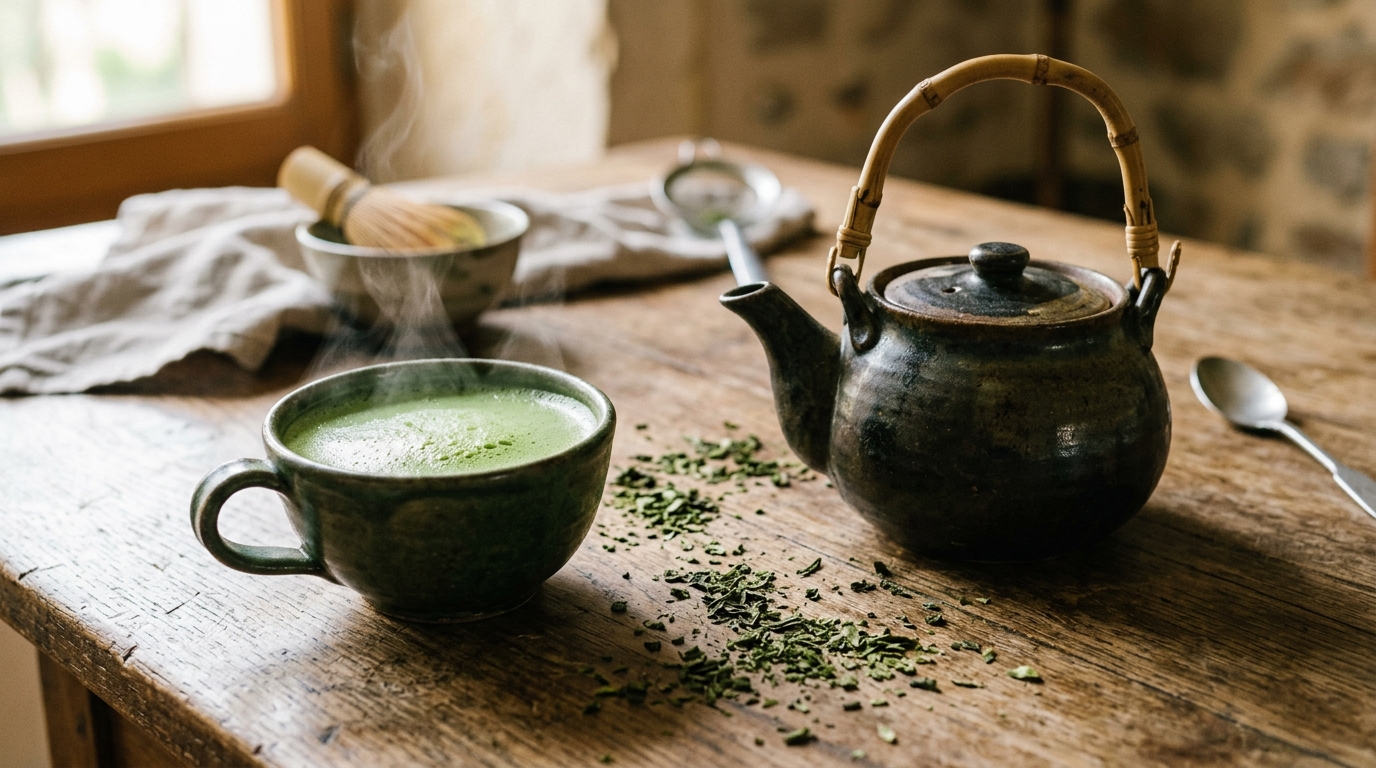
An attractive emerald-green drink, celebrated for its health benefits and its ultra-photogenic allure, can sometimes hide less flattering surprises. That’s precisely what happens to many matcha enthusiasts, drawn to this Japanese powder that has become essential in trendy cafés and fashionable pastries for several years now. Its bright color, its reputation as a miracle antioxidant, and its Instagrammable aspect have turned it into a social media star. But behind this healthy image lies a reality that few consumers suspect. A Que Choisir investigation has just lifted the veil on an aspect of this beverage that is little known, revealing a troubling common thread among all the matchas tested. Something that should make you think twice before draining your next cup in one gulp.
- Out of 7 matchas tested by Que Choisir, all contain aluminum and 4 exceed the threshold set by Anses, up to four times the recommended limit.
- Unlike infused green tea, matcha is consumed as whole ground leaves, which prevents filtering out contaminants like aluminum.
- Anses advises caution on matcha latte and its derivatives, while no European regulation currently governs aluminum content in foods.
- Why matcha hides a trap that classic green tea avoids
- Aluminum levels up to four times higher than recommendations
- A health risk that already extends beyond the casual matcha enthusiast
Why matcha hides a trap that regular green tea avoids
Everything comes down to the method. When preparing traditional green tea, the leaves steep and remain at the bottom of the teapot, filtered before tasting. Matcha, by contrast, works in the opposite way: tencha leaves are ground entirely into a fine powder, which is whisked directly into hot water or milk. The result is that nothing is filtered out; nothing is left behind. The leaf is swallowed whole, along with everything it contains—both the good antioxidants and the less desirable substances. This seemingly minor preparation detail actually changes the exposure to contaminants naturally present in the plant quite dramatically.
Aluminum levels up to four times higher than recommendations
Aluminum isn’t an additive; this metal occurs naturally in the volcanic soils where the tea plant grows, notably in Japan and China. Infused green tea poses little trouble because aluminum barely dissolves in hot water. But with matcha, everything changes since the whole leaf ends up in the cup. Que Choisir tested seven matchas of varied price and quality, and the finding is unequivocal: all are contaminated with aluminum. Even more worrying, four out of seven references surpass the reference value set by Anses, some samples approaching nearly four times that threshold in a single cup. A figure that leaves you dizzy, all the more so given that there is currently no European law regulating this aluminum content in foods and beverages.
A health risk that already extends beyond the casual matcha enthusiast
Aluminum is not a metal to be taken lightly: it is neurotoxic in cases of high chronic exposure. In 2025, Anses established a toxicological reference value that is much stricter than the one Efsa had set since 2008, namely 3.5 times lower. And perhaps the most striking figure isn’t the matcha alone: according to Anses’ total diet study, published in 2026, 39% of adults already exceed this new threshold on a daily basis from all sources combined. This datum reframes the overall exposure to this metal, well beyond the case of matcha latte enthusiasts alone.
In light of these results, Que Choisir does not call for a ban, but urges caution. The association recommends limiting consumption of matcha latte and derived products like matcha cookies, while awaiting European regulation to finally address this gray area.
Matcha retains its qualities, particularly its high antioxidant content, but its unique mode of consumption now calls for a touch more vigilance. The question remains whether this alert will be enough to change habits, or whether the vivid green hue will continue to triumph over prudence.
