
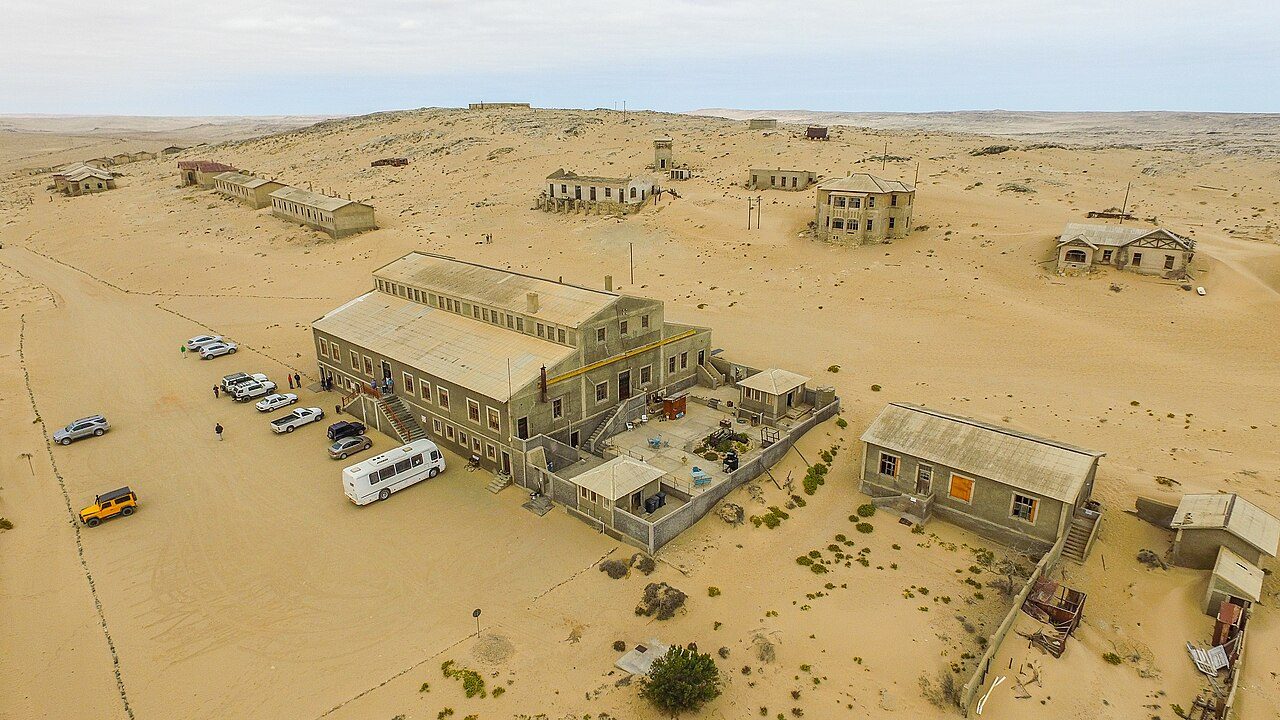
About ten kilometers from Lüderitz, in southern Namibia, a town once German is buried under sand. Kolmanskop no longer has inhabitants since the 1950s, and no one clears the dunes that push in through doors and windows. In several houses, the sand climbs up to halfway along the walls.
Everything begins with a shovel, in 1908.
- A railway worker discovers a diamond in 1908 and triggers a rush into the Namib desert
- Kolmanskop grows to about 1,150 residents at its peak in the 1920s, with a hospital, a casino, and a ballroom
- The discovery of richer deposits in 1928, 270 kilometers south, leads to progressive abandonment between 1954 and 1959
A Diamond Picked Up Along the Rails
In April 1908, a railway worker named Zacharias Lewala clears the sand that has piled up on the Lüderitz–Aus line. He comes across a shiny stone, hands it to his superior, the German railway inspector August Stauch, and triggers a rush. In September of the same year, the colonial authorities declare the Sperrgebiet, the “restricted zone,” whose access has remained controlled to this day.
The German colonists build in the middle of the desert a small town for the rich. There is a hospital equipped with what passes for the first X-ray machine in southern Africa, a ballroom, a casino, a bowling alley, and an ice factory for household iceboxes. Drinking water arrives from Cape Town by boat to Lüderitz, then by rail.
In the 1920s, the town counts about 300 European adults, around forty children, and roughly 800 local workers, i.e., about 1,150 people according to CNN’s tally. Other sources record only 350 Europeans, hence the variable figures for the “maximum population” from one site to another.
Nearly five million carats, in just a few years.
1928: The Jackpot Is Elsewhere
From 1928, much richer deposits are found about 270 kilometers south, near the mouth of the Orange River, close to Oranjemund. The diamonds of Kolmanskop, which were initially picked up by hand in the sand, are exhausted, and the operation shifts to chasing the money. The drop in prices after World War I accelerates the miners’ departure. The last residents leave between 1954 and 1959 according to sources, 1956 being the date given for the hospital’s closure.
The desert did not wait long to reclaim its rights. While the community lived there, it kept the dunes at bay through constant maintenance. Since then, the southern winds push sand through every opening, and visitors now walk in houses where they sink up to their knees.
Current population: zero inhabitants.
Visiting a Restricted Zone
The site remains in the Sperrgebiet, and you do not enter as you would in a museum. A permit is mandatory, and Namdeb, the diamond company jointly owned by the Namibian state and De Beers, is the name associated with the management of the place. Two options exist: a standard ticket, bought at the entrance during opening hours, and a photo permit that allows access outside these hours, useful for the sinews of light at dawn.
The history of these sanded walls is far from postcard-perfect. Kolmanskop belonged to German South West Africa, a colony founded on violence and genocide, which ended in 1915 and became Namibia only in 1990. Local workers labored nine-hour days, six days a week, while the salons hosted balls. The ballroom and the casino thus tell less of a glorious era than of an exquisitely organized inequality.
Departure dates of the last inhabitants vary from 1954 to 1959 according to sources, and the figure of 1956 corresponds to the hospital’s closure. The peak population of the town ranges from 350 to more than 1,100 depending on whether one counts or excludes the African workers. Before citing one figure, it is better to check what is included, because the lower figures omit the 800 local workers.
Sources: muchbetteradventures.com | hauntedsilence.com
