
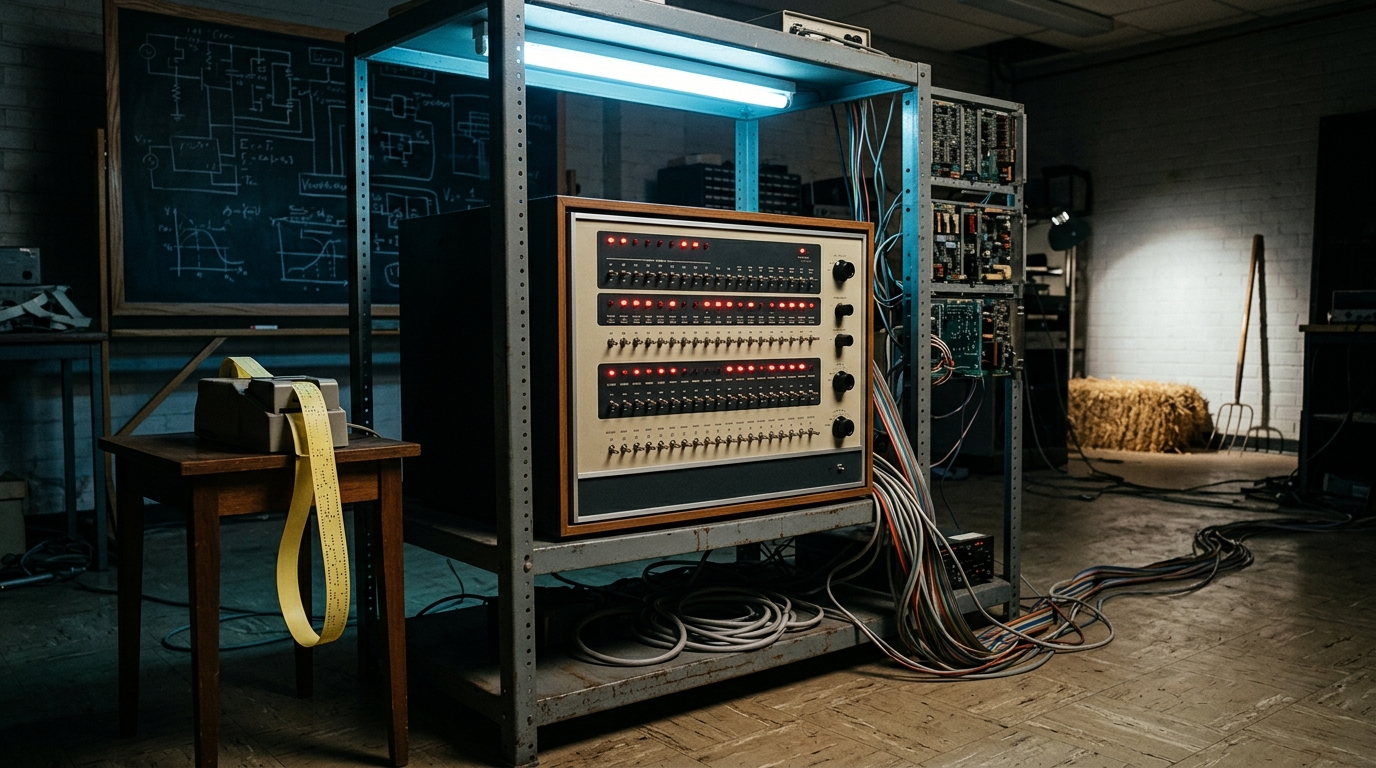
In 1971, Communist Poland unveiled a computer faster than its American and British counterparts. Its creator, Jacek Karpiński, would nonetheless spend his days far from the calculation rooms, amid the pigs. Between technical prowess and political sabotage, this story reads like a novel no one would have dared to write.
- The K-202, designed by Jacek Karpiński between 1970 and 1973 in collaboration with British firms Data-Loop and M.B. Metals, executed about a million instructions per second, rivaling the American Data General SuperNOVA and the British CTL Modular One of that era.
- A victim of a conflict with the state-backed rival Elwro and of sabotage accusations, Karpiński was sidelined from his project after only about thirty units were built, and he redirected his career to pig farming.
- The concept of the K-202 survived through its successor, the Mera 400, produced in several hundred units, and the two original machines are today on display at the Warsaw Museum of Technology.
- A Polish 16-bit computer faster than its Western rivals
- When Communist bureaucracy killed a technological gem
- From cutting-edge computing to pig farming: Karpiński’s unexpected career shift
A Polish 16-bit computer faster than its Western rivals
Between 1970 and 1973, a team led by engineer Jacek Karpiński developed the K-202, a 16-bit minicomputer built in collaboration with two British firms, Data-Loop and M.B. Metals. At the time, pulling a machine of this calibre out of an Eastern Bloc country was already an administrative as well as a technical feat.
On paper, the figures are impressive. The K-202 executes about one million instructions per second, placing it in direct competition with the American Data General SuperNOVA and the British CTL Modular One, two market benchmarks of the era. For a machine designed behind the Iron Curtain, that was a performance that did not rely on luck.
According to the Polish press agency PAP, the K-202 might even have been the first minicomputer to use memory segmentation based on paging, a technique that allows RAM to be divided into blocks managed more efficiently. Imagine a filing cabinet where each drawer is labeled and independently accessible from the others: roughly the principle this machine would have helped democratize.
The prototype was built in a year, then presented at the Poznań International Fair in 1971. The booth drew crowds, including Edward Gierek, who was then the First Secretary of the Polish United Workers’ Party. A computer made by Poles, capable of rivaling the West: on paper, it was an ideal showcase for the regime.
When Communist bureaucracy killed a technological gem
Thanks to financial support from Data-Loop and M.B. Metals, routed through the METRONEX import-export company, about thirty copies of the K-202 eventually rolled off the production lines. Fifteen of them were sent to the United Kingdom, while the rest were absorbed by Polish institutions. A modest figure, but coherent for a machine that never truly shifted into mass production.
A detail that speaks volumes about the difficulties encountered: all units delivered to M.B. Metals were reportedly returned for repair. Moving from a brilliant prototype to a reliable series is often the Achilles’ heel of ambitious projects, and the K-202 did not escape this rule.
But the fatal blow came chiefly from within. A conflict erupted with Elwro, a state-supported competitor, and production of the K-202 was simply halted. Karpiński himself was sidelined from his own company amid charges of sabotage and embezzlement, charges that smelled more of political score-settling than of a genuine industrial investigation.
Polish media covering the case described a volatile mix: conflicts of interest, technical difficulties in moving from prototype to serial, and recurring problems with payments in foreign currencies, a classic headache for any company trading with the West from behind the Iron Curtain. Co-produced with the British firm Data-Loop, the K-202 was thus halted by the Polish regime after only about thirty units, burying one of the Eastern Bloc’s most promising computing trajectories in the process.
From cutting-edge computing to pig farming: Karpiński’s unexpected career shift
Driven from his own project, Karpiński never truly found his place again in Poland’s computer industry. He retreated to a farm in Wilkowo, in the Masurian region near Olsztyn, where he took up pig farming. The contrast is striking: the man who had designed one of the fastest machines of his era spends his days in a pigsty, far from printed circuits.
This agricultural interlude does not last forever, however. In 1981, after obtaining a passport, Karpiński left Poland to settle in Switzerland. He lived there until 1990, before returning to Poland and passing away in Wrocław at the age of 83.
The K-202 did not disappear with its creator. It had a successor, the Mera 400, produced this time in several hundred units, proof that the initial concept did indeed have an industrial future once freed from personal squabbles. Today, the K-202 and AKAT-1, another machine linked to Karpiński, are on display at the Warsaw Museum of Technology, where they remind visitors that an Eastern Bloc country did indeed try to play in the big leagues of computing.
There remains something deeply unjust about this arc. A engineer capable of competing with American and British laboratories ended up tending pigs, a victim of a system unable to tolerate that a technical success slip from its grip. The K-202 may not have been the most famous machine in the history of computing, but its story, it certainly deserves to be told.
