
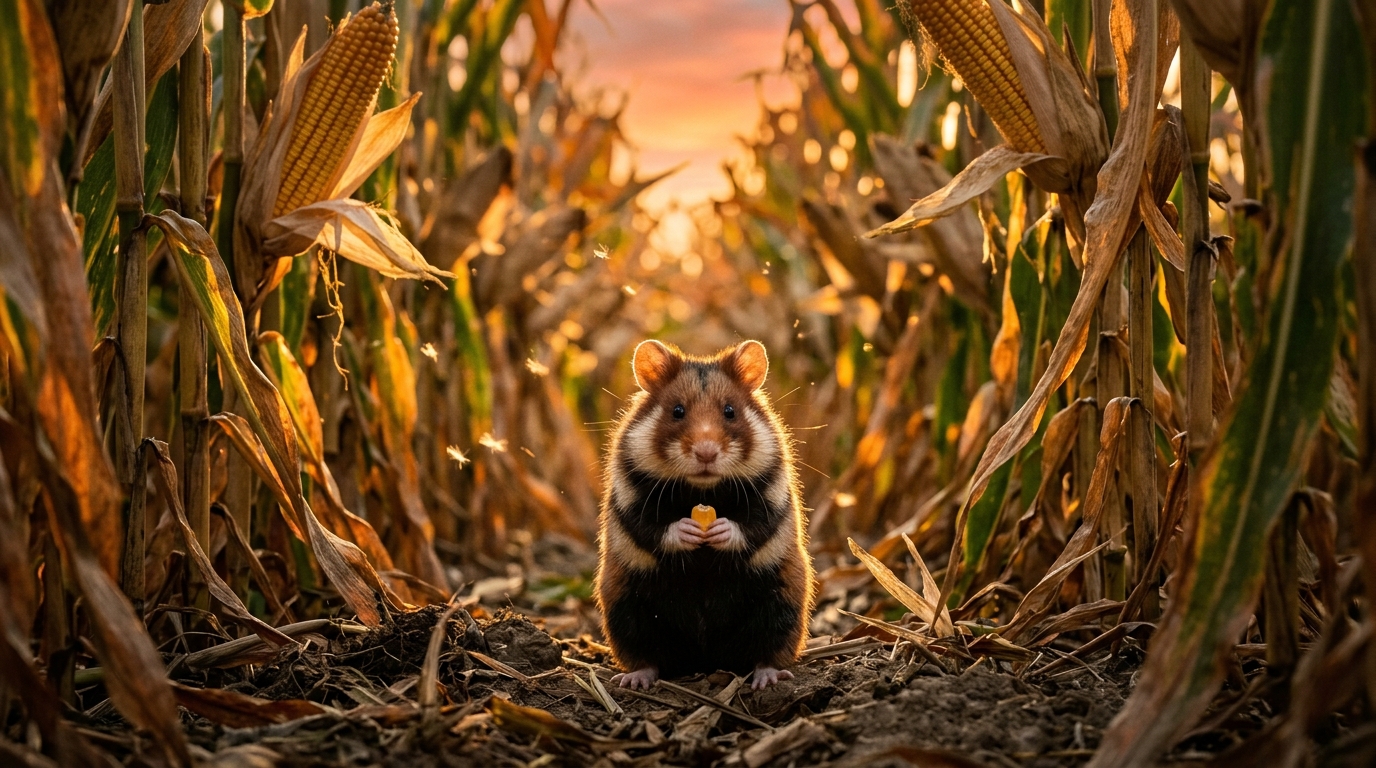
In a burrow dug beneath an Alsatian cornfield, a scene as brutal as it is unexpected unfolds before the researchers: a mother hamster turns on her own litter. Documented by a CNRS team from Strasbourg and published in Proceedings of the Royal Society B in 2017, this behavior finds a simple, chilling explanation: a nutritional deficiency triggered by a maize-heavy diet.
- An exclusively maize-based diet, deficient in vitamin B3 (niacin), can cause up to 95% infanticide among pregnant females of Alsace’s European hamsters.
- This deficiency triggers symptoms reminiscent of human pellagra, altering maternal behavior to the point that mothers no longer recognize their own offspring.
- Adding vitamin B3 to the diet eliminates this phenomenon, opening the way to diversified agricultural practices to safeguard the endangered species.
- The Alsace European hamster, a species at the brink
- A 100% maize diet, and entire litters that vanish
- Vitamin B3, the missing link between intensive agriculture and cannibalism
- What this CNRS study changes for the survival of Cricetus cricetus
The European hamster of Alsace, a species on the brink
The European hamster of Alsace, known scientifically as Cricetus cricetus, bears little resemblance to the household rodent many picture spontaneously. It is a wild species emblematic of the Alsatian plain, whose population has fallen for decades to such an extent that reintroduction campaigns have had to be launched, as recently reported by France 3 Alsace. Rapid urbanization, habitat fragmentation, and shifts in agricultural practices have progressively eroded the living space of this small mammal, once so common in the region that it nearly became part of the landscape.
Facing this worrying decline, a CNRS researcher named Caroline Habold has been studying the fate of these last wild hamsters since 2010. Her team has pinpointed a phenomenon as unexpected as it is revealing: a direct link between the rapid expansion of monoculture grain crops and the emergence of nutritional deficiencies in the animal. A lead that would soon lead to particularly troubling discoveries about the species’ maternal behavior.
A 100% maize diet, and entire litters that vanish
To understand what was going wrong in wild populations, the Strasbourg researchers conducted laboratory experiments over several months, after three years of work on the question. The protocol was starkly simple: feed the hamsters exclusively maize, that grain ubiquitous in Alsatian fields since the rise of industrial agriculture. The scientists aimed to observe the effects of such a diet on reproduction and on the behavior of pregnant females.
The result exceeded all expectations. The females subjected to this exclusive regime began to devour their own offspring immediately after birth, a behavior the researchers described as infanticide. According to the published works, this phenomenon would affect up to 95% of litters under the most severe conditions of deficiency. A figure that measures the quiet catastrophe playing out beneath the ears of maize, out of sight, and which could partly explain the demographic collapse observed in the species for years.
Vitamin B3, the missing link between intensive agriculture and cannibalism
What remained was to understand the biological mechanism behind this behavioral shift. The answer lies in a molecule more commonly found in dietary supplements than in zoological articles: vitamin B3, also known as niacin. Maize, unlike other cereals, is particularly low in this vitamin and in its precursor, tryptophan. When paired with wheat, another dominant crop in Alsace, it fails to meet the protein needs of the females during gestation, a period when their bodies are most taxed.
Deprived of this essential vitamin, the hamster’s body develops symptoms eerily reminiscent of a well-documented human disease, pellagra, sometimes nicknamed the disease of the three Ds because of its triad of symptoms: diarrhea, dementia, and dermatitis. In the Alsatian rodent, this deficiency would trigger a form of mental confusion pushing mothers to no longer recognize their own offspring as such. To test this hypothesis, researchers carried out a second set of experiments by offering the females a maize-based diet enriched with vitamin B3. The results were unequivocal: adding this simple supplement was enough to eliminate the symptoms and prevent infanticide.
What this CNRS study changes for the survival of Cricetus cricetus
This discovery goes far beyond a curious scientific anecdote; it points directly to an agricultural model built on intensive monoculture. To deepen these findings and explore concrete avenues for improvement, scientists established an experimental plot in Ittenheim, in the Bas-Rhin, to study the impact of different farming practices on the rodent’s health. The idea would be to promote more diversified crop associations, capable of giving hamsters a nutritionally balanced diet rather than an ocean of maize impoverished of essential nutrients.
These studies thus provide a concrete lever for local stakeholders involved in preserving the species: farmers, local authorities, and nature protection associations. By adjusting cultivation practices, even modestly, it becomes feasible to reduce this cannibalism phenomenon tied to malnutrition and to give reintroduced populations a better chance to establish themselves sustainably in the Alsatian plain.
This tale of hamsters eating their own young serves, in its own way, to remind us how living beings remain linked to the delicate balances of their surroundings. A field changing its crops, a nutrient missing, and an entire ancestral behavior can derail. By digging beneath this surprising anecdote, the Strasbourg researchers have ultimately highlighted a broader truth: the fragility of ecosystems in the face of the uniformization of agricultural landscapes, and the urgent need to rethink our farming models to safeguard the biodiversity around us, even in its most unexpected manifestations.
