
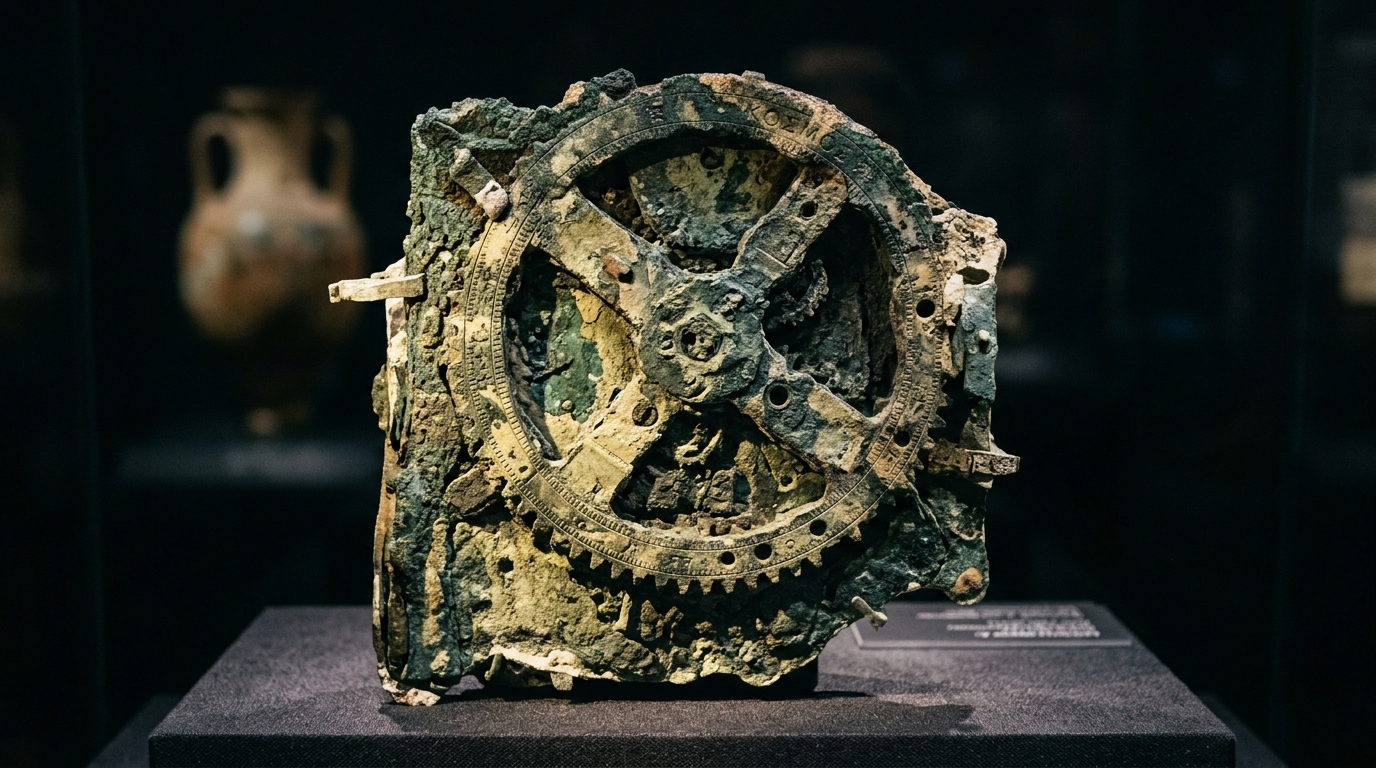
Picture Greek sponge divers at the very dawn of the twentieth century, hauling up from the depths of the Aegean Sea a salt-streaked, time-worn bronze mass. At first glance, it looked no different from other wreckage shards. And yet, this shapeless block would upend our understanding of ancient ingenuity. Hidden within this corroded lump was a gearwork of astonishing sophistication, capable of reproducing celestial movements with a precision once thought reserved for modern instruments. This device is the Antikythera mechanism, and its story deserves careful attention.
- Discovered in 1901 in a wreck off Antikythera, this bronze mechanism dates from 150–100 BCE and represents only about a third of the original device, spread across 82 fragments.
- X-ray analyses revealed more than 30 gears (up to 235 teeth) and 354 holes corresponding to the Greek lunar calendar, a finding confirmed in 2024 by the University of Glasgow using technologies from the LIGO project.
- Capable of predicting eclipses, planetary positions, and the dates of the ancient Olympic Games, this instrument demonstrates a level of Greek mechanical mastery that Europe would not match until medieval astronomical clocks.
- A Corroded Mass That Hid a Sky-Calculating Machine
- Dozens of Bronze Gears to Model the Heavens
- A Mechanical Precision That Antiquity Should Never Have Reached
- What This Object Reveals About the Greeks’ Lost Knowledge
A Corroded Mass That Hid a Sky-Calculating Machine
It was in 1901 that the object resurfaced—quite literally—in the wreck of a Roman vessel discovered off the Greek island of Antikythera, which would lend its name to the device. At the time, few grasped the significance of the find. It would take decades of analysis, radiography, and reconstruction to realize that this block of bronze wasn’t merely decorative or religious trinketry but a genuine machine for computing celestial positions. Modern researchers now date its manufacture to between 150 and 100 BCE, a timeframe that matches the shipwreck that carried it. The artifact, now housed at the National Archaeological Museum in Athens, accounts for only about a third of the original mechanism, distributed among no fewer than 82 fragments. This fragmentation, rather than simplifying the task, complicated the scientists’ work for years as they tried to piece together how it functioned.
Dozens of Bronze Gears to Model the Heavens
What makes this artifact so captivating is the intricacy of its internal architecture. X-ray studies have identified more than 30 gears, some with up to 235 teeth carefully cut into bronze. In total, 27 cog-wheels have been documented, with some gears bearing as many as 127 teeth and others reaching 235. This extraordinary display of mechanical precision even earned the Antikythera mechanism a place in a Google Doodle in 2017, which celebrated it as the first mechanical computer in history. A study conducted by the University of Glasgow and published in 2024 added a new layer to these findings by showing that the device contains 354 holes, a number that aligns precisely with the Greek lunar calendar of the era. The researchers, Graham Woan and Joseph Bailey, used Bayesian statistical methods and technologies derived from the LIGO project—normally used to detect gravitational waves—to refine their measurements of a device that is more than two millennia old.
A Mechanical Precision That Antiquity Should Never Have Reached
The real astonishment for historians of science lies in the technological gulf this object reveals. Before its discovery, many believed that the Greeks of antiquity understood astronomy primarily on a theoretical level, through calculation and observation, without any instruments capable of physically materializing their celestial models. The Antikythera mechanism proves otherwise. It could predict the positions of the planets, anticipate lunar and solar eclipses, and even set the dates of the ancient Olympic Games—a calendrical function one did not expect to find in such a device. The capacity to synchronize several distinct astronomical cycles—lunar, solar, and planetary—within a single mechanical apparatus had no European counterpart until the medieval astronomical clocks, more than a thousand years later. Built in the 2nd century BCE, the mechanism calculated astronomical cycles with bronze gears, a performance that feels almost anachronistic, given what scholars typically attributed to engineers of the era.
What This Object Reveals About the Greeks’ Lost Knowledge
Beyond its technical prowess, the artifact sheds light on a broader spectrum of vanished knowledge. It testifies to a tradition of Greek mechanical engineering from which nearly all traces have disappeared, owing to a lack of surviving texts or other preserved examples. How many other similar mechanisms might have existed and then vanished into oblivion, lacking a wreck like this to preserve them and to bring them back to light centuries later? This question has haunted researchers for well over a century. It continues to drive contemporary scientific discourse, with new publications that continually refine our understanding of the machine’s computational capabilities. Each advance in imaging or statistical analysis allows researchers to peel back another layer of this millennia-old mystery and to learn more about the scientific ambitions of ancient Greece.
In the end, the Antikythera mechanism is not merely another archaeological curiosity to display in a museum case. It embodies a humbling lesson for our era, which has long underestimated the ingenuity of ancient civilizations. Each corroded bronze fragment, every gear tooth painstakingly analyzed, reminds us that human genius did not begin yesterday, and that treasures of knowledge may still lie hidden somewhere in the Mediterranean, waiting for the moment to resurface.
