
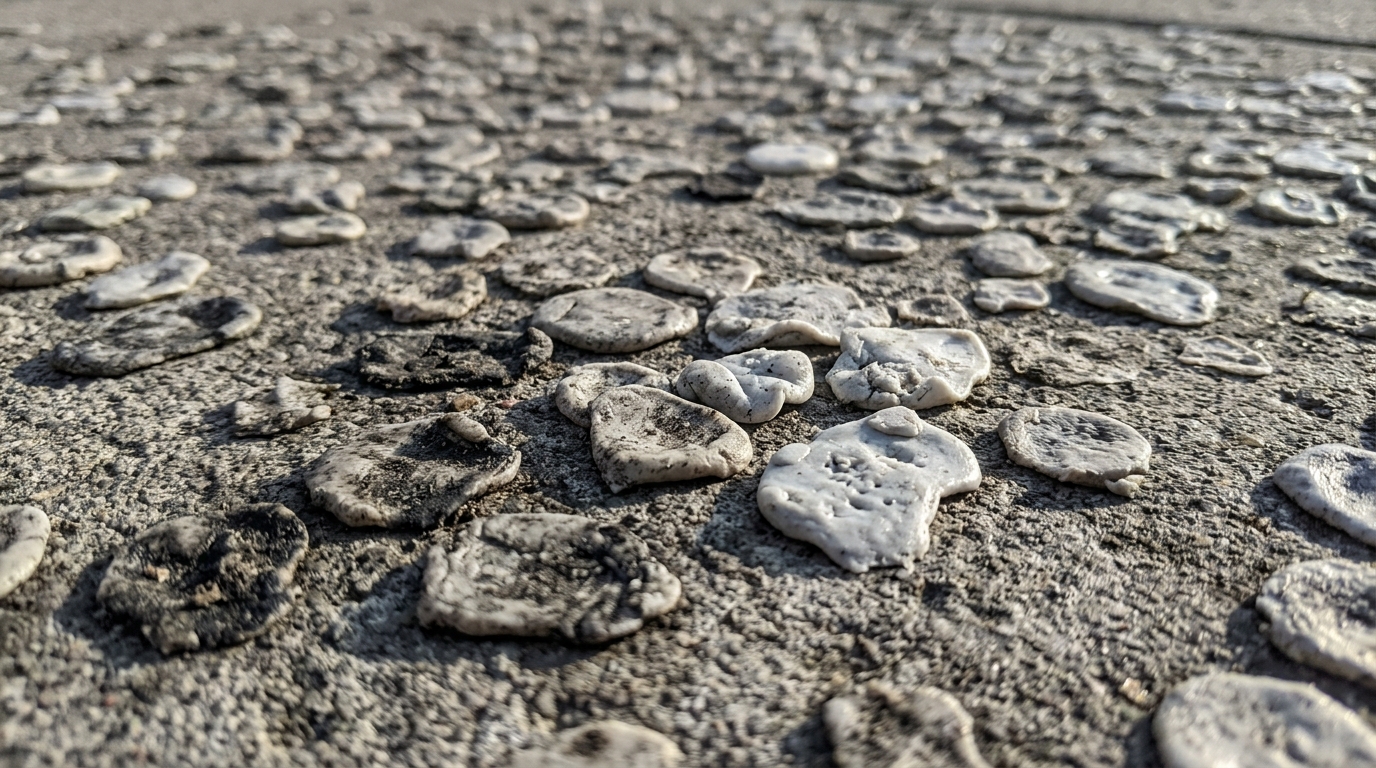
People often think that chewing gum, once spit out, eventually dissolves like a candy left out in the rain. It’s, in fact, the quiet excuse millions offer daily, sticking their gum under a table or spitting it on the sidewalk without giving it another thought. Yet this belief is completely false, and it costs cities and the environment. Each French person chews on average nearly 500 grams of chewing gum per year, ranking France in second place worldwide for consumption, just behind the United States. A figure that can be dizzying when you consider what actually becomes of this little chewed ball once abandoned on the pavement. In Bordeaux, a company even had to install around twenty collection kiosks to try to curb a phenomenon that six in ten French people reproduce without a second thought.
- The modern chewing gum is made from a synthetic rubber derived from petroleum, not natural tree gum.
- In Bordeaux, the KeeNat company installed about twenty “Freegum” collection stations to recycle spent chewing gums into a new plastic material.
- A chewing gum discarded on the ground takes about five years to break down, and up to twenty-five years in a marine environment, thus contributing to plastic pollution of the oceans.
- The secret gum no one really chews
- Bordeaux faces a waste that no one sees as such
- Five years to disappear: the hidden price of an automatic gesture
- What a simple chewing gum reveals about our collective habits
The secret gum that no one really chews
Contrary to the rosy image of natural gum harvested from an exotic tree, the vast majority of chewing gums sold today rely predominantly on a synthetic elastomer, not natural tree gum. For decades, the industry has replaced this raw material with a synthetic elastomer base, a petroleum-derived compound designed to provide a soft and durable texture in the mouth. In other words, what we mechanically chew for about twenty minutes is chemically far closer to plastic than to fruit or natural resin. This truth changes everything: a waste we might deem harmless behaves in reality like any plastic packaging discarded in nature, with the same capacity to persist and to pollute over the long term.
Bordeaux faces a waste that no one recognizes as such
This is precisely why the social enterprise KeeNat launched its program in the Bordeaux metropolitan area, notably in Bassens, Lormont, Cenon and Floirac. This pilot, started in 2020 as part of the Grand Project of the Right Bank Cities, benefited from the support of the Nouvelle-Aquitaine Region and ADEME. After developing the ÉcoMégot device for cigarette butts in 2016, the company tackled another urban scourge with its solution named Freegum: around twenty posts-shaped kiosks, equipped with an information card and a simple opening to slide in used gum. According to Sandrine Polipré, KeeNat’s co-CEO, chewing gums alone would account for up to 100,000 tonnes of plastic found each year in oceans worldwide. A figure that places this everyday habit in a dimension far larger than the mere Bordeaux sidewalk.
The collection itself is carried out by bicycle, to minimize the environmental footprint of the operation. The gums gathered are then sent to a laboratory to be cleaned and valorized, with the stated aim of turning them into a new reusable plastic material, in a approach similar to the British startup Gumdrop, which already recycles this type of waste into shoe soles.
Five years to disappear: the hidden price of an automatic gesture
The figure that gives this initiative its meaning is this: a chewing gum takes about five years to break down once abandoned in the urban environment, some sources even suggesting a range from three to ten years, or up to twenty-five years when it ends up in a marine environment. It is thus described as the second-most-produced waste in the world, just behind cigarette butts, two urban pollutions that share the same characteristic: their small size makes their actual impact easy to overlook.
Cleaning these grayish stains that pepper our sidewalks is far from trivial either. It often requires water blasted under pressure to detach the gum hardened to the pavement. This runoff then carries residues toward the gutters, then the sewers, before they join rivers and, ultimately, the oceans. In other words, the act intended to make the gum disappear from sight actually contributes to its dissemination far beyond the curb, turning a local waste into global plastic pollution.
What a simple chewing gum reveals about our collective habits
The Bordeaux initiative fits into a prevention-focused approach rather than a cure: it is better to propose a simple alternative action, such as throwing your gum into a dedicated collection point, rather than continuing to fund municipal cleanups that consume water and strain public budgets. For behind this small chewed rectangle discarded is a fairly accurate indicator of our collective habits: we rarely care about what happens to an object the moment it leaves our hand, especially when it is tiny and seemingly harmless.
This project, though modest when viewed within the scope of a single metropolis, raises a broader question that applies well beyond the Right Bank of Bordeaux: how many seemingly trivial actions, repeated daily by millions of people, end up weighing heavily on the environmental balance without anyone paying real attention?
Next time a piece of chewing gum ends up between your teeth, it might be worth remembering that it is not a natural waste destined to vanish on its own, but a small fragment of plastic likely to endure for years on a sidewalk, or decades in the ocean. A simple reflex, to look for a trash can rather than the ground, could indeed change things, in Bordeaux as elsewhere.
