
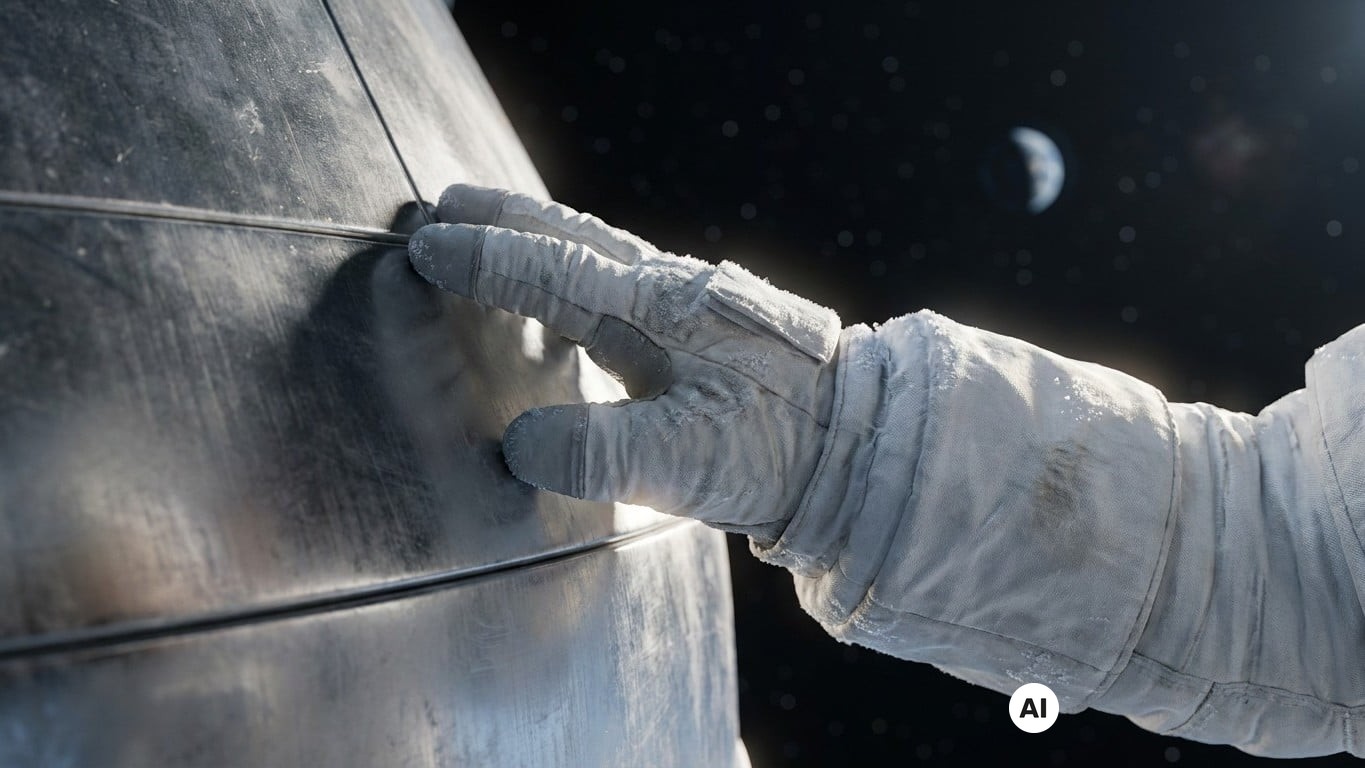
Every astronaut returning from an extravehicular activity (EVA) describes the same thing with uncanny precision: a stubborn odor clinging to their gloves, helmet, and suit. Not metaphorically, not imagined. A real, identifiable scent that evokes grilled steak, molten metal, or welding fumes. Welcome to one of the most bizarre sensory discoveries in space exploration.
An Olfactory Consensus Born of the Void
When astronauts return from missions, they all converge on one observation: space has a peculiar smell. According to their accounts, it resembles “grilled steak,” “hot metal,” or even “welding fumes.” What makes this phenomenon so unsettling is the unanimity. Dozens of men and women, from different nationalities and trained in distinct programs, come back with the same description.
Astronaut Don Pettit, during his time aboard the ISS, wrote: “Every time I opened the airlock door to greet colleagues returning from an spacewalk, a very distinct odor teased my olfactory senses. At first I had great difficulty pinpointing its source. I thought it came from the ducts, but I noticed this smell permeated their suit, helmet, gloves, as well as the tools.” Veteran astronaut Peggy Whitson, for her part, described a persistent, strong scent, reminiscent of gunpowder. Two astronauts, two slightly different descriptions, yet the same sensory category: combustion, metal, heat.
A direct whiff of pure space remains impossible for humans, as the vacuum would be fatal. But when astronauts leave the ISS, compounds present in space cling to their suits and return with them into the station. This mechanism of a “chemical stowaway” allows, indirectly, to sense the universe.
The Death of Stars Trapped in a Molecule
When stars die, the process generates compounds known as polycyclic aromatic hydrocarbons (PAHs). These molecules are present throughout the solar system, including on Earth—in coal, in petroleum, and in some foods. They are also formed during the burning of coal, tobacco, wood, or meat. The barbecue aroma in your backyard on a warm summer evening shares something fundamental with the residues of dying stars billions of years ago. It’s hard to imagine a more vertiginous connection.
Louis Allamandola, founder and director of the Laboratory for Astrophysics and Astrochemistry at NASA’s Ames Research Center, notes that these molecules “seem to be everywhere in the universe” and “float endlessly,” present in comets, meteorites, and interstellar dust. They have even been proposed as a possible basis for the first forms of life on Earth. One dizzying detail: the scent stuck to an astronaut’s suit could be the trace of a stellar explosion billions of years old.
PAHs, which show up in charred foods such as grilled items or overcooked roasts, are also ubiquitous in interstellar space. In fact, more than 20 percent of the universe’s carbon could be trapped in the PAH form. The chemistry of the cosmos and the chemistry of our everyday cooking thus share the same molecular signatures.
Ozone and Metal: The Second Hypothesis
A second theory proposed by researchers suggests that during an EVA, isolated oxygen atoms latch onto the suit. When the airlock is repressurized, molecular oxygen (O2) flows in and bonds with these lone atoms to form ozone (O3), which would account for the sharp, metallic odor reported. Ozone is precisely that characteristic scent we perceive after an electrical storm or near an overheating copier. Earthbound, once again.
There are variations depending on the mission: lunar excursions yield notes of sulfur and iron tied to the regolith, while EVAs around the ISS emphasize ozone and traces of recycled cabin air. Most astronauts, however, agree on one point: the aroma is intense, bright, and persistent, lasting several hours after returning to the cabin.
NASA Has Commissioned a Fragrance of Space
To make astronaut training more realistic, NASA commissioned in 2008 chemist Steve Pearce to create a scent that faithfully reproduces what astronauts describe. The aim: to eliminate the element of surprise in orbit. Pearce was chosen with purpose; a few months earlier he had already recreated the odor of the Russian space station Mir for an exhibition.
These accounts, however, may carry a potential bias, notes Robin Isnard, a doctor of astrochemistry. “Some metallic surfaces may have been altered outside the International Space Station, resulting in the production of certain organic substances.” Thus, the odor reported by astronauts could be the product of oxidation, rather than an intrinsic property of space itself. The two major theories still lack data from rigorous official studies. That said, the PAH line remains the most thoroughly documented to date.
There is something quite extraordinary about the idea that the universe, 13.7 billion years old, finally makes itself felt to us through a familiar scent. The molecular cloud Sagittarius B2, located near the center of the Milky Way, is thought to harbor ethyl formate in quantities sufficient to evoke raspberry and rum. The next scheduled EVA from the ISS might bring back, attached to a suit’s sleeve, a chemical fragment from this billions-of-years-old cloud. An olfactory memory of the universe, quietly tucked between two Nomex seams.
Sources: Grilled steak, burnt powder, raspberry? In search of the secret ingredients of the scent of space (franceinfo.fr) | slate.fr
Article prepared with the help of AI · Our method
