
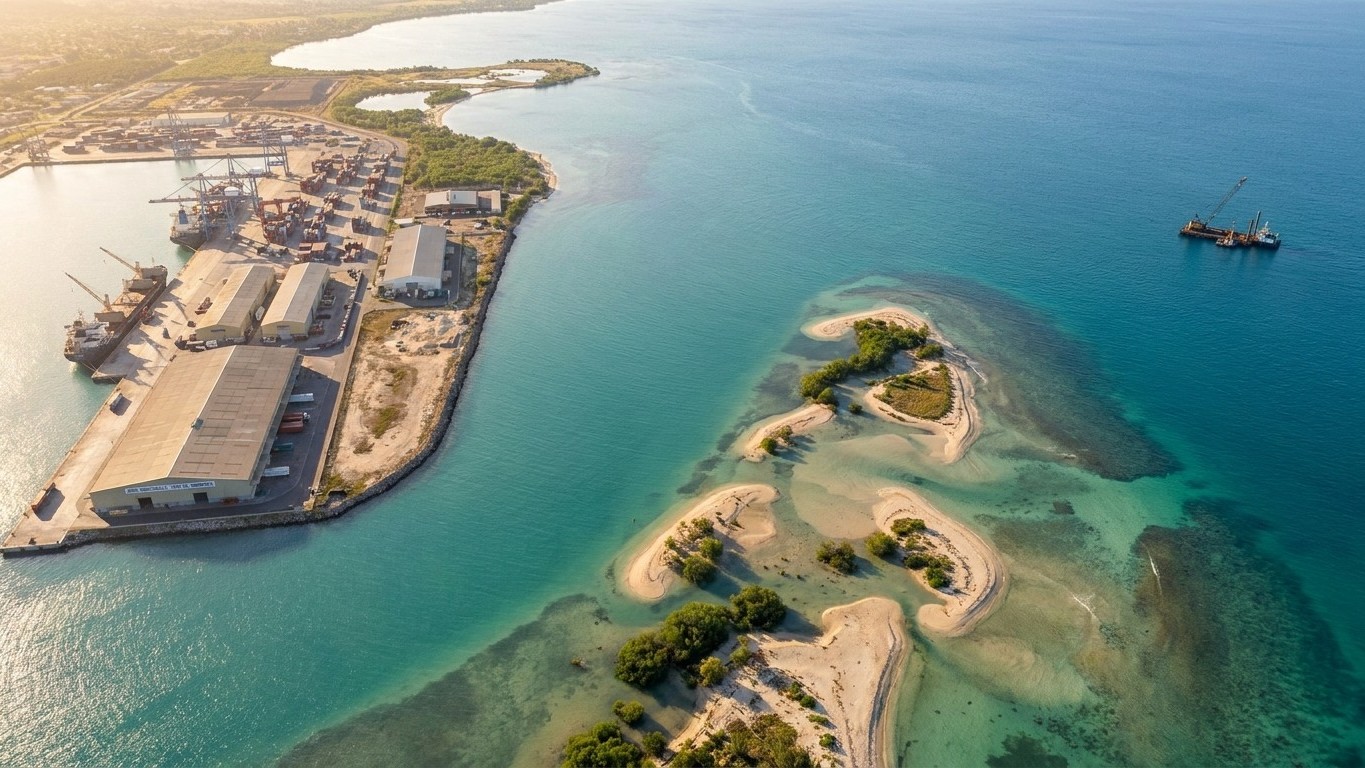
721 square kilometers. That is the area Singapore claimed in 2019, compared with 527 km² at its independence in 1965. In a half-century, the city-state has swollen by nearly 40 percent, without annexing any neighboring territory or pushing back a single land border. It simply imported sand. Hundreds of millions of tonnes dumped into the sea to transform mud flats into business districts, airport runways, or industrial zones. The problem is that this sand came from somewhere, and it had to be taken from elsewhere to be laid down here.
Key takeaways
- Singapore expanded by 194 km² in half a century, but not by annexing land
- Around twenty Indonesian islands disappeared entirely to feed this expansion
- Export restrictions simply shifted the problem to new regional suppliers
Around Twenty Indonesian Islands Erased from the Map
Indonesia bore the bill first, and heaviest. Singapore’s enlargement was achieved at the expense of about twenty Indonesian islands, which simply vanished from the surface of the globe, before Jakarta banned the export of its sand in the early 2000s. Entire islets, located notably near the Makassar Strait, were sucked up by dredgers until only a thin tongue of sand remained visible at low tide. These islands, once averaging around fifty hectares each, have today given way to a slim layer of sand about a hundred meters wide, visible at low tide.
The mechanism is almost mechanical, in the literal sense. By extracting sand from the sea indiscriminately, the natural balance is disturbed. The pumping of marine sand creates a void that nature quickly fills through the combined actions of wind and waves. It is then the sand from neighboring beaches and islands that fills these enormous holes. It is not enough to remove sand at one precise spot: an entire coastal system collapses in a cascade, far beyond the initial dredging zone. This chain reaction explains why islands never directly dredged ended up eroding and then disappearing as well.
The diplomatic note eventually arrived. Indonesia accuses Singapore of being responsible for the disappearance of 24 of its islands and the reduction of 7 others, due to the indiscriminate dredging of sand that reduced their area until, at times, they were completely submerged. Some of these islets served as boundary markers for drawing maritime borders. Their disappearance created an embarrassing legal vacuum: how to delimit a border when the reference point no longer exists?
Jakarta closes the tap; Singapore changes supplier
Faced with the scale of the damage, Indonesia eventually cut off supplies. The ban on sand exports, decreed in the early 2000s, could have seriously restrained Singapore’s territorial appetite. It did not. The city-state now sources mainly from Cambodia, where the sand-dredging industry has a devastating impact, according to the British NGO Global Witness. Singapore’s sand simply changed nationality, without changing its final destination.
Malaysia and Vietnam followed the same path as Jakarta, restricting their exports in turn. But parallel supply chains did not disappear for good. Thanks to local smuggling networks, Singaporean traders—operating under fake names and fake companies—continue to source sand from Cambodia, Indonesia, Malaysia, and Vietnam, flouting import prohibitions with the tacit support of the Singaporean government. Over two decades, the scale of the phenomenon is dizzying: a UN-linked analysis estimated in 2019 that Singapore had imported 517 million tonnes of sand in twenty years, making it the world’s leading importer of sand. To put it in perspective, that would be enough to fill several hundred thousand Olympic-size swimming pools, solely to fill the sea around a territory barely larger than Réunion Island.
The Hidden Price of Expansion, Also at Singapore
The city-state did not merely export the damage; it also absorbed a portion of it at home. Nearly all of the original shoreline, and its accompanying mangrove forests and natural beaches, were lost. So too were two-thirds of Singapore’s coral reefs. Intertidal coral reefs declined from 16 km² to 9 km² between 1993 and 2011, a retreat directly linked to the intensity of the land-reclamation works along the coasts. An interesting paradox: mangroves, meanwhile, advanced slightly during the same period, thanks to restoration programs launched in parallel. As if Singapore was making up with one hand for what it was destroying with the other.
Aware that sand has become a geopolitically explosive resource, the city-state eventually changed its technique. Rather than systematically reclaiming with imported sand, it now relies on polders, land reclaimed behind dikes, without a massive external material influx. A polder of 800 hectares was thus completed on Pulau Tekong, without resorting to large-scale sand imports to fill it. The Singaporean government now presents these extensions less as real estate whimsy than as a bulwark against rising seas, an argument that has taken on new significance since climate change has entered the public debate.
One remaining question that few official reports address head-on: who in the region still agrees to sell their coastline at the price of the cubic meter? Myanmar and Cambodia continue to appear regularly in Singapore’s supply chains, often via shell companies that mask the sand’s true origin. As long as no international convention regulates this trade on a global scale, nothing prevents another score of islands elsewhere from eventually being swallowed to enlarge another space-constrained city-state.
Sources: academia.edu | medium.com | lepetitjournal.com
