
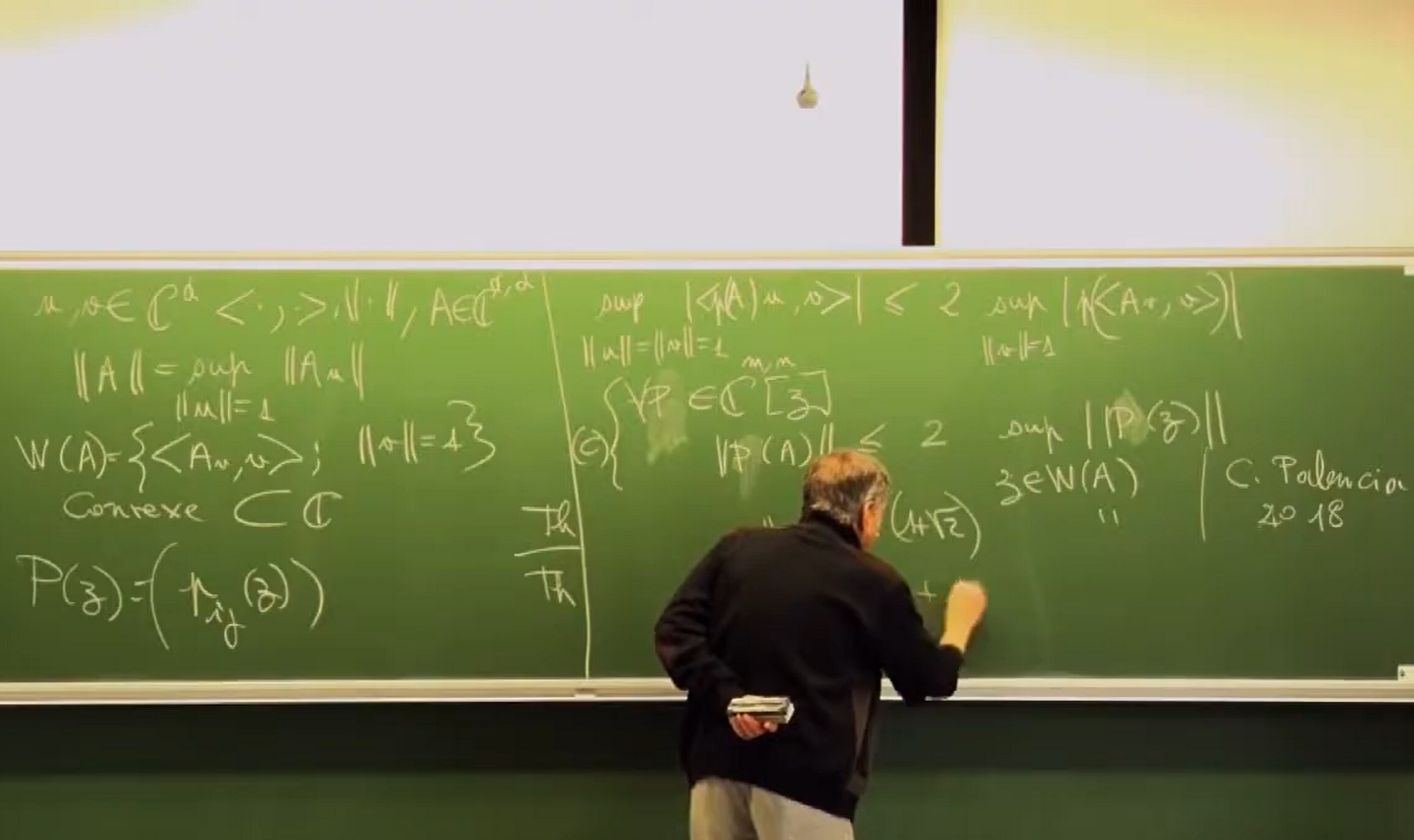
Recently in China, a neurosurgery resident managed to solve a major puzzle of numerical linear algebra dating back about twenty years, thanks to the latest version of ChatGPT. Yet the individual was originally working on a concrete problem related to his medical research on transcranial ultrasound.
The neurosurgeon used the latest ChatGPT model
In 2004, the French mathematician Michel Crouzeix stated a problem in matrix analysis – Crouzeix’s conjecture – proposing an upper bound for the norm of a function applied to a matrix. According to the expert, the answer to this problem could be very useful in numerical analysis and operator theory, among other areas. Yet a few weeks ago, the answer to this puzzle was formulated to general surprise by neurosurgeon Jin Shanmu, from the Peking Union Medical College Hospital (China). Originally, the doctor was not aiming to enter the history of mathematics at all. He simply sought to solve a concrete technical and algorithmic problem in connection with his own transcranial ultrasound research, namely brain imaging with ultrasound.
The Chinese neurosurgeon used the latest OpenAI model GPT-5.6, more precisely the specialized version GPT-5.6-Sol, operated via the professional ChatGPT Work interface. The expert configured the model to autonomously explore proof strategies over a long session. And, the AI carried out continuous calculations for 16 hours before generating the complete and valid demonstration of Crouzeix’s conjecture.
For now, details of Jin Shanmu’s work have been available on Preprints.org since July 27, 2026. According to sources, the very first version of this report is said to have been published on Cornell University’s ArXiv platform (United States). Professor Alex Townsend is said to have discovered this initial version while performing a routine check. Obviously, the publication was quickly shared with Michel Crouzeix.
A demonstration that felt like a double earthquake
Today, the publication remains labeled “not peer-reviewed” at present. However, Michel Crouzeix has rigorously examined the demonstration before asserting that the mathematical logic was perfectly sound. The puzzle was officially validated on August 15, 2026, as evidenced by a publication by Alex Townsend (PDF in English / 4 pages). This confirmation would thus remove doubts within the scientific community, which had been wondering about the ability of an AI to produce a demonstration without subtle errors or logical hallucinations.
« L’hypothèse de Crouzeix était ouverte depuis plus de deux décennies, nous avons donc initialement lu la prépublication avec un certain scepticisme mais après quelques heures, nous avons réalisé que l’argument était tout à fait valable. », a déclaré Alex Townsend dans sa publication.
Finally, it should be noted that solving Crouzeix’s conjecture is a double earthquake, as it represents both a major advance for applied mathematics and a revolution in the method of scientific research. This work opens the door to more stable computer calculations and a better understanding of the stability of imaging systems or fluid mechanics. Moreover, this case shows that non-experts can tackle complex problems outside their field, and makes AI models like ChatGPT more credible as co-researchers.
