
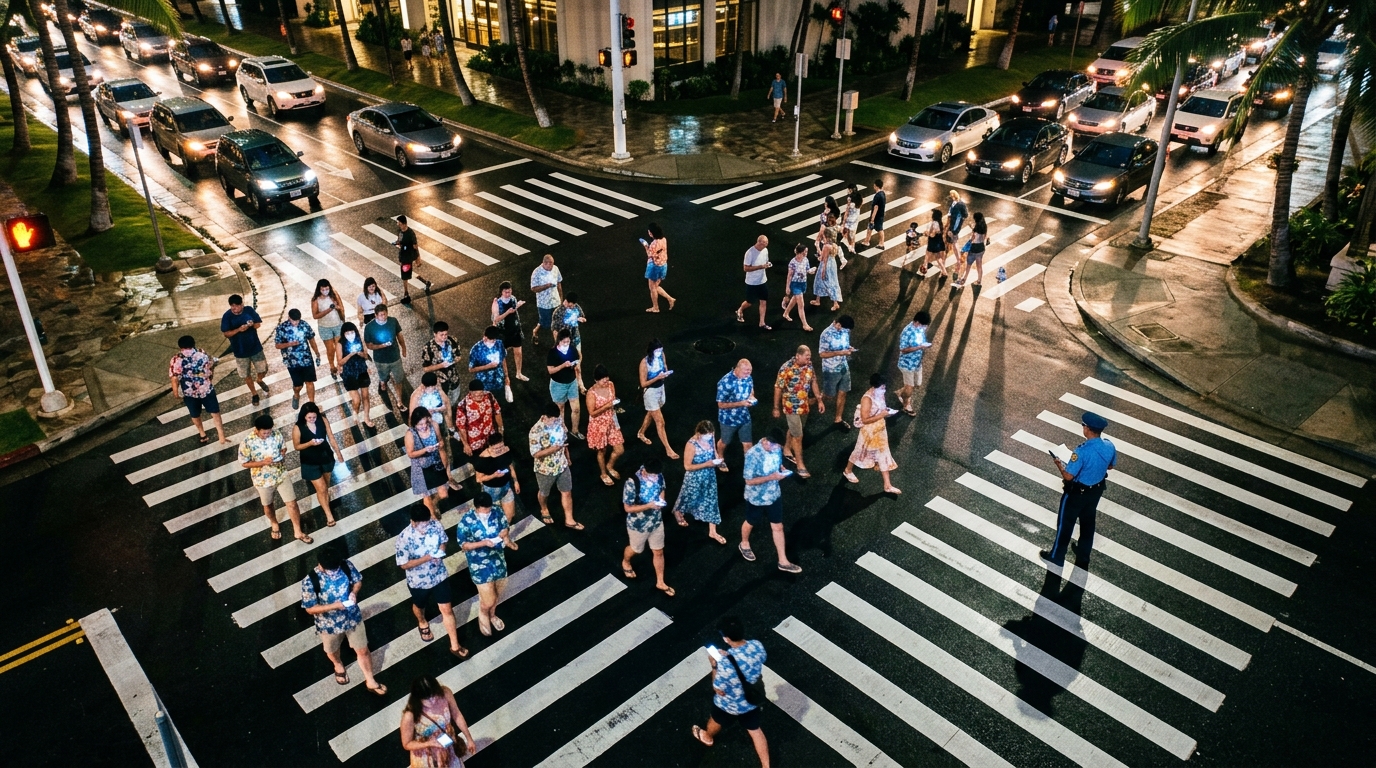
In Honolulu, lowering your eyes to your phone while crossing the street can literally cost you. For several years now, Hawaii’s capital has been sanctioning pedestrians distracted by their screens at crosswalks. An idea that is surprising, but one that responds to a reality far more serious than it might seem.
- Since October 2017, Honolulu prohibits looking at a screen (smartphone, tablet, computer, console) while crossing a crosswalk, with exceptions for 911 calls and emergency responders
- The fines range from $15 for a first offense to $75–$99 for a third, far less than the $130 penalty for jaywalking
- This law addresses a rise in pedestrian fatalities in the United States and Hawaii, and is now inspiring other cities such as Sassari in Italy and a similar nationwide project in Italy
- Honolulu, a pioneer law that reverses the roles on the road
- A simple glance at the screen, up to a $99 bill
- Why this law is inspiring imitators well beyond Hawaii
Honolulu, a pioneering law that reverses the roles on the road
Let’s go back a bit in history. In October 2017, Honolulu became the first major American city to legislate on a phenomenon nicknamed across the Atlantic as distracted walking, literally walking while distracted. The law, embodied in the bill known as Bill 6, simply forbids looking at a screen while crossing a crosswalk.
What stands out in this approach is the reversal of perspective. Usually, when we talk about road safety, we think about drivers’ behaviors. Here, the municipality chose to hold pedestrians accountable as well, starting from a simple observation: far too many people were getting struck while their noses were buried in their smartphones, right in the middle of a crosswalk that was supposed to protect them.
Before pulling out the fines book, the local authorities took time to warn. For about three months, Honolulu’s police conducted an information campaign and issued warnings rather than fines. A way to give everyone time to adapt to this new rule before it carried financial penalties.
A simple glance at the screen, up to a $99 fine
Let’s dive into the specifics of the sanctions, because this is where Hawaii’s law truly stands out. For a first offense, the minimum fine is $15. A nearly symbolic amount, designed as a reminder rather than a harsh punishment.
Things get tougher for those who commit a third offense. The penalty then rises to between $75 and $99, nearly seven times the amount of the first fine. Enough to deter stubborn habits. Interestingly, higher amounts had been considered before the bill’s final passage, up to $100 for a first offense, $200 for a second, and $500 for a third. The lawmakers ultimately opted for a more moderate version.
What makes the law particularly precise is its clear definition of what is allowed or not. Talking on the phone while walking remains permitted, provided you keep your eyes up. However, consulting a screen—whether it is a smartphone, a tablet, a laptop, or even a gaming console—is strictly forbidden during the crossing. The legal exceptions cover emergency calls to 911 and emergency responders acting in their official capacity. By comparison, crossing outside a crosswalk, what Americans call jaywalking, costs $130 in Honolulu, a much higher fine than the one reserved for pedestrians simply distracted by their screen.
Why this law is inspiring imitators well beyond Hawaii
If Honolulu has legislated as firmly as it did, it’s not a matter of calendar coincidence. In the United States, pedestrian fatalities had jumped 9% in 2016 compared with the previous year, reaching 5,987 deaths, the heaviest toll recorded since 1990 according to federal data. A signal strong enough to push a city to act, even if it means legislating on a behavior as seemingly ordinary as looking at your phone.
The problem, moreover, is not limited to Hawaii. On the island of Oʻahu, where Honolulu sits, 18 pedestrians had already died in traffic crashes by September 29, 2025, matching the total for the previous year. The pedestrian mortality rate has been rising since 2023, a worrying trend despite the law having been in place for several years. An analysis conducted under the Oahu Vision Zero Action Plan sheds further light: 44% of fatal or serious pedestrian crashes occur when the person is crossing at a protected crosswalk. The most common scenario remains a driver going straight or turning left directly into the crosswalk, a reminder that vigilance must be shared among all road users.
This awareness now extends far beyond the Hawaiian archipelago. In Italy, the government is debating in 2026 a €75 fine for pedestrians checking their phone while crossing. A measure that has already existed since 2018 in Sassari, in Sardinia, one of the first European cities to take this step. As the Honolulu-born idea continues to travel, driven by a shared observation across continents: our screens captivate us at the worst possible moment, and the street does not always forgive inattention.
In essence, this Hawaiian law tells a broader story about our era. Our phones have become extensions of ourselves, to the point of capturing our attention even in the most ordinary daily moments, such as crossing a street. Since October 2017, the Honolulu Distracted Walking law has sanctioned pedestrians who look at a screen on a crosswalk with fines ranging from $15 to $99, a concrete reminder that road safety now concerns as much our digital habits as our behavior behind the wheel.
