
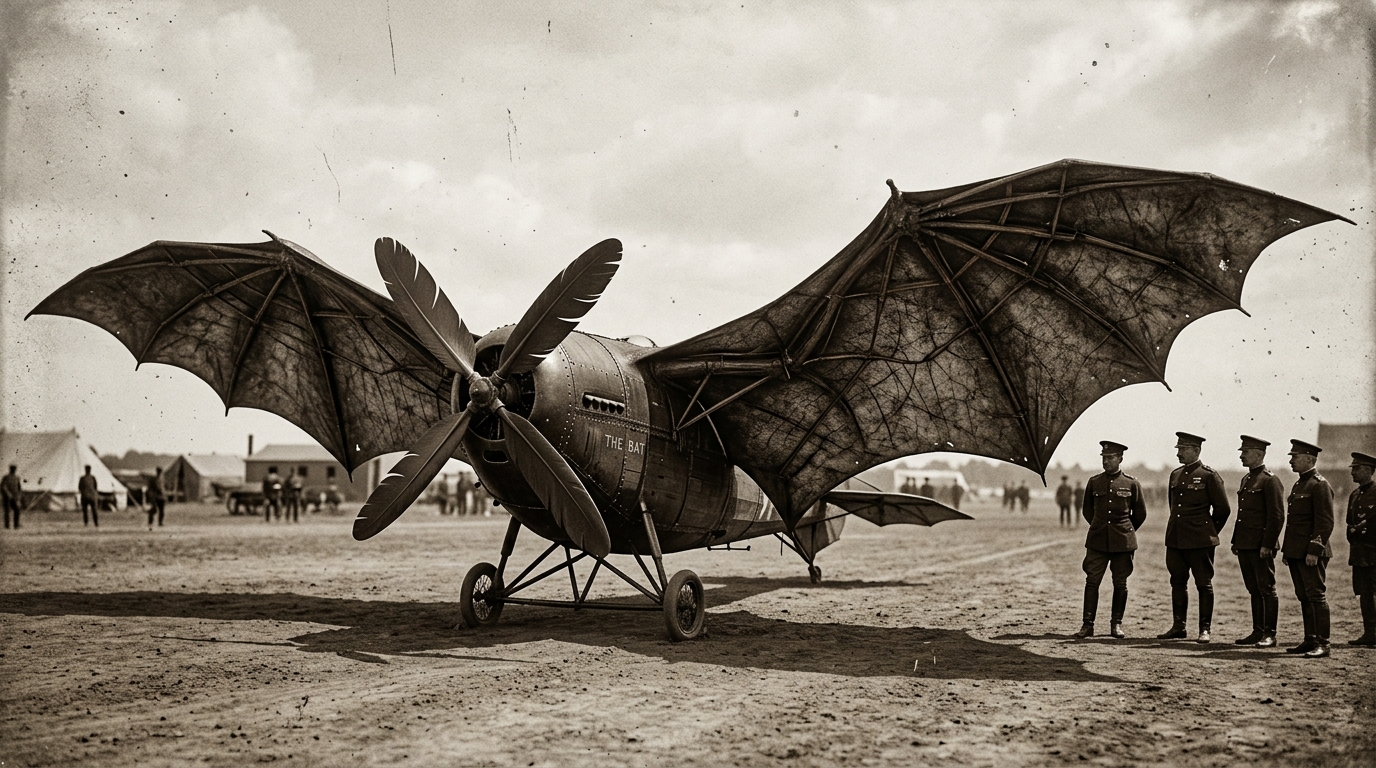
We almost always associate the beginnings of French aviation with Louis Blériot’s crossing of the Channel. Yet, twelve years earlier, the French state was already financing a machine with bat-like wings, powered by steam. A little-known, nearly forgotten story that deserves attention this season as we willingly recall the great adventures of the past.
- In 1897, Clément Ader tested the Avion III, nicknamed the Aquilon, a bat-winged aircraft with a 16-metre wingspan financed by the War Ministry for 65,000 francs
- During the trials at the Satory camp in October 1897, a gust of wind veered the craft off its circular path, and it never truly left the ground according to the official report
- After this failure, the state refused to fund further trials, ending the project twelve years before Blériot’s Channel crossing in 1909
- When the French army bet on a giant bat
- Clément Ader, the engineer who was already inventing the word “airplane”
- The day the Avion III crashed and nearly changed history
- Twelve years before Blériot, France had already tried everything
When the French army bet on a giant bat
Imagine the scene: a military camp on the outskirts of Paris, a circular runway cut into the grass, and at the center, a machine like nothing seen before. Its wings, deeply curved, span no less than 16 metres in wingspan, closely echoing the silhouette of a bat in flight. This design isn’t accidental: the inventor deliberately copied nature, convinced that flying mammals held the secrets of lift. The aircraft, named Avion III but nicknamed “the Aquilon,” even carried a four-blade propeller carved from bamboo, another nod to this animal-inspired approach.
What makes this story so remarkable is that the project wasn’t the work of a lone tinkerer. The French War Ministry had agreed to fund the efforts, unlocking at the time a substantial sum of 65,000 francs. Two independent steam engines, each delivering 20 horsepower, were supposed to propel this extraordinary two-seater. It’s a far cry from the postcard image of early aviation cobbled together in barns: here, the State itself was backing a technology still in its infancy.
Clément Ader, the engineer who was already inventing the word “airplane”
Behind this singular machine lies a Toulouse-born engineer named Clément Ader, a figure today too little known to the general public, even though he literally forged the vocabulary of aeronautics. Indeed, he is the one credited with coining the term “airplane,” a designation that would come to define all fixed-wing aircraft long after his experiments. Passionate about flight for many years, Ader did not merely sketch plans: he built, tested, and rebuilt, with a stubbornness that commands respect given the technical means available at the time.
His approach was decisively biomimetic, long before the term became fashionable in contemporary laboratories. By studying the flight of bats, he concluded that the curvature of the wings played a crucial role in generating lift. This intuition, while it did not suffice to keep the Avion III aloft for long, demonstrates a serious scientific method, far from the caricature of the eccentric inventor that history sometimes preserves.
The day the Avion III crashed and nearly changed history
It was at the Satory military camp, not far from Versailles, that the decisive tests took place on October 12 and 14, 1897. A timing choice that, in hindsight, seems oddly fitting: we are exactly at the same season, on the cusp of autumn, when winds begin to rise and become capricious. And it is precisely this which sealed the fate of the machine.
During the second test, an unexpected gust of wind pushed the craft off its circular trajectory. General Mensier, the official witness sent by the ministry, recorded in his report a blunt conclusion: the machine had never truly left the ground. After spending 65,000 francs, a substantial sum for the era, the French state simply refused to fund further trials. The Avion III adventure ended there, abruptly, on an administrative failure more than a technical one.
One might wonder what would have happened if that wind had not blown that day, or if the state had chosen to persevere despite the setback. Would the history of French aviation have taken a different turn? No one can say with certainty, but this episode illustrates how major technological advances sometimes hinge on details as trivial as an unforeseen gust of wind.
Twelve years before Blériot, France had already tried everything
Placed in its chronological context, the tale is dizzying. Louis Blériot crossed the Channel only in 1909, twelve years after the Satory trials. In other words, long before French aviation would be etched into history with legendary names, the state had already attempted, funded, and abandoned such a bold and risky experiment. This precedence completely changes how we should view the origins of the nation’s aeronautics.
Far from being a mere historical accident, the Avion III episode reveals an overlooked continuity between the late nineteenth century’s exploratory trials and the early twentieth century’s triumphs. The engineers who followed Clément Ader, whether aware of it or not, walked in the footsteps of a man who had already explored biomimicry, lightweight engines, and aerodynamic design. Too often we forget that major technological breakthroughs almost always rest on earlier failures, patiently digested by the scientific community.
This story of a mechanical bat funded by the War Ministry deserves to be told far more widely than it is today. It reminds us that innovation rarely travels in a straight line, but rather advances in leaps, through spectacular failures and the stubbornness of individuals. So, the next time we talk about the pioneers of French aviation, perhaps we should begin with Toulouse and Satory, well before mentioning the Channel and Calais.
