
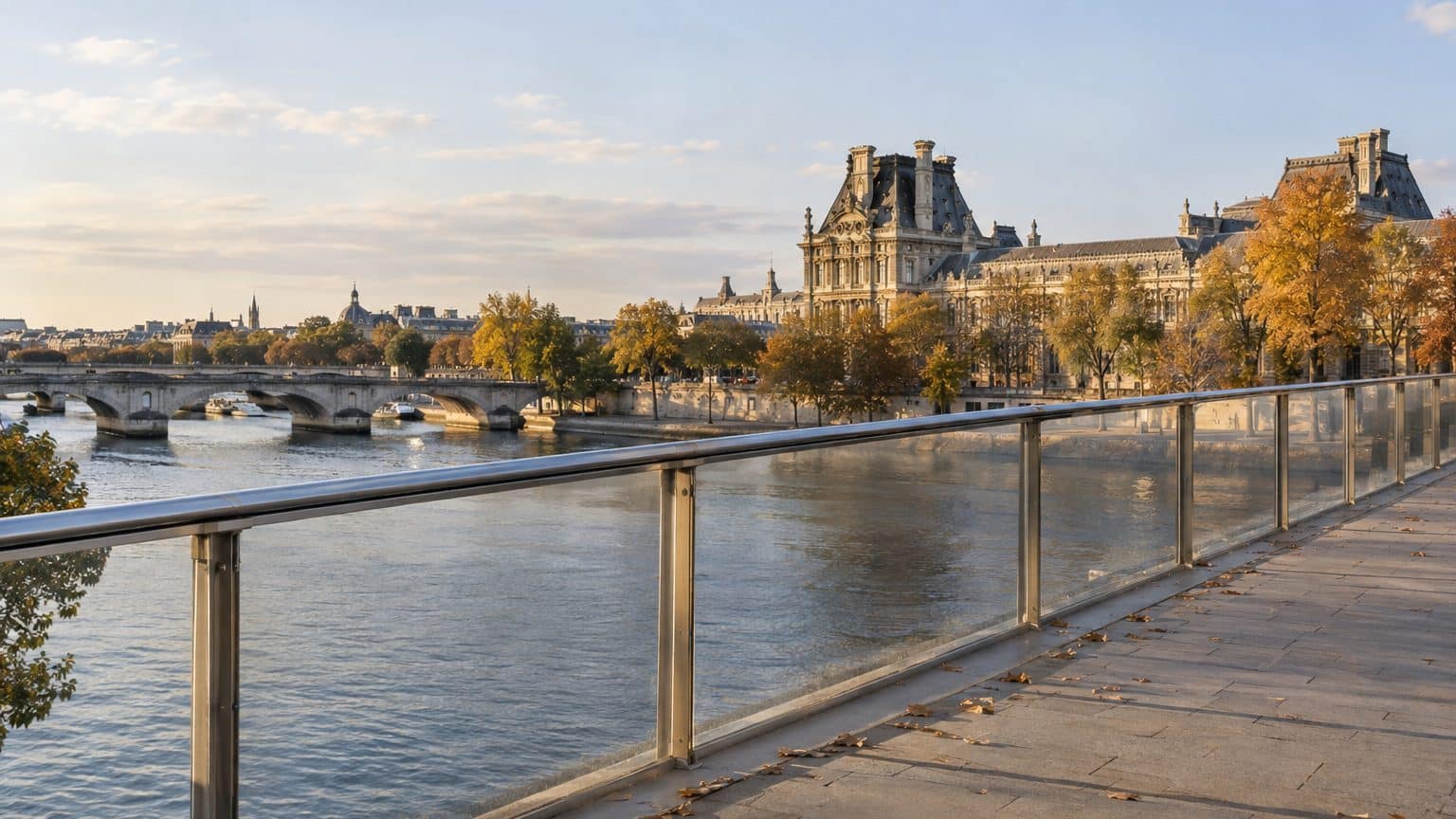
- The Pont des Arts lost its metal grills in June 2015.
- Nearly a million padlocks were removed, totaling 45 tonnes.
- One railing had collapsed in June 2014, with no casualties.
A Bridge Turned Transparent
On the Pont des Arts, the view now passes through the handrails. Transparent panels have replaced the metal grills, and not a single padlock hangs there anymore. This emptiness stems from a municipal operation launched on June 1, 2015, which removed 45 tonnes of metal during a week of work.
On these glass panels, nothing can be fixed to them.
The irony is there: the most intimate gesture imaginable ended up dictating a change in layout. The glass panels were planned as early as autumn 2015, with the promise that nothing could be attached anymore, according to franceinfo. The town hall also hoped that such a clear signal would deter padlock placements on the other bridges of the capital. The Pont de l’Archevêché, near Notre-Dame, another favorite spot for lovers, was to undergo the same replacement of grills by glass panels.
A Padlock, a Key, the Seine
The ritual unfolded in three steps. The couple hooked a padlock onto the parapet, tossed the key into the Seine, and swore that it would last “forever.” The practice had become very popular starting in 2008, according to Le Moniteur.
The key at the bottom of the river captured the poetry of the gesture: there would be no way to reopen what had just been sealed. The padlock is not a jewel; it is a lock. No one imagined, when sealing it again, that the lock would eventually weigh more than the feeling.
The tally, for its part, was conducted by the city. Between 700,000 and 1 million padlocks, according to franceinfo, “nearly a million” according to Bruno Julliard, who was then Paris’s first deputy mayor. In total, 45 tonnes, roughly the weight of seven adult African elephants lined up on the bridge. Put against a million pieces, that comes to about 45 grams per padlock—less than a chicken egg.
A padlock weighs almost nothing; a million of them weigh 45 tonnes.
As the railing filled, according to various accounts, some couples attached their lock to another already in place. The structure had not been designed for this kind of permanent load. Each lover added a few tens of grams, without seeing the sum.
June 8, 2014: The Railing Gives Way
Sunday, June 8, 2014, just before 6 p.m., about 2.40 meters of railing on the Pont des Arts collapsed under the weight of the padlocks. More than 700 kilograms of locks dangled from that single stretch of railing. There were no victims, a fact all sources confirm. The bridge was evacuated and closed, then reopened that same evening, according to franceinfo.
The City did not wait for a second incident to act. Thirty-seven sections of railing had already been removed and temporarily replaced by wooden and glass panels, Le Moniteur reports. Anne Hidalgo, for her part, had warned from the start of her term that she intended to put an end to this practice.
The reasons laid out by Bruno Julliard in a communiqué blended three criticisms: the aesthetic of the structure being compromised, the deteriorating condition of the framework, and potential accidents. The 2014 collapse gave a very concrete illustration of the third point. Franceinfo sums up the decision in one sentence: it was mainly taken for safety reasons, after a railing gave way under their weight.
June 1, 2015: The Removal Operation
Monday, June 1, 2015, from 8 a.m., municipal services set to work. They cut the padlock-filled grills with a metal saw, pile the remnants at the back of trucks, and store them in warehouses. “We will remove nearly a million padlocks, or 45 tonnes,” announced Bruno Julliard in front of a crowd of journalists, many from the international press. The walkway remained closed all week.
In the meantime, the bridge was not left bare. Four street artists—Jace, El Seed, Brusk, and Pantonio—created a 150-meter frieze composed of 56 panels, unveiled starting June 8. This temporary exhibition was to give way to the glass panels in the fall.
As for the padlocks, the city spoke of recycling them rather than discarding them.
Bruno Julliard stressed that Paris must remain the capital of love: you can declare your love, even ask for someone’s hand in marriage on the Pont des Arts, but not with a padlock. The City had launched the hashtag #LoveWithoutLocks, and AFP recalled a campaign inviting tourists to post selfies rather than fixing a lock. The simplest course today is to take a photo, since the glass panels offer a clear frame of the Seine and the Louvre.
Sources: lemoniteur.fr | franceinfo.fr
