
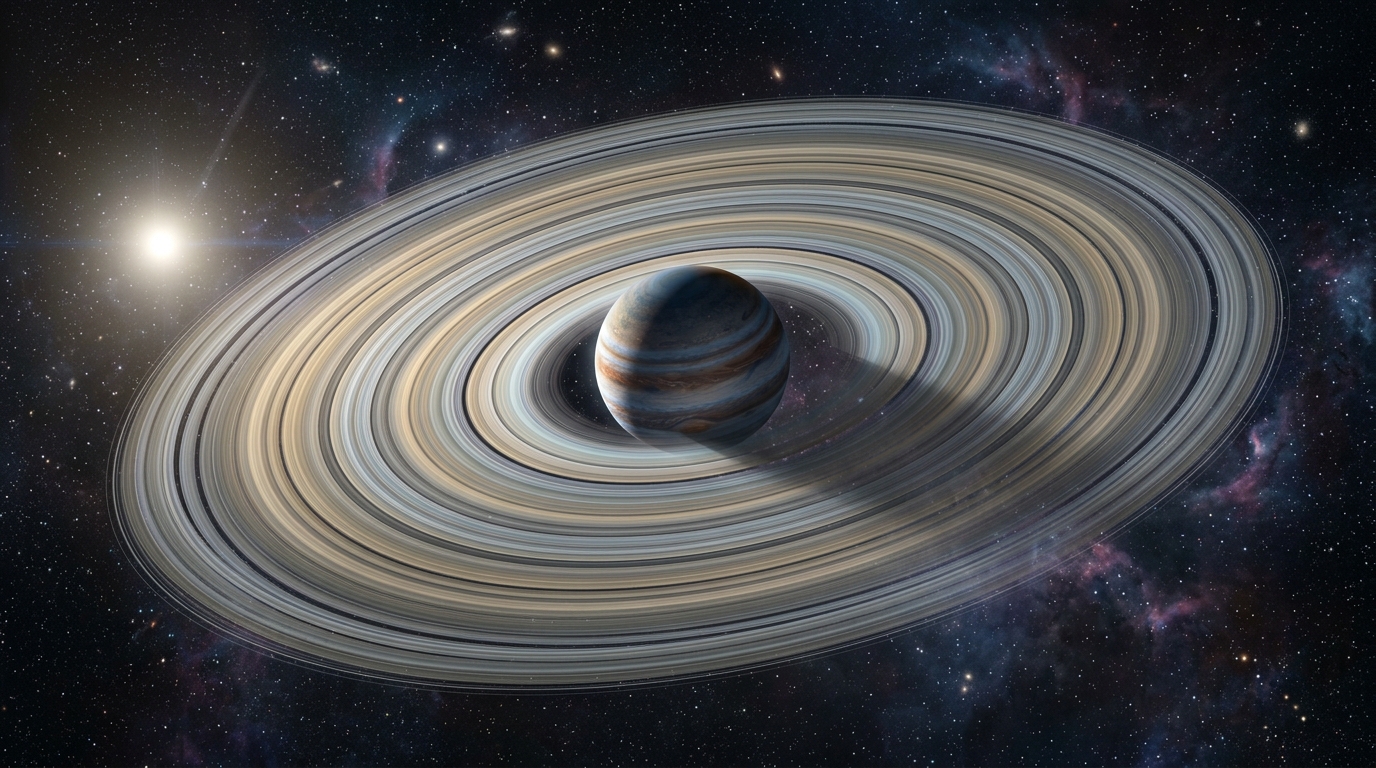
What if Saturn’s rings, those we have admired for generations with a simple telescope, were ultimately only a modest curiosity on the scale of the universe? At 430 light-years from Earth, a celestial object hides a system of 37 rings whose outer radius surpasses 200 times that of our beloved gas giant, relegating Saturn to amateur status.
- The exoplanet J1407b hosts a ring system of 37 rings, versus 7 for Saturn, discovered thanks to a 56-day stellar eclipse observed in 2007
- The outer radius of this system reaches about 90 million kilometers, i.e., 640 times larger than Saturn’s rings
- Dating only 16 million years, this system would be a forming circumplanetary disk rather than a stable ring set, offering a glimpse into the birth of exomoons
- When a star dims for two months, astronomers panic
- 37 rings vs 7: Saturn downgraded to amateur
- 90 million kilometers in radius: a system that could swallow our Moon
- What J1407b teaches us about the birth of distant worlds
When a star dims for two months, astronomers panic
It all started with an anomaly that few astronomers could have anticipated. In 2007, the star 1SWASP J140747.93-394542.6, located in the constellation Centaurus, began to fade dramatically for a total of 56 days. Such a prolonged eclipse could not be explained by the simple passage of a ordinary planet in front of its star: something else was needed, something far more extensive to block the light for so long.
It was by analyzing data from the SuperWASP project (Super Wide Angle Survey for Planets), which hunts exoplanets using the transit method, that the astronomer Eric Mamajek identified this strange light signature. This discovery would, a few years later, lead to the unveiling of J1407b, the first known exoplanet to host a ring system. An object that has since continually fascinated the scientific community.
37 rings against 7: Saturn downgraded to amateur
In 2012, Matthew Kenworthy, from Leiden University, confirmed and detailed the structure of this extraordinary system. Where Saturn proudly displays its seven main rings, often regarded as the jewel of our solar system, J1407b counts as many as 37, each stretching over tens of millions of kilometers. A difference in scale that is dizzying and clearly recasts what we thought we knew about planetary ring systems.
Since that initial discovery, observations have been refined and new analyses of the collected data have allowed a better understanding of the architecture of this ensemble. The astronomers notably spotted regular spacings between certain rings, voids that probably reveal the presence of satellites in formation, what we call exomoons. These gaps act a bit like furrows carved by orbiting bodies, precisely as some moons of Saturn shape the divisions in its own rings.
90 million kilometers in radius: a system that could swallow our Moon
Here is the figure that measures the scale of this discovery: the ring system of J1407b has an outer radius estimated at about 90 million kilometers, i.e., 640 times larger than Saturn’s rings. To visualize this size, imagine a structure capable of spanning more than 40,000 times the surface area covered by Saturn’s rings, while containing the equivalent of an entire Earth mass of material in suspension.
If we could observe this system from Earth, instead of our own planetary rings, the spectacle would be striking: the rings and their gaps would appear several times larger than the full Moon in the night sky. A reminder of the vertigo-inducing scale of these formations, far exceeding anything our solar system has produced to date.
What J1407b teaches us about the birth of distant worlds
One essential question remains: can such a system endure? Given its young age, the answer is probably no, at least not in this form. The star system hosting J1407b is only 16 million years old, which is extremely young by astronomical standards. Combined with the outsized size of the observed structure, this youth leads researchers to favor another hypothesis: it would not be a stable, enduring ring system like Saturn’s, but rather a circumplanetary disk or a proto-exomoon still in formation.
In other words, J1407b would offer a unique glimpse of a pivotal moment: the moment when moons begin to form around a planet, arising from a chaotic disk of material. It is precisely the kind of phenomenon Matthew Kenworthy’s team continues to chase, sifting through vast observation catalogs in search of new eclipses as strange as the one recorded in 2007. These occultations seem to remain, for now, the only concrete way to observe the earliest stages of exomoon formation elsewhere in the galaxy.
From Saturn to J1407b, the contrast is striking: on one side, a stable ring system admired for centuries; on the other, a giant and ephemeral structure, witness to planetary birth still underway, hundreds of light-years away. This discovery invites us to rethink what we considered exceptional in our own solar system, and reminds us how much the universe still brims with configurations we could never have imagined. Who knows what other surprises lie behind the next eclipses astronomers are about to scrutinize?
