
Four kilometers of flooded galleries, days under pressure, and twelve teenagers who had never worn a diving mask in their lives. Between June 23 and July 10, 2018, thirteen people were trapped in the Tham Luang Nang Non cave in northern Thailand, near the borders with Myanmar and Laos, before emerging alive thanks to a rescue operation without equal in the history of cave exploration.
Key takeaways
- Twelve children and their coach trapped 4 km underground: how authorities had to reinvent the rescue in three days
- Eleven hours of extreme diving for a round trip: why waiting was not a viable option
- A spectacular medical decision: the children were sedated to pass through the submerged passages
An underground river traps a football team
What began as a routine training outing ended with twelve children and their coach blocked by rising water in the Tham Luang Nang Non cave in Chiang Rai province, Thailand, near the borders with Myanmar and Laos. The group, members of Moo Pa Football Club, the “Wild Boars,” regularly visited the cave after practice. That day, rain came earlier than usual. The subterranean waters swollen by the monsoon pushed the group deeper into the cave, until they were four kilometers from the entrance, with no turning back. A mother alerted authorities that evening after realizing her son had not come home.
It would take several days of searching before British divers established first contact. When rescuers finally reached the group, they found them huddled on a muddy ledge of a partly flooded chamber, exhausted but alive. The news then spread around the world: the thirteen had been found. Now the question was how to get them out.
Eleven hours of diving to reach the “Wild Boars”
The problem boiled down to a single figure. To travel the round trip through the jagged, water-filled passages to reach the boys and their coach, a seasoned diver would need eleven hours: six hours there and five hours back, aided by the current. Eleven hours, for an experienced diver equipped with the proper gear. The children, however, had never dived, and some could not swim at all.
Facing this reality, Thai authorities initially considered a more reasonable option: to wait. At first, the rescue seemed likely to unfold over several weeks, enough time to introduce the group to diving equipment, a plan that could improve their frail health after many days without food. A Thai naval captain even spoke of stocking provisions to last for months. But the weather would not permit such luxury: the monsoon threatened to submerge the remaining galleries, making any future evacuation impossible. Action had to be taken quickly, and differently.
To organize the operation, Thailand mobilized an impressive international contingent. The Thai government called on around ninety divers, including forty foreigners and thirteen “world-class” specialists, among them Australian Richard Harris, who is also an anesthesiologist. This seemingly minor detail would prove decisive later.
Thirteen lives entrusted to darkness: evacuation under sedation
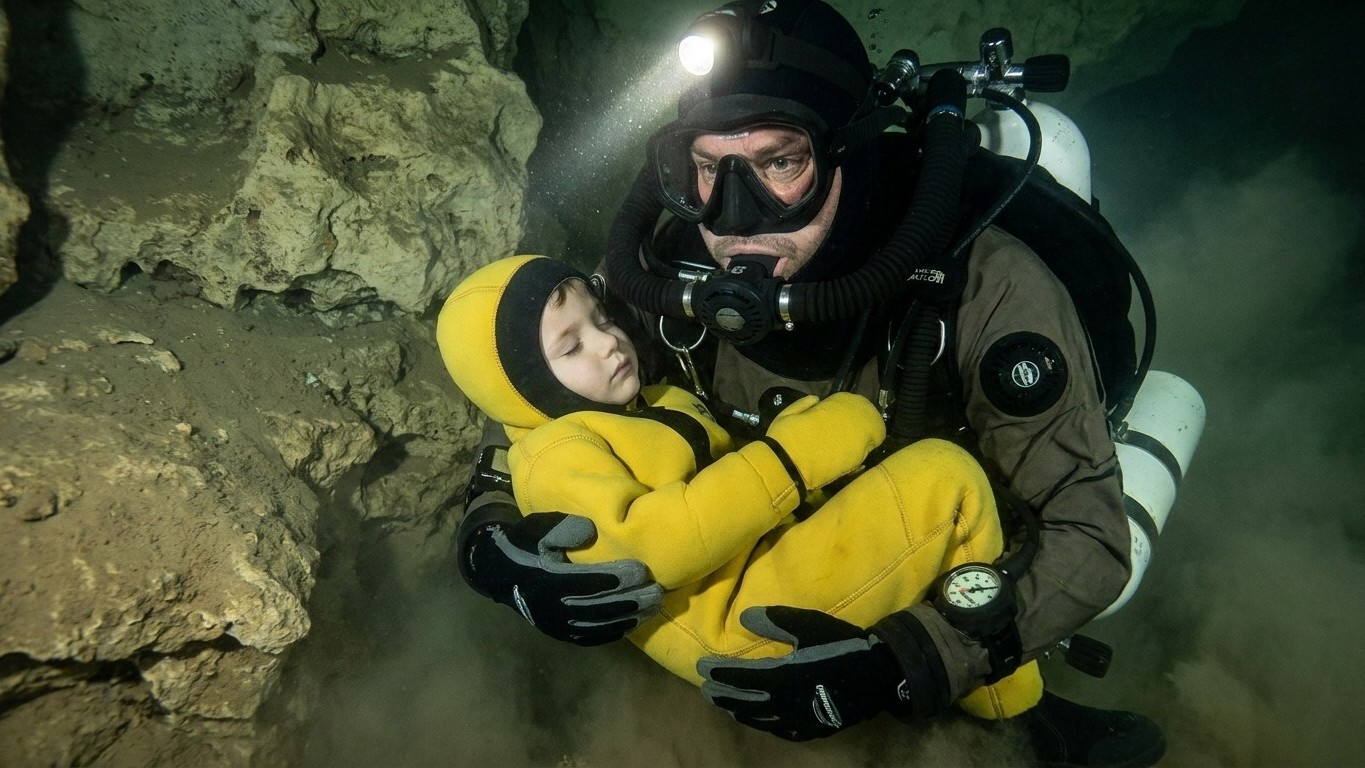
The chosen method was almost science-fiction in medical terms. Rather than attempting to teach the basics of diving to panicked teenagers in a pitch-black tunnel, the team decided to sedate them. The head of the ruling junta stated that rescuers gave the children a “mild sedative” to prevent panic, but that they were not knocked out by drugs. Each boy was thus placed in a semi-conscious state before being equipped and handed over to a diver, who literally pulled him through the submerged passages.
The testimony of the last diver who exited the cave provides a clear picture of the children’s condition at the moment of extraction. “Some of them were asleep, others were wriggling their fingers as if groggy. But they were breathing,” explained Commander Chaiyananta Peeranarong, who was the final diver to emerge from the cave at the end of the rescue. A sentence that alone captures the scale of the technical and medical gamble undertaken.
The operation unfolded over several days, in small groups. As the boys arrived, ambulances ferried them away from Tham Luang to board a helicopter for Chiang Rai hospital, and word spread quickly: four boys had been rescued and all were alive. Between each wave of extraction, the diving teams, exhausted, had to reorganize everything for the next day. Jason Mallinson and the worn-out team members prepared for the following day, when four more boys would have to be brought to safety, without stopping, as dozens of oxygen bottles needed refilling and replacement, ropes needed re-tensioning, and many other tasks awaited. Three days of continuous effort, for twelve teenagers and their 11- to 16-year-old coach who, weeks earlier, never imagined they would one day pass through a siphon with their eyes closed, literally.
The price of the rescue
This technical achievement came at a human cost. During the preparations, a former elite member of the Thai Navy lost his life. Saman Kunan belonged to a team attempting to establish an oxygen supply line to the chamber where the children awaited rescue, and the former Thai Navy SEAL had lost consciousness on the way back. He died on July 6, 2018, four days before the last survivors left the cave. The diver had volunteered for the rescue mission, having left the armed forces years earlier to work as a security guard at Bangkok’s airport.
His sacrifice did not go unrecognized. A second death would later be added to the toll: on December 27, 2019, Beirut Pakbara, a Thai Navy SEAL, died from a blood infection contracted during the rescue operations. In response to these losses, the Kingdom of Thailand chose to officially honor Saman Kunan’s memory: he was posthumously named Knight Grand Cross First Class of the noble Order of the White Elephant, one of the country’s highest distinctions, by King Vajiralongkorn. A mural titled “The Heroes” was also installed in the new commemorative hall built at the entrance to Tham Luang cave, so that the names of the rescuers who died remain forever linked with those of the thirteen survivors.
Sources: konbini.com | france24.com
