
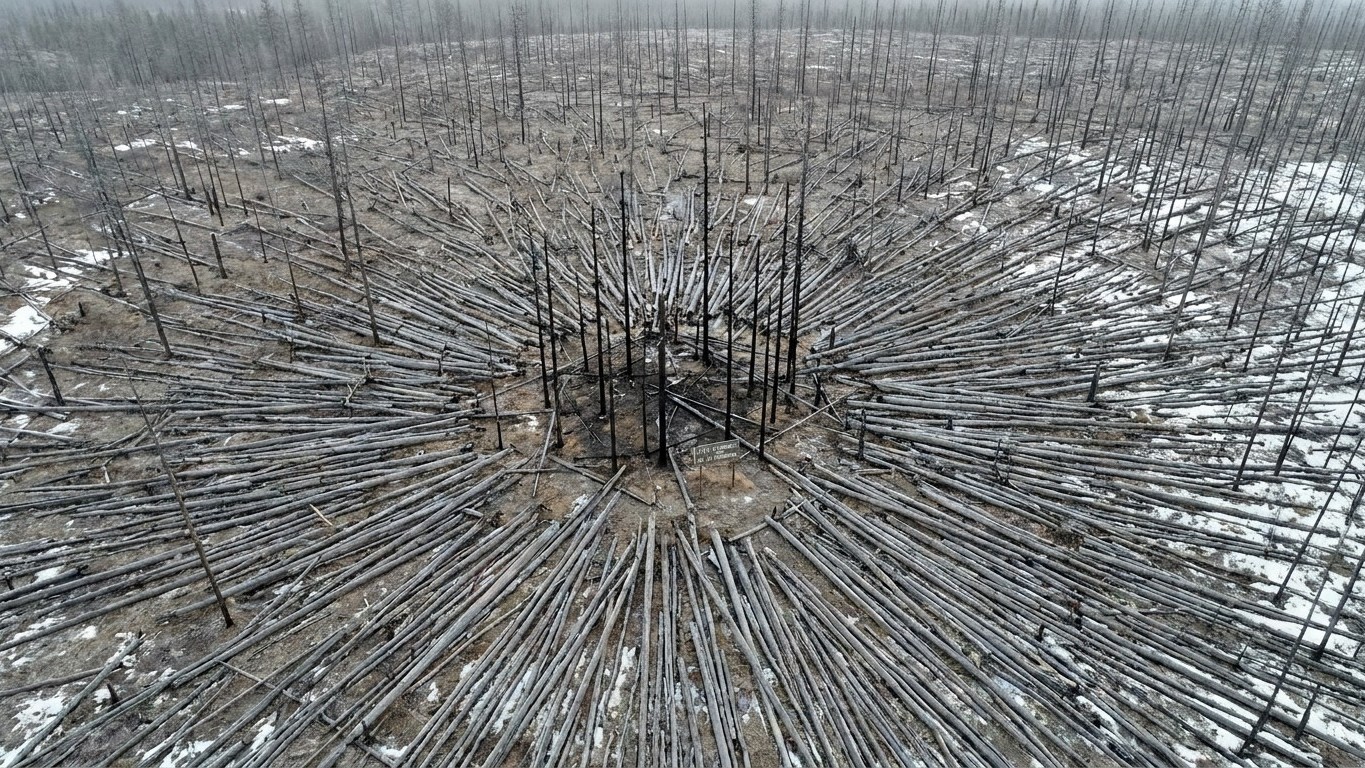
On June 30, 1908, at 7:14 in the morning, a cataclysm erupted above a remote portion of central Siberia, instantly felling tens of millions of trees across hundreds of square kilometers, all arranged in a starburst pattern radiating from a single point on the ground. The explosion occurred at approximately 7:14 AM on June 30, 1908, in central Siberia, with an energy estimated at 15 megatons of TNT, a thousand times the power of the Hiroshima bomb. The immediate consequence: no one at the time understood what had just happened. And for good reason, no scientific expedition would reach the site for nearly twenty years.
Key takeaways
- An explosion a thousand times more powerful than Hiroshima razes 2,000 km² of forest, yet no witness understands its origin
- The major mystery: why no crater? The very absence becomes the key to the mystery
- Trees felled in a perfect star reveal a story that craters would have concealed
A blast felt from tens of kilometers away
The focal region of the event is a barren human landscape, the taiga along the Podkamennaïa Toungouska river, just north where a handful of Evenk families lived. About eighty kilometers from the ground zero, Evenk communities were knocked from their horses, overturned from boats, and torn from their beds, while herds of reindeer panicked and fled. The sky brightened with a fiery ball, an intense heat was felt for miles around, and the blast swept away roughly 800 square miles of forest, a little over 2,000 square kilometers by modern estimates.
The shockwave did not stop there. In 1975, Ari Ben-Menahem, a seismologist at the Weizmann Institute in Israel, analyzed the seismic waves triggered by the event and estimated the energy released at between 10 and 15 megatons, equivalent to about 1,000 Hiroshima bombs. Seismographs thousands of kilometers away recorded the tremor. In the days that followed, unusual luminous skies were reported as far as England, a phenomenon some researchers attributed to dust in the upper atmosphere.
Twenty years before the first expedition
Why did it take so long to send researchers to the site? The answer rests in one word: Siberia. The region was isolated, and the political upheavals in Russia in the years after 1908 made early expeditions impossible. The 1917 Revolution, the ensuing civil war, the collapse of the Russian Empire—these upheavals meant the young Soviet Union had other priorities than trekking through a Siberian forest many days’ travel from a village.
Ultimately, in 1927 a mineralogist named Leonid Kulik, commissioned by the Soviet Academy of Sciences, managed to organize an expedition to the site. Kulik’s team made the arduous journey to Toungouska in 1927, enlisting local Evenk trackers to guide them to the impact site. Kulik, convinced that an ironn meteorite had crashed there, hoped above all to recover metallic fragments of scientific value to the Soviet state. He did not suspect what awaited him.
A forest laid out like the spokes of a wheel
What Kulik uncovered exceeded anything he could have imagined. While exploring the area, the team found that the felled trees formed a vast radial ring, their treetops pointing outward away from a presumed impact center. Around this center, trees were split and laid down radially for 15 to 30 kilometers; everything had been devastated and carbonized, and vegetation showed little sign of regrowth even two decades later.
Even more peculiar: at the epicenter itself, a handful of trees remained standing, though stripped of branches and bark, scorched in place. There exists an 8-kilometer diameter zone at the epicenter where trees were scorched and bare of limbs but remained upright like telegraph poles, a phenomenon that testifies to the effect of a shock wave originating at an altitude of 6 to 8 kilometers. This ground signature, a perfect star pattern, allowed researchers to pinpoint the epicenter with remarkable precision, without needing any physical debris to guide them.
The void that intrigued, the absence that explained everything
Kulik was seeking a crater and meteorite fragments. He found neither. At the epicenter he discovered only a swamp. No crater. No meteorite. For decades, this absence fueled the wildest theories, from an alien spacecraft or a mini black hole to methane explosions rising from the swampy soil.
Yet this very void, rather than being an insoluble puzzle, eventually became the key to understanding the event. The missing crater, long framed as Toungouska’s greatest mystery, is better understood as the explanation itself: a crater forms when an object survives its atmospheric passage and strikes the ground intact; Toungouska’s object never touched down, it shattered in flight. An explosion aloft, with no ground impact—this is what the starry field of tens of millions of felled trees tells us, even without a crater to point to.
As for the precise nature of the object that blew up that morning—a frozen comet or a rocky asteroid—the debates persisted for a century, with proponents of a vaporized cometary nucleus and advocates of a body pulverized in flight. But on the mechanism of the blast itself, the experts in impact physics, those who have modeled bolide dynamics in the atmosphere since the foundational work of Christopher Chyba and his team in the 1990s, are the authorities today on this question.
Sources: lindahall.org | indiandefencereview.com
