
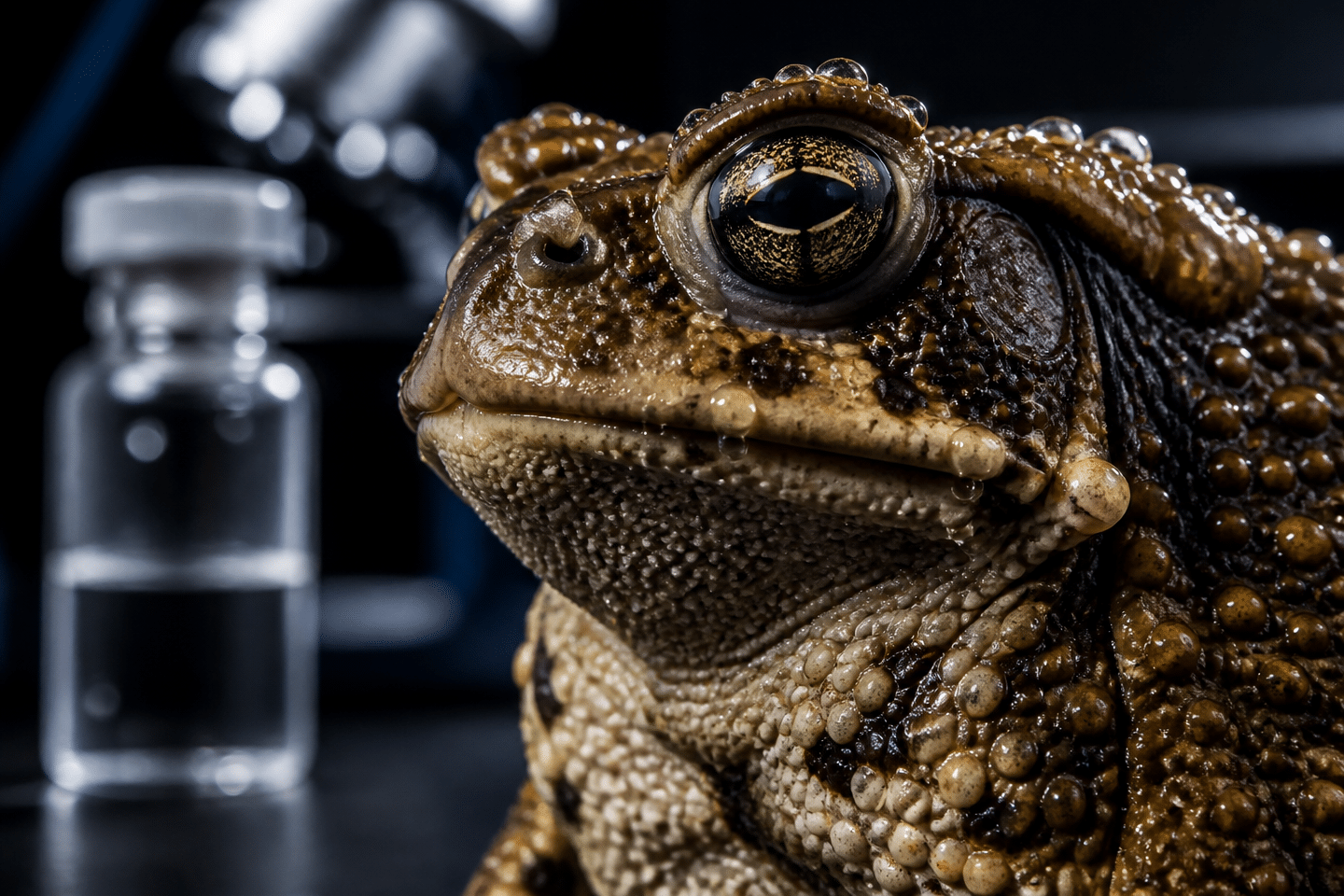
A derivative of a toad’s venom is being tested today as a treatment for depression. An international team has just published the results of a clinical trial conducted on 193 adults with treatment-resistant depression. The findings are encouraging, though not spectacular.
- A clinical trial involving 193 adults tested mebufotenin, derived from the Colorado toad venom, as a nasal spray against treatment-resistant depression, with monitoring reduced to two hours compared with four to twelve for other psychedelics.
- With the highest dose, about one in three participants showed clear improvement one week after administration, an effect maintained for most up to eight weeks, while the placebo group showed very few changes.
- Unlike the risky practice of licking these toads, the molecule is not orally active and nasal administration at precise doses, under medical supervision, remains the only safe method tested.
- A toad venom faster than traditional therapy for depression
- Two hours at the hospital against twelve: the promise of an express psychedelic
- Licking a toad does not replace a supervised clinical trial
A toad venom faster than traditional therapy for depression
For several years, research has focused on psychedelic drugs such as psilocybin or ketamine to treat depression. The results have been encouraging, but these substances pose a major practical problem: they plunge patients into an altered state of consciousness that can last for many hours.
Under such conditions, it is impossible to let someone catch the bus or drive their car immediately after treatment. Patients must be monitored for the duration of the effects, which entails substantial logistical costs and greatly hinders large-scale use of these therapies.
This is where an unlikely player enters the scene: the Colorado toad, scientifically known as Incilius alvarius. This animal secretes, via its venom glands, a molecule called mebufotenin. Its primary role would be to deter predators, not to intoxicate anyone, but its psychoactive effects have turned out to be markedly shorter than those of other psychedelics studied to date.
Two hours at the hospital against twelve: the promise of an express psychedelic
To assess this potential, researchers split 193 adults into two groups. The first received, intranasally, a single dose of 8 or 12 milligrams of mebufotenin benzoate. The second group received a low-dose placebo of the same preparation. All participants benefited from support by qualified professionals and were not allowed to take other antidepressants during the study.
The first clear advantage is evident: the short duration of the psychedelic experience allowed most patients to be deemed ready for discharge after just two hours. By comparison, the psychedelics most studied typically require four to twelve hours of monitoring before discharge.
In terms of efficacy, the figures are modest but real. About a quarter of the participants who received the highest dose reported a noticeable improvement the day after dosing. One week later, this figure rose to nearly one-third, and the effect persisted for most participants up to the end of the study, eight weeks after administration. In the placebo group, very few people reported a notable change.
These results remain below what some ketamine studies have shown for the same condition. It remains to be seen whether higher doses, or repeated dosing, could strengthen the effect without increasing side effects. Notably, the same team had previously achieved more pronounced benefits with repeated administration of another formulation in a trial involving 81 participants.
In an accompanying editorial, Dr. Chittaranjan Andrade of the Indian National Institute of Mental Health and Neurosciences highlights another major advantage: the rapid onset. Conventional antidepressants typically take four to eight weeks to produce a perceptible effect. He questions the relevance of reserving such express treatments solely for treatment-resistant depression if efficacy is confirmed more broadly.
Licking a toad does not replace a supervised clinical trial
The results show an interesting effect, but this is by no means a reason to go licking toads. Yet, the psychedelic properties of mebufotenin have indeed sparked a toad-licking craze among some thrill-seekers, apparently unshaken by the idea.
The problem is that mebufotenin is not truly orally active. To experience its effects orally, one would need to ingest a large amount, with all that implies: toad venom contains other molecules capable of causing vomiting, or even more serious complications.
Several deaths have been attributed to improper use of toad venom preparations. In the clinical trial, mebufotenin was administered nasally, at precise doses, under medical supervision, and the side effects, though frequent, remained manageable. This is not the same as attempting to bite a batrachian in your garden.
The study is freely accessible in the Journal of the American Medical Association, accompanied by its editorial. This offers a glimmer of hope for a rapid treatment option for the most resistant forms of depression, provided the work remains in laboratories, far from ponds and the neighborhood’s toads.
