
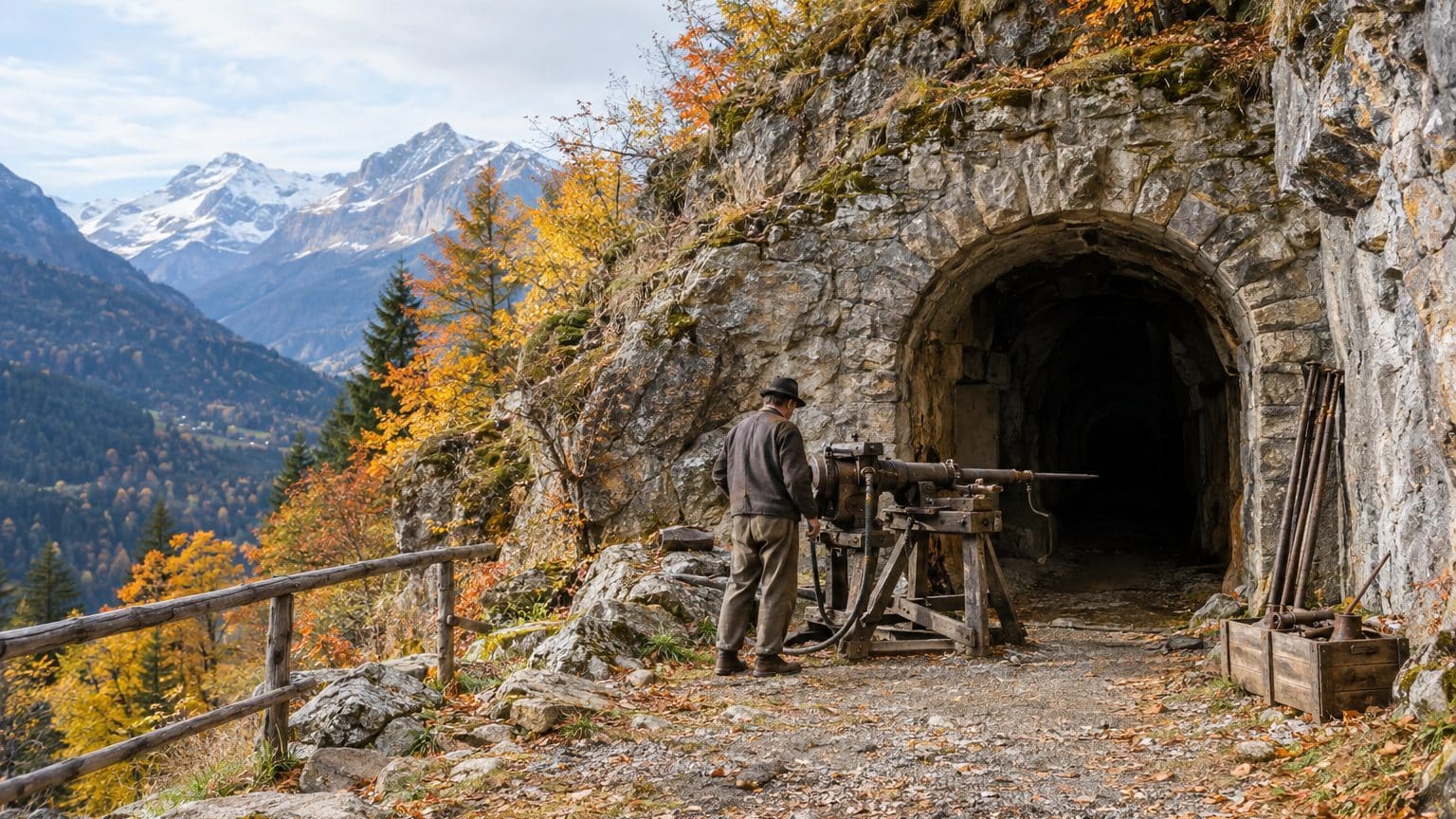
The Fréjus Tunnel, also known as the Mont-Cenis Tunnel, was driven at two markedly different speeds. By hand, the miners advanced about 0.6 meters per day. By 1870, on the Bardonecchia side, the pace reached 2.44 meters per day with compressed-air drills, up to four times faster. This leap is associated with the name of Savoy engineer Germain Sommeiller, who, however, did not work alone.
Four times as fast, but not from day one.
- In the beginning, the miners advanced about 0.6 m per day by hand.
- In 1870, the compressed-air drills reached 2.44 m per day at Bardonecchia.
- In the early years, the machine was slower than the arms due to breakdowns and inexperience.
- The two galleries met on December 25, 1870, after 12,233 m of rock had been bored.
0.63 m per day: The pace of the drill
Work began in 1857 between Modane, in Savoy, and Bardonecchia, in Italy. The first tunnel heading was completed on the Modane side by the end of August 1857, followed by the Bardonecchia side on November 14 of the same year. The drill holes were then bored by hand, yielding an advance of about 0.6 m per day. The record as of January 1861 was harsh: in three years and four months, only 725 m had been dug on the Bardonecchia side, i.e., 0.63 m per day.
The math is dizzying. To bore 12,233.55 m at this rate, a single front would have required more than 53 years, and even with two fronts advancing at the same time it would have taken even longer (these are order-of-magnitude figures drawn from the 0.63 m per day rate, not contemporaneous estimates).
On January 12, 1861, a machine starts at Bardonecchia.
January 1861: Compressed air enters the gallery
The first Sommeiller perforator, powered by compressed air, replaces the strength of the arms at Bardonecchia. On the Modane side, the machine would arrive only on January 25, 1863. The invention was not the work of a single man: Sommeiller developed it with two other engineers, Grandis and Grattoni, and other inventors were working on the same topic, including Bartlett and Colladon.
The beginnings were disappointing. In 1861, progress fell to 0.47 m per day, thus slower than manual work, due to breakdowns and the inexperience of the workers.
A new machine in a mountain gallery is, at first, a learning process. Teams had to be trained, repaired, adjusted, and restarted, and the curve only rose with the years.
2.44 m per day: the curve takes off
The pace eventually rose clearly. On the Bardonecchia side, it reached 2.27 m per day in 1869, then 2.44 m per day in 1870, which amounts to 889 m dug in that year. On the Modane side, where the machine arrived later, progress was 2.05 m per day in 1870. In relation to the 0.63 m per day by hand, these figures yield a ratio of about 3.3 to nearly 3.9 depending on the front.
The phrase “four times faster” is therefore a ceiling reached at the end of the project, not an average over the entire duration. The year 1861 even shows the opposite, with a machine slower than hands.
December 25, 1870: the last wall yields
On December 25, 1870 at 4:25 p.m., the probe passes through the final rock wall.
This wall measures about 4 meters in thickness and it is destroyed with explosives during the night of December 25–26. In total, 7,080 m had been dug from Bardonecchia and 5,153 m from Modane. The two galleries thus meet after 12,233 m of rock, to which are added the final decimeters.
The length of the work depends on what is measured. Between its two entrances, the tunnel is 12,233.55 m long, i.e., about 12.2 km drilled. With the access connections, trains cover 12,847 m, and after the 1881 modification, roughly 13.6 km.
Germain Sommeiller, born February 15, 1815, in Saint-Jeoire-en-Faucigny, Haute-Savoie, died July 11, 1871. He would not see his tunnel in operation, since the opening occurred more than two months later.
On September 17, 1871, a first train of 400 people crossed the tunnel in 22 minutes, from Bardonecchia to Fourneaux. At the manual rate of 0.63 m per day, 22 minutes of drilling would correspond to about 1 cm of rock.
👉 A small gesture for Space Group? Follow us on Google, add us to your favorites, and find us on Google News so you don’t miss any discoveries.
Sources: structurae.net | tracesdefrance.fr
