
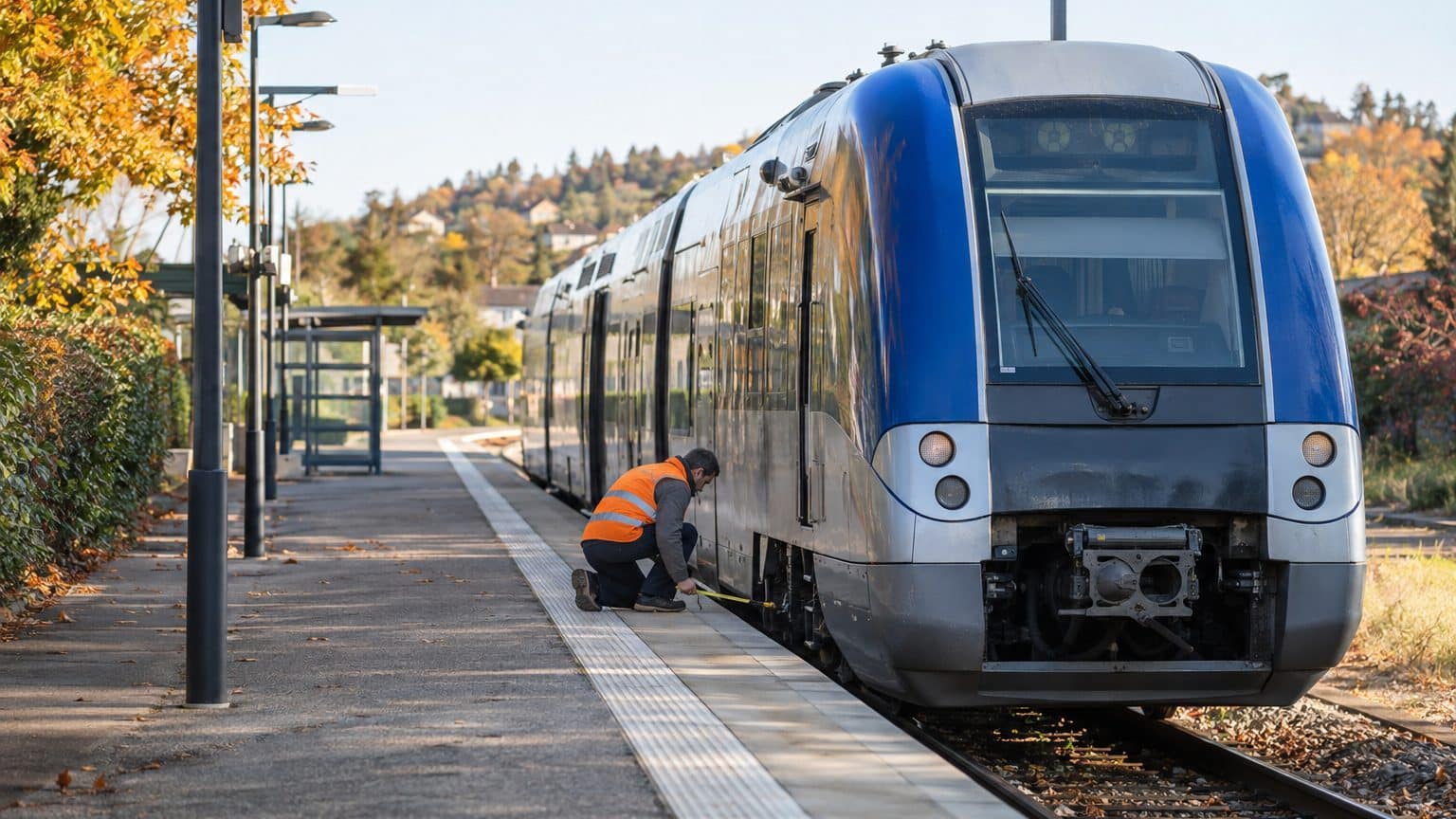
Of the 8,700 platforms on the French rail network, 1,300 were to be shaved down by a few centimeters to accommodate new trains. That amounts to nearly one platform in seven, according to a ministerial response to a written question posed in the National Assembly. The trains in question are regional trainsets ordered by SNCF in 2009 and 2010, wider than the ones they replace.
A few centimeters per platform, 50 million euros announced in total.
- 1,300 platforms out of 8,700 must be shaved to accommodate the new trains.
- SNCF ordered 341 regional trainsets in 2009 and 2010, for about 3 billion euros.
- The announced works cost at least 50 million euros, and only one delay affected the service entry.
341 Trains Ordered, One Width Too Wide
The SNCF placed its orders in 2009 and 2010. It selected 182 Regiolis sets, built by Alstom, and 159 Regio 2N sets, designed by Bombardier: 341 firm trains, for around 3 billion euros. When broken down per unit, the calculation comes to just under 9 million euros per train on average. The framework contracts extended even further, up to 2,000 trains according to the press, illustrating the scale of the industrial challenge.
These trainsets share a common feature: they are wider than their predecessors, a choice that SNCF and RFF present as a response to public expectations. On certain older platforms, this extra width left the edge too close to the tracks.
The key term is the loading gauge, the envelope swept by a train as it travels. Everything inside it, including the platform edge, must be cleared, and this is what is at stake here by only a few centimeters. The 341 firm orders represent about 17% of the 2,000 trains that the framework contracts could cover, according to the press.
May 2014: the Revelation, then the Admission
On May 20–21, 2014, a press revelation brought the matter into the public eye: the new trainsets would be too wide for some of the old platforms, too close to the tracks. SNCF and RFF confirmed that 1,300 platforms on the 8,700-network needed modernization.
The two entities acknowledged a coordination defect.
Four years separate the 2009 and 2010 orders from this revelation. In the meantime, work had begun in 2013, indicating the problem had been identified before it became public knowledge.
The figure of 1,300 comes from the official source, the government’s response. The Association of French Regions meanwhile proposed 1,200 platforms too close to the tracks, i.e., 100 fewer. This gap accounts for just over 1% of the network. In both cases, more than a thousand platforms needed to be revised.
On the cost side, RFF and SNCF announced 50 million euros. Media reports had cited 80 million, which would yield, according to the version used, between 38,000 and 62,000 euros per platform.
Shaving a platform means cutting off a few centimeters from the side facing the track. On the scale of a single platform, the operation seems modest. Multiplied by 1,300, it becomes a nationwide program of works spread over several years.
Two Readings of the Same Flaw
SNCF and RFF dispute the notion of trains that exceed standard widths. According to them, the trainsets comply with the international loading gauge. It is the old platforms that are too close to the tracks. The works, in their view, amount to adapting the network to a new generation of equipment.
The critical reading emphasizes the decision chain: trains were ordered before the platform question was resolved. Both statements can be correct at the same time, and this is what a coordination failure between RFF for the lines and SNCF for the trains—two separate entities—captures.
My view: the expense is not the most striking aspect. Relative to the 3 billion euros of orders, the 50 million figure weighs about 1.7%, and the 80 million cited by the press around 2.7%. What is more troubling is the sequence of operations: trains were ordered before the platform question was decided.
A Project from 2013 to 2016, Only One Delay
In May 2014, 300 platforms had been treated, about 23% of the 1,300 to be revised. The program planned to complete everything by 2016, leaving roughly 1,000 platforms to address in just over two years.
The trains were to enter service progressively through to the end of 2016, in step with deliveries. Each rollout required platforms compatible with the line concerned. The construction schedule thus likely followed the delivery schedule, a sequence that leaves little room for delay when a constraint emerges late.
The commissioning of the trains was delayed only on the Tarbes–Montréjeau line.
In Midi-Pyrénées, some platforms affected by the shaving had been rebuilt two years earlier. This detail fuels the charge of a lack of coordination between projects, though it is not clear how many platforms fall into this case. For those, the cost would have accumulated: a first renovation, then a second intervention two years later.
No final post-2016 assessment could be found: it is therefore better to speak of at least 50 million euros announced. Written question No. 56772, available on the National Assembly site, remains the official document setting the figure at 1,300 platforms out of 8,700.
👉 A small gesture for Space Group? Follow us on Google, add us to your bookmarks, and find us on Google News so you don’t miss any discoveries.
Sources: france3-regions.franceinfo.fr | rtbf.be | lagazettedescommunes.com
