
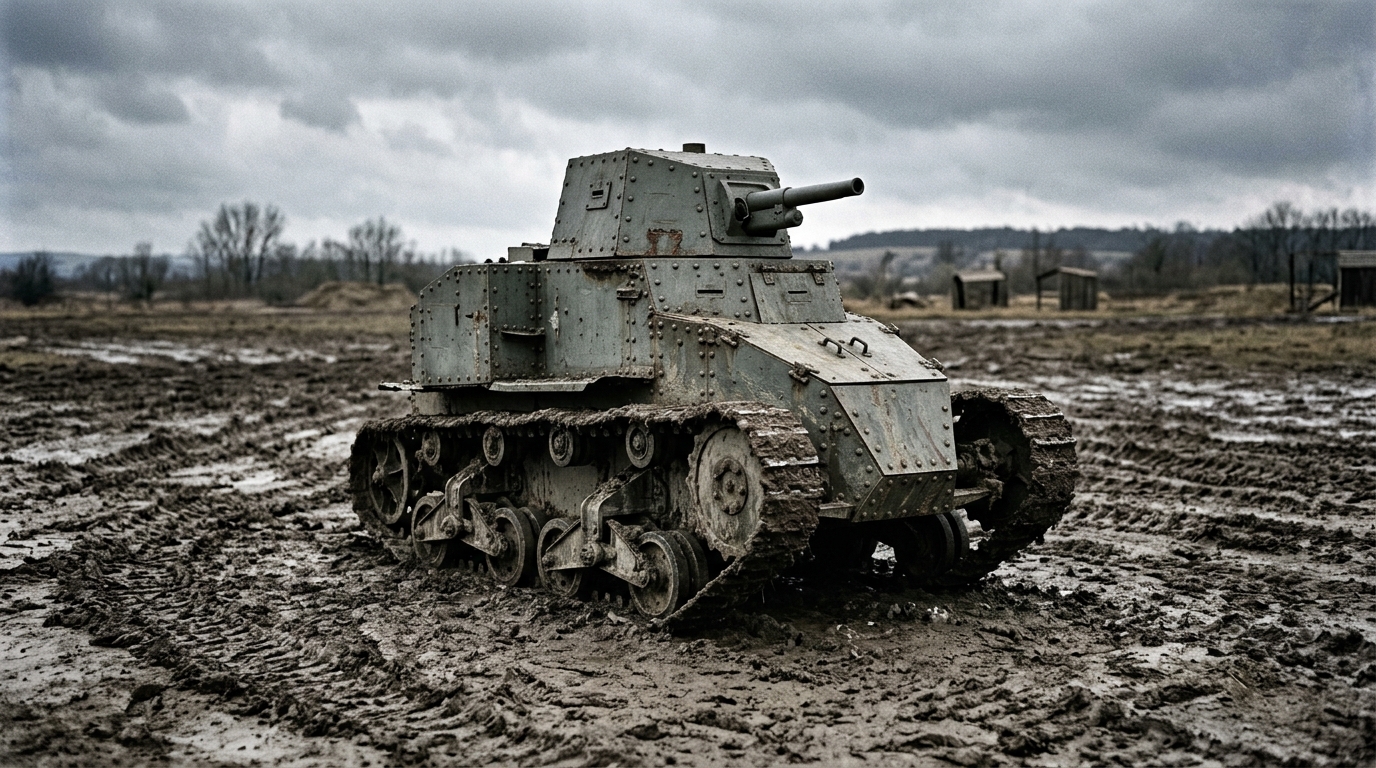
A tank intended to equip the French colonies, drawn by one of the leading figures in the automotive industry, and which ends its existence… solitary, unique, having never fired a shot in action. This is the kind of paradox that gives full flavor to the military history of the interwar period. For behind the sober facade of 1930s French tanks lie sometimes projects left by the wayside, industrial ambitions that collided with budgetary and technical barriers. The Char D3, derived from the D1 by Renault, is nearly the perfect illustration. An armored vehicle conceived to traverse the terrains of overseas territories, but which never progressed beyond the single prototype stage. A look back at this curiosity of French armored history.
- The D3 tank, derived from the D1 for the colonial army, was produced in only a single example after trials judged disappointing in 1932.
- Unlike its cousin the D2, accepted for production in 1933, the D3 was abandoned due to armor that was too light, excessive weight, and insufficient speed.
- The D3 chassis found a second life in 1935 by being converted into a self-propelled gun under the designation ACL 75 G-R.
- Renault had promised a colonial fleet, it delivered only a single chassis
- The D2 succeeds where the D3 fails
- A unique prototype, no battles, an almost empty file
- The D3 does not die, it becomes a self-propelled gun
Renault promised a colonial fleet, but delivered only a single chassis
Everything begins with a mission entrusted to Renault in the early 1930s: to derive the Char D1, then in service, into a version adapted for the French colonial army. The program was officially launched in May 1930, when the manufacturer received the order to develop two derivative versions of the D1, the Char D2 and the Char D3. The idea of a colonial tank is not new: it fits within an army program dating back to 1926, which already aimed at designing an armored vehicle specifically conceived for theaters of external operations. The ambition was clear: prioritize speed and a large autonomy, even if it meant sacrificing the thickness of the armor.
But between the publication of the specifications and the signing of the contract for experimental prototypes, there would be a wait until December 1931, i.e., more than a year and a half of delay. A context that can be partly explained by the financial crisis beginning in 1929, which greatly reduced the French army’s budget from 1930 onward. The prototype, bearing the factory code Renault VA, finally entered trials in late April 1932, at the same time as another experimental vehicle, the Renault UZ, delivered without a turret. A third model, even lighter, the Renault VO, would never leave the drawing board. The final result of this industrial venture: only one Char D3 was built, whereas the Char D1 from which it derived had, in contrast, been produced in 160 units between 1931 and 1935.
The D2 succeeds where the D3 fails
Renault was actually working on two parallel projects derived from the same D1 chassis. The first, the Char D2, aimed to modernize the armored vehicle for metropolitan forces. Its fate was quite different from that of its colonial cousin, since it was approved for production on 12 December 1933. Production was limited, certainly, but real, unlike the fate that awaited the D3.
The Char D3, for its part, was supposed to address very specific constraints that the D1 did not cover—the colonial terrains requiring autonomy and mobility. But during the trials, the vehicle proved to be a genuine technical failure: armor judged too weak, weight excessive, speed insufficient against the criteria set. The project was then abandoned by the army, which would later turn to other concepts—lighter armored vehicles or automitrack-equipped vehicles—to equip its colonies. This divergence of destinies between two vehicles born from the same base perfectly illustrates the industrial and military trade-offs of an era when not all tank projects enjoyed the same support.
A unique prototype, no battles, an almost empty file
The Char D3 never saw combat. No military campaign, no deployment, no trace of operational use in the available archives. Its service history simply remains blank, with no conflict associated with it.
The precise technical characteristics of the vehicle, its exact armor, its propulsion, the onboard armament, remain still rather blurry today. The sources available on this vehicle remain fragmentary, limited to a few contextual elements gleaned here and there. This lack of documentation is not incidental; it testifies to the marginal status this project held in the history of French interwar tanks, somewhat like footnotes in a history book that one ends up forgetting.
The D3 does not die, it becomes a self-propelled gun
The story could have ended there, with a single prototype relegated to the status of industrial curiosity. But the chassis of the Char D3 did not end up in scrap. It was converted into an artillery vehicle, under the designation Automoteur Garnier-Renault, ACL 75 G-R, tested in 1935. A second life that radically changed its initial function.
From a failed colonial tank project, the chassis becomes a firing platform, far from the original ambition that presided over its design. A nearly symbolic reconversion, which reminds us that in military industry nothing is truly wasted; everything transforms, even the most evident failures.
Between a failed colonial project and a conversion into artillery hardware, the Char D3 encapsulates the hesitations and industrial dead ends of France’s 1930s military. A promised fleet, a single chassis delivered, and ultimately a life entirely condensed into a handful of trials and an unexpected reconversion. The story of the Char D3 reminds us that not all prototypes become legends; some remain merely the discreet witnesses of a time when the French army was still searching, sometimes stumbling, for the armored vehicles that would shape its future.
