
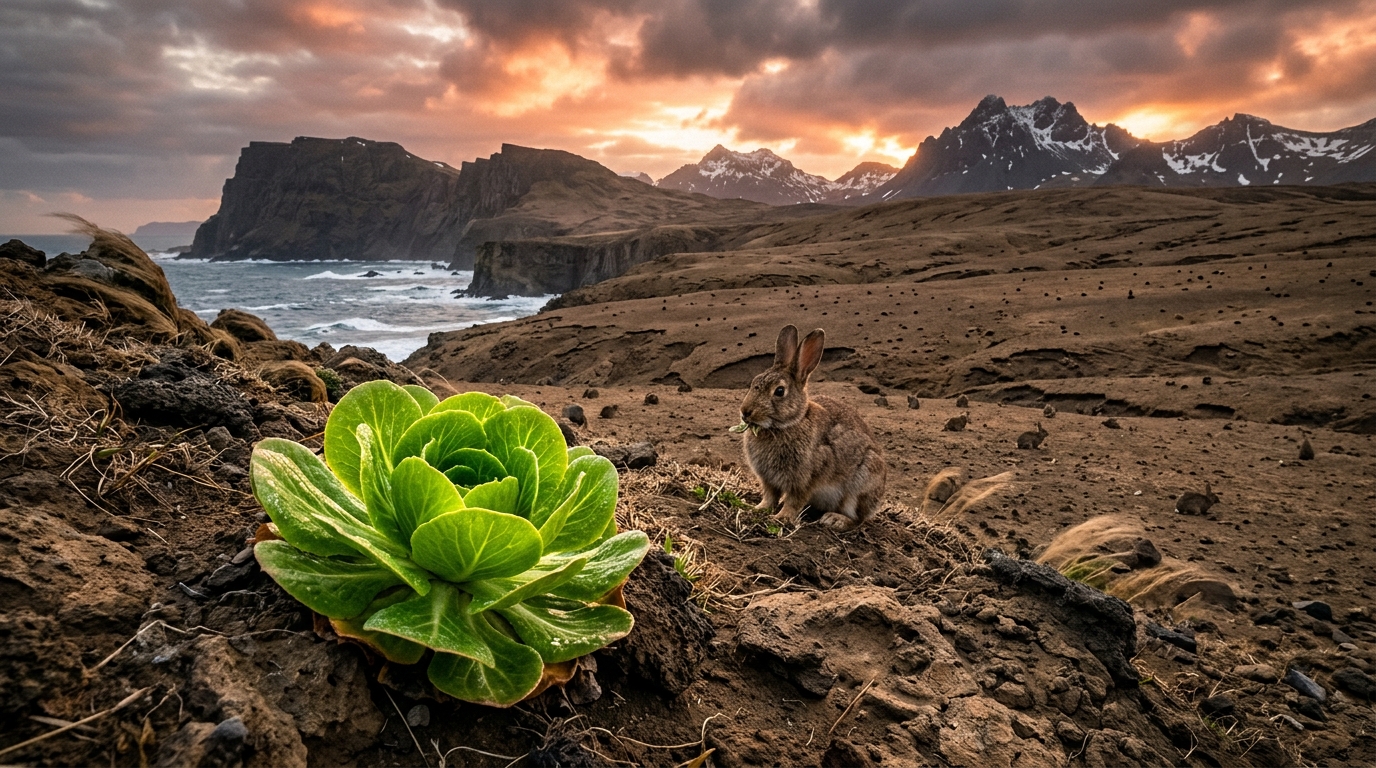
Imagine a 19th-century shipwreck survivor stranded on the wind-swept shores of the Kerguelen archipelago. Exhausted, with gums swollen by scurvy, he knows that a lean, bitter plant grows somewhere on these hostile lands and that it could save his life. Today, that same castaway would search in vain: the plant has nearly disappeared, replaced by uniform moors where thousands of rabbits teem. This paradox is not fiction; it is the consequence of a decision made in 1874 by British sailors who, with the best of intentions, sought to stock a pantry for future wrecks. Unknowingly, they signed the death sentence of the only plant capable of saving them from scurvy.
- In 1874, British sailors introduced rabbits to the Kerguelen to feed potential shipwreck survivors, in a place with no predators to curb their spread.
- These rabbits devoured the Kerguelen cabbage, a plant rich in vitamin C that protected castaways from scurvy, driving it nearly to extinction.
- This proliferation also promoted soil erosion and disrupted the local ecosystem, prompting scientists to carry out eradication operations, such as on Île Verte.
- A Poisoned Gift for Tomorrow’s Castaways
- The Cabbage That Saved Lives, Devoured in Silence
- Living Brambles Against Ravenous Teeth
- What the Kerguelen Tell Us About Our Ecological Mistakes
A Poisoned Gift for Tomorrow’s Castaways
At the end of the nineteenth century, navigators skimming the southern seas knew that these icy waters and desolate shores could become a deadly trap if a ship were to wreck. As a precaution, the idea arose to introduce animals capable of rapid reproduction to provide a readily accessible food source for stranded sailors. The rabbit, prolific and easy to hunt, seemed the perfect solution. No one at the time imagined that this act of foresight would unleash a chain reaction devastating for an island ecosystem that had remained isolated for millions of years and was utterly undefended against such a voracious herbivore.
Without natural predators and in an environment where vegetation had never had to defend itself against grazing, rabbits multiplied at a staggering rate. In just a few decades they colonized most of the archipelago, permanently altering the face of these subantarctic lands.
The Cabbage That Saved Lives, Devoured in Silence
The Pringlea antiscorbutica, better known as the Kerguelen cabbage, had already been catalogued in 1776 by surgeon William Anderson during James Cook’s expedition. This endemic plant of the subantarctic islands of the Indian Ocean, also found on Heard, Crozet, or Marion, contains vitamin C levels comparable to Brussels sprouts or parsley. Despite its pronounced bitterness, it likely saved many sailors from the scurvy, that dreaded disease that decimated crews on long voyages.
But this crucifer with an extremely slow growth rate had never coevolved with a terrestrial herbivore. It possessed no mechanism to defend against intensive grazing by rabbits. The consequence was swift: where rabbits proliferated, the Kerguelen cabbage nearly vanished. Dense, healthy populations survive only on satellite islets such as Mayes or Howe, which were spared rabbits, or on cliffs so sheer that they remain inaccessible to even the nimblest animals.
Living Brambles Against Ravenous Teeth
The gradual disappearance of the Kerguelen cabbage was only the visible part of a much larger upheaval. Azorelle, another emblematic plant of the archipelago, suffered the same fate, dramatically reducing the local plant diversity. This ecological vacuum opened the door to Acaena magellanica, a rose family plant with a formidable capacity to colonize, which now covers vast tracts in monoculture moorland—a landscape far poorer than the original mosaic of vegetation.
By destroying the vegetative cover, rabbits left soils exposed, promoting massive erosion under the influence of fierce winds and unrelenting rains that characterize the region. The consequences echoed through the animal world: breeding sites for some petrels degraded, while the cat population, descended from two individuals released in 1956, managed to thrive by feeding in part on these rabbits, which had become easy prey. It was a domino effect in ecology, where each weakened link pulled the next one down.
What the Kerguelen Tell Us About Our Ecological Mistakes
In response to this realization, ecological restoration efforts began to take shape, notably on Île Verte in the archipelago, where eradicating the rabbits allowed the early signs of plant regrowth to be observed. These carefully planned and costly operations illustrate how much easier it is to introduce a species than to repair the damage it causes decades later.
The Kerguelen cabbage, once gathered without restraint for its anti-scorbutic virtues, is today a protected species whose consumption is strictly forbidden. This reversal—from a vital resource to a threatened plant requiring legal protection—encapsulates the archipelago’s story. Even now, as scientists continue restoration efforts in these isolated southern lands, the example of the Kerguelen continues to provoke reflection on the sometimes unforeseen consequences of human interventions in fragile ecosystems.
From this history rises a question that extends far beyond these remote islands: how many other decisions, made today with the best of intentions, will yield similarly cruel surprises for future generations?
