
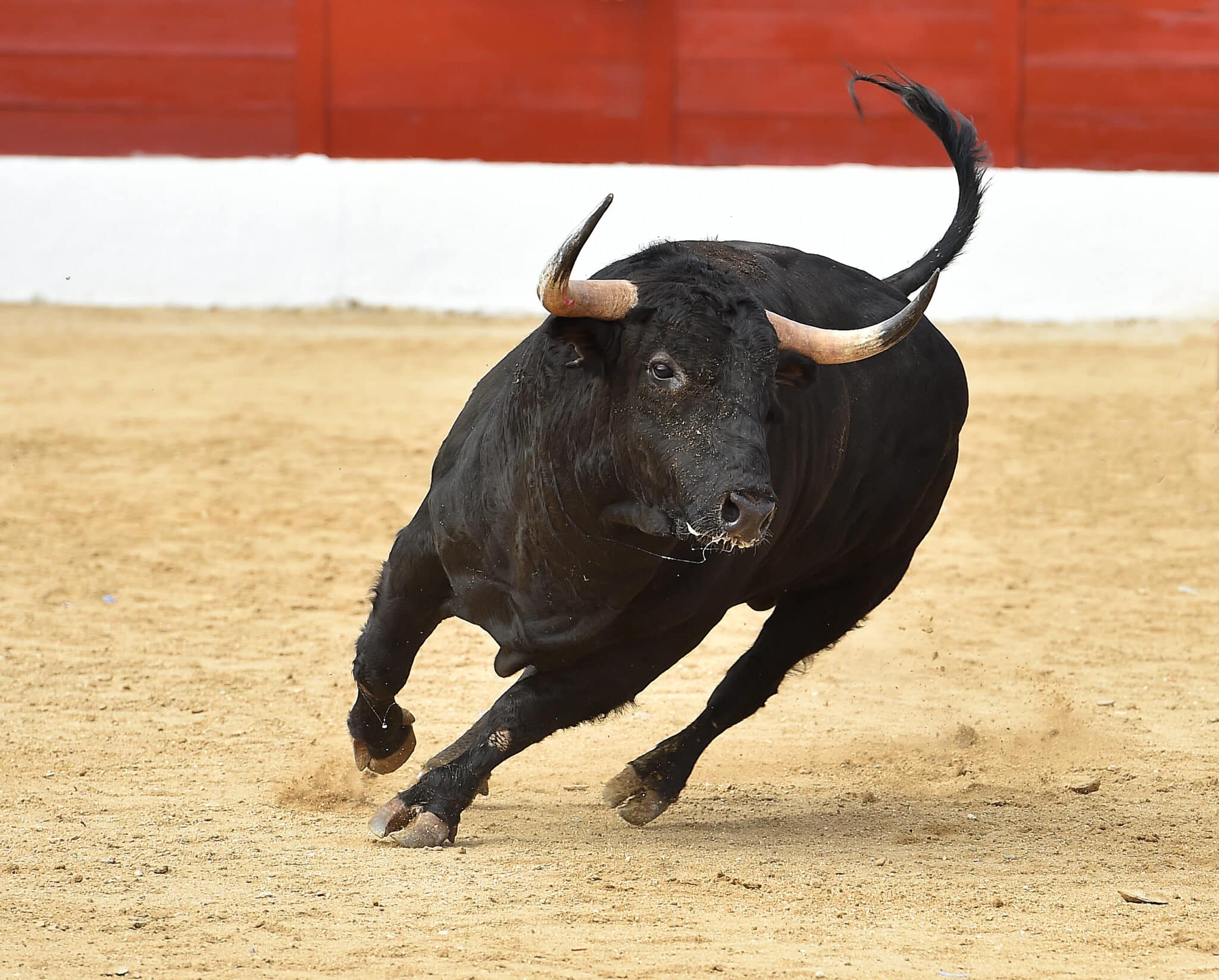
For centuries, the image of the enraged bull charging a red cape has been etched into our imagination, particularly through bullfighting. But is that scarlet color really what triggers its fury? Modern science reveals that what we thought we knew about bovine vision is, in fact, completely different.
Color vision in bulls
Contrary to what many imagine, bulls — like most cattle — do not see colors the same way humans do. They are dichromats, meaning they have only two types of cone cells in their eyes, whereas humans have three. Cones are responsible for color perception.
This arrangement makes bulls sensitive to blues and greens, but nearly unable to distinguish red and orange from green or gray. In other words, what we perceive as a bright red cape looks to a bull like a dull, grayish object.
The movement of the cape, not its color, is actually the trigger that captures the bull’s attention and provokes a response. Studies on bovine vision confirm that these animals react mainly to contrast and motion, not to the red hue.
The role of human illusion
The tradition of the red cape arises more from aesthetic and symbolic choices than from a behavioral necessity. In bullfighting arenas, red serves to heighten the drama for spectators because it draws the human eye and evokes danger or aggression.
For the bull, red holds no special meaning. Modern experiments in animal behavior show that even capes of different colors trigger similar charges, as long as movement is present. This highlights the difference between human and animal perception, and shows how easy it is to project our own interpretations onto animal behavior.
Why this confusion persists
The idea that red excites the bull is a cultural myth, amplified by art, literature, and cinema. Human spectators associate red with anger and danger, which makes the story coherent for us but entirely wrong from the animal’s point of view.
Understanding how bulls see is also important for farming and animal welfare. For example, professionals today know that sudden movements or strong light contrasts stress cattle more than the color of objects in their surroundings, which can guide gentler and safer handling of animals.
