
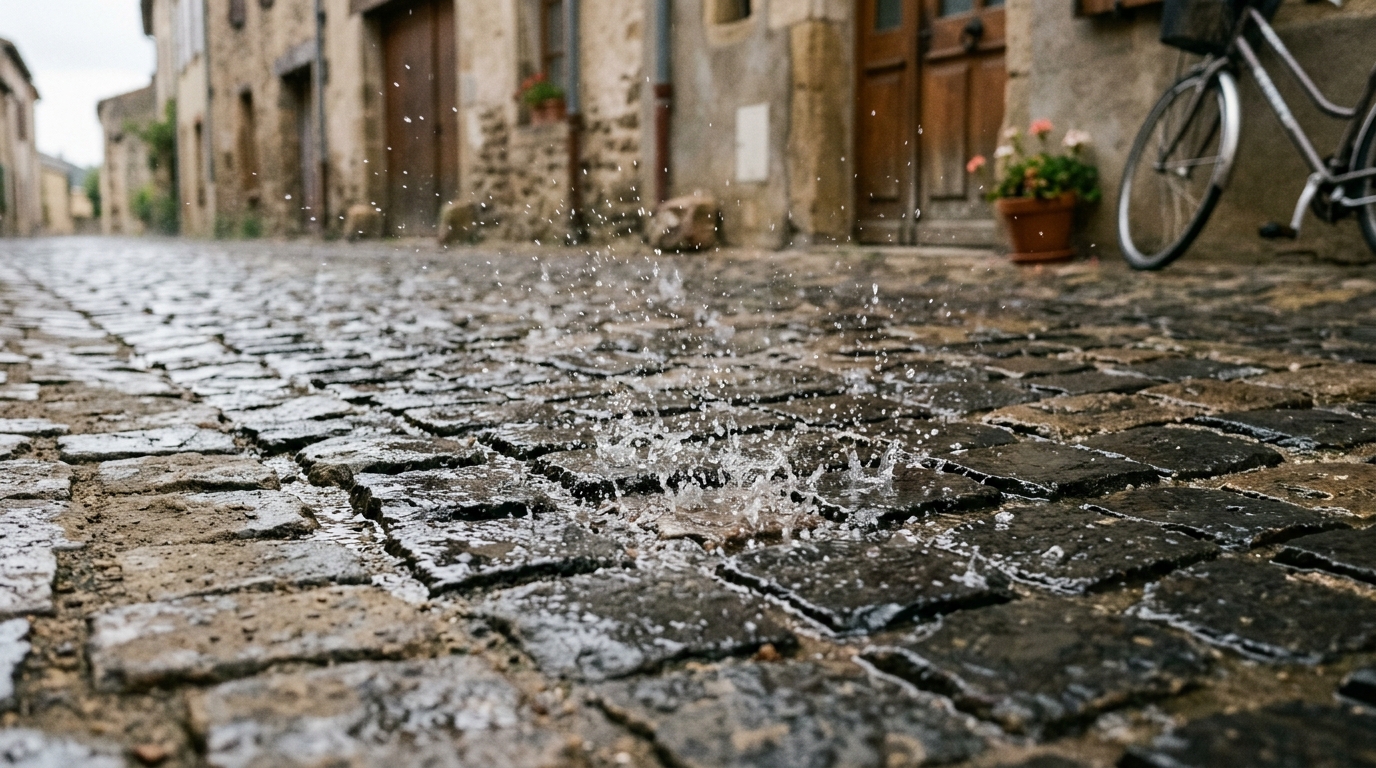
As the first drops meet a porous surface after a spell of dryness, that distinctive scent fills the air. This phenomenon, studied since the 1960s, frequently resurfaces whenever rain moistens soil that has remained parched. It has a name, a scientific history, and above all a precise mechanism that has been captured frame by frame on film.
- Petrichor, coined in 1964, designates the earthy scent released when rain touches soil that has remained dry for several days.
- The impact of droplets on a porous surface forms air bubbles at the contact point which rise to the surface and burst, releasing aerosols that carry this odor, notably geosmin.
- According to about 600 MIT experiments, light to moderate rains produce more aerosols than heavy downpours, and urbanization could eventually reduce the phenomenon.
- Humidity, that subtle signal that already heralds the scent to come
- When the drop hits the ground, everything unfolds in a fraction of a second
- Champagne in a puddle: what 600 MIT experiments reveal
Humidity, that subtle signal that already heralds the scent to come
Even before the rain falls, something is already washing through the air. An increasing humidity often precedes the arrival of showers, and it can foster the release of certain soil odors. It is a discreet signal, nearly imperceptible, yet very real: the nose sometimes detects weather changes before the first drops. This phenomenon has a scientific name, petrichor, a term coined in 1964 by two Australian scientists, Isabel Bear, a chemist, and Richard Thomas, a mineralogist. Its Greek etymology is evocative: petros means stone, and ichor denotes the blood of the gods. Literally, petrichor is thus a stone’s blood, a poetic image to describe this earthy and slightly woody scent that follows rain. Petrichor appears mainly after a drought, when the soil has remained dry for several days before finally receiving water. It’s also worth noting that this smell is not universally loved: some perceive a moldy note, while others associate it with pleasant memories, those of hot weather suddenly cooled by rain.
When the drop hits the ground, everything unfolds in a fraction of a second
It is truly at the moment of impact that the outcome is decided. When a raindrop lands on a porous surface, the air trapped in the tiny pores forms small bubbles at the contact point. These bubbles then rise to the surface and burst, releasing a cloud of aerosols invisible to the naked eye. It is these particles that carry with them the scent of petrichor, but not only: they can also transport bacteria and viruses present in the soil. One surprising detail to note: it is not heavy downpours that produce the most scent. Drops that fall at a slower pace tend to emit more aerosols, because these are less washed away than during a strong shower. This is why petrichor is most noticeable after light to moderate rains. Once released, these particles do not stay still: the wind can carry them some distance, which explains why the smell of rain can become perceptible even before the drops reach us.
Champagne in a puddle: what 600 MIT experiments reveal
This mechanism has eventually been dissected thanks to ultra-fast cameras. The principle closely resembles what happens in a glass of champagne: tiny bubbles form, grow, rise, and then burst at the surface. To understand the phenomenon in detail, around 600 experiments were conducted by MIT researchers on 28 different surface types, ranging from engineering materials to varied soil samples. Drop impact speeds were altered to simulate different rainfall intensities, while the permeability of each surface was measured with precision. The result: the amount of aerosol released depends on both the drop speed and the soil’s water-absorption capacity. Among the compounds identified in this bouquet of odors, geosmin plays a central role: it is one of the main drivers of this unmistakable earthy scent. A point worth noting for the future: this rain scent largely comes from bacteria and fungi present in the soil, and their presence tends to diminish as cities expand. Growing urbanization could therefore, in time, affect this phenomenon. For now, rest assured, the smell remains clearly perceptible even in urban environments.
What had seemed merely an olfactory sensation thus hides a genuine physical ballet, invisible to the naked eye but very real beneath a light rain. The next time this familiar scent grips you after a shower, you’ll know it comes from thousands of tiny bubbles bursting at the soil’s surface. A playful question to ponder remains: will this distinctive fragrance continue to endure as our cities keep expanding?
