
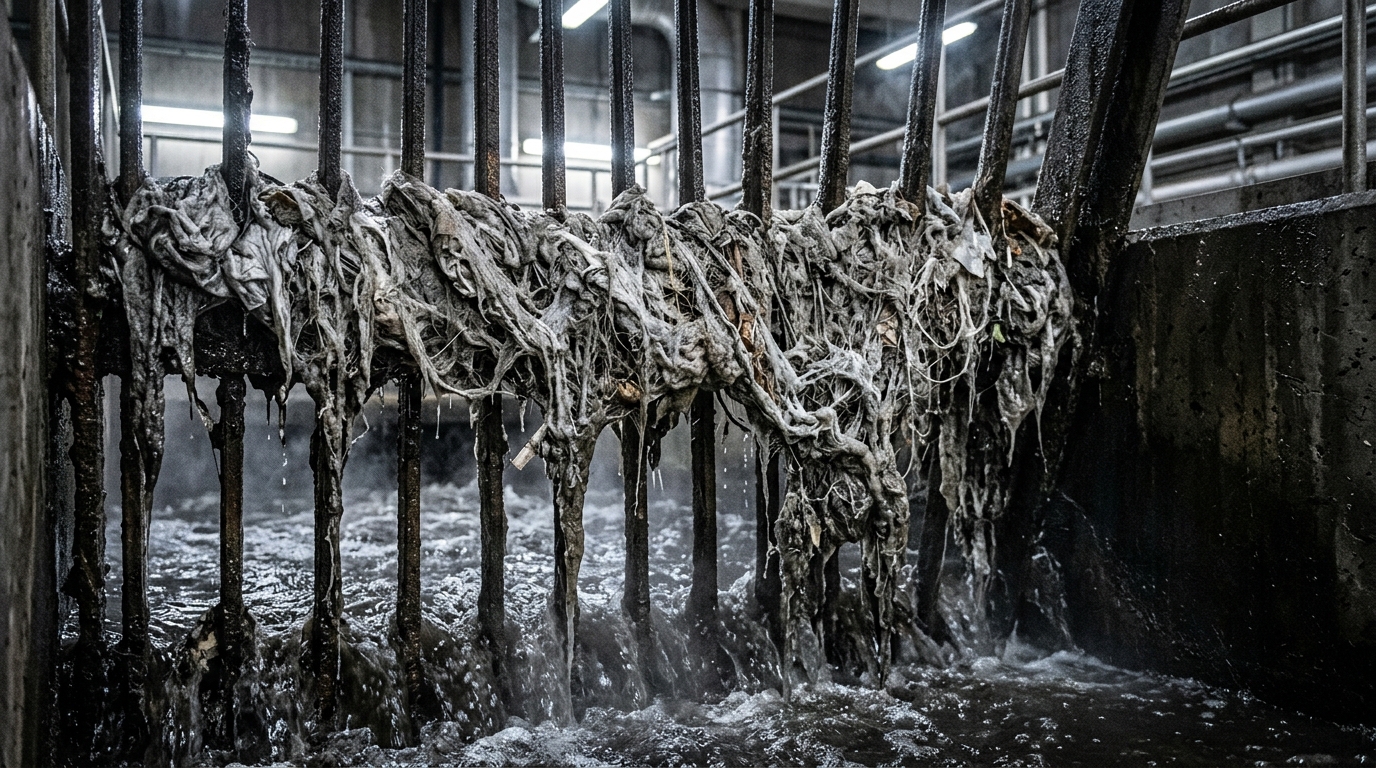
And what if a simple everyday reflex were enough to bring one of Île-de-France’s largest infrastructures to its knees? As the back-to-school season begins and Francilians return to their routines, a quiet phenomenon continues to accumulate beneath their feet—literally—in the pipelines.
- Wipes, even those marketed as “biodegradable,” contain plastic fibers that do not break down and accumulate in the station’s bar screen.
- The Seine Amont plant in Valenton processes wastewater from more than 2.2 million people daily, with a flow rate that can reach 15 m³ per second.
- The recommended solution is simple: always dispose of used wipes in the trash rather than flushing them.
- The small gesture that becomes an industrial nightmare
- Valenton, a giant designed for water, not for fabric
- The hidden bill no one sees on their water bill
- What needs to change before the grills give way for good
Every day, tons of so‑called “biodegradable” wipes end up stuck in the metal bar screens at Valenton, the largest wastewater treatment plant in Île-de-France. The result: an 80% saturation rate, teams working in a constant state of urgency, and a bill that quietly climbs for millions of Francilians.
The small gesture that becomes an industrial nightmare
Flushing a wipe down the toilet seems harmless. It’s a quick, almost automatic act, often driven by the label “flushable” printed on the packaging. Yet that commercial promise does not match any physical reality once the product is in the pipes. Unlike toilet paper, designed to break down when in contact with water, the vast majority of wipes still contain plastic fibers that resist, cling to one another, and form compact clumps.
This small gesture repeated by millions of households in Île-de-France turns, when multiplied, into a constant stream of waste that converges at a single point: the Seine Amont wastewater treatment plant in Valenton, Val-de-Marne. On site, the assessment by Olivier Browne, the plant’s director, is unequivocal: “we have practically 80% of wipes” among the wastes recovered by the bar screen, that large metal comb used to filter water before it enters the heart of the plant. A figure that makes one’s head spin when you know it concerns all solid wastes captured, across all uses.
Valenton, a giant designed for water, not for fabric
Commissioned in 1987, the Seine Amont plant is not a small neighborhood facility. It is the second-largest wastewater treatment plant in Île-de-France, with a nominal capacity of 3,600,000 population equivalents. Each day, it treats the wastewater of more than 2.2 million people spread across Val-de-Marne, the Bièvre valley, parts of Hauts-de-Seine and Seine-Saint-Denis. A volume that can reach 600,000 cubic meters of water per day, and climb to 1,500,000 cubic meters on rainfall days thanks to its clariflocculation unit.
To absorb such volumes, the water enters a 45-meter-deep concrete shaft, with an inflow that can reach 15 cubic meters per second at the plant’s entrance. This infrastructure was designed to handle water, organic matter, and a certain amount of conventional solid waste. It was never sized to absorb a massive influx of synthetic textile fibers. The bar screen, intended to play a secondary filtration role, ends up on the front line, forced to trap and remove the wipes from the flow before they clog pumps and disrupt downstream treatment. A role for which it was never originally designed.
The hidden bill no one sees on their water bill
What few Francilians imagine is the real cost of this everyday gesture. Manually or mechanically removing tons of wipes, maintaining equipment prone to premature wear, continuously monitoring pumps threatened by clogging—this all requires time, equipment, and energy. A workload that is never fully visible to users, but which certainly weighs on the overall functioning of the public wastewater service.
The paradox is even sharper given that the Valenton site has also embarked on an ambitious modernization program. The site houses a thermal drying unit—unique in Europe—capable of reducing the volume of sludge from treatment by 65%, subsequently transformed into granules usable in agriculture. The SIAAP has also inaugurated, in partnership with Veolia, a biomethane production unit from the same sludge, injecting 45 GWh of green gas into the GRDF network each year. In other words, the plant invests in innovation and the circular economy on one hand, while on the other hand, it must devote an ever larger share of its resources to fighting an avoidable waste, discarded on reflex.
What needs to change before the grills give way for good
In response to this situation, several local authorities are stepping up awareness campaigns. This is the case for the Paris – Val de Marne metropolitan area, which also feeds the Valenton plant and emphasizes a straightforward message in its communications: “no wipes in toilets.” A slogan that captures the core issue in one phrase, yet which still struggles to produce lasting changes in habits, as the act of flushing a wipe remains ingrained in the daily life of millions of households.
Some manufacturers have begun offering cotton wipes that are truly biodegradable, but they remain a minority on the market. According to water-sector professionals, the vast majority of products sold still contain synthetic fibers that do not break down in pipes. The simplest and most effective step remains to consistently dispose of used wipes in the trash rather than flushing them. A small change at the individual level, but one that could markedly alleviate infrastructures already pushed to the limit, at Valenton and elsewhere in France.
Behind the 80% figure lies far more than a technical curiosity: it reflects a persistent disconnect between reassuring marketing packaging and a far more stubborn industrial reality. As autumn settles in and daily routines resume, perhaps this is the moment to rethink this seemingly trivial act, before Valenton’s grills, and those of many other French stations, finally give way under the pressure.
