
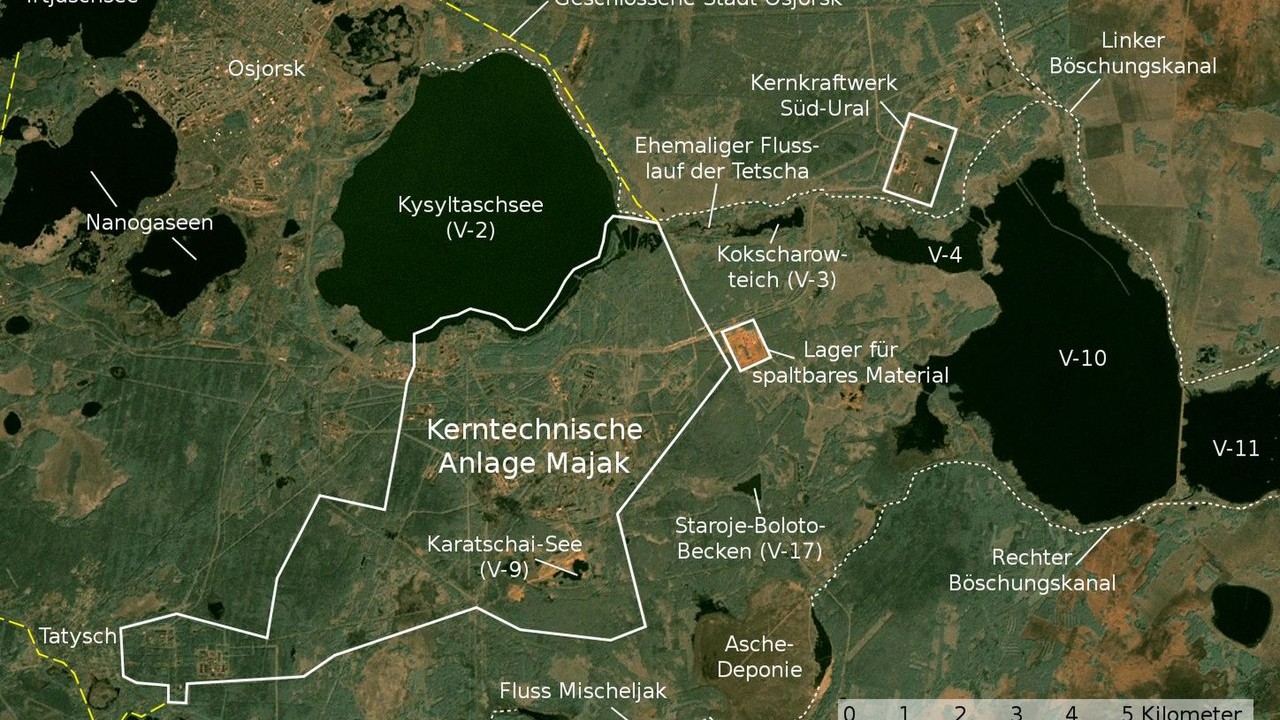
Just over four quadrillion becquerels of radioactivity accumulated in a body of water the size of a few football fields. That is the tally for Lake Karachay, in the southern Urals, which from 1951 onward became the Soviet military nuclear program’s liquid waste dump. Today, it no longer exists as a lake: it lies buried under tons of concrete, rock, and soil, in a project completed in late 2015 after more than forty years of work.
Key takeaways
- A small Urals lake becomes the USSR’s radioactive trash can as early as 1951, gradually accumulating unimaginable levels of contamination
- A meteorological incident in 1968 exposes Soviet authorities to the danger of uncontrollable dispersal over hundreds of kilometers
- The measured radioactivity level sets a macabre record that even Chernobyl did not match, justifying the nickname of the most polluted place on Earth
An Open-Air Nuclear Dump from 1951
The Maïak complex, located near the then-closed town of Ozyorsk (renamed Chelyabinsk-40 under Soviet secrecy), produced the USSR’s military plutonium. From 1951 onward, the Soviet Union used Karachay to store radioactive waste from Maïak, the storage and reprocessing plant situated near the town close to Ozyorsk. The choice of this small lake was no accident: too small to cool the reactors, it became instead the receptacle for the most dangerous effluents, those deemed too “hot” for the site’s underground storage tanks.
The initial plan envisioned temporary use, while awaiting the materials’ return to Maïak’s reinforced concrete tanks. But history took a different course. In 1957, an explosion in those same underground storage tanks, later known as the Kychtym disaster, contaminated a large portion of the region. Fearing international attention, Soviet authorities redistributed the radioactive discharges across several sites, including Karachay Lake, which became a permanent dumping point rather than a provisional solution.
1968: When the Wind Dispersed the Contamination
The lake shrinks as discharges accumulate and weather conditions partially dry it out. Its surface area drops from 0.5 km² in 1951 to merely 0.15 km² at the outset of the 1990s. In 1968, a drought exposes sediments on the lake bottom that had been underwater. The wind then blows the exposed, contaminated mud far from the lake, and the dust affects about 500,000 people. Radioactive particles spread over hundreds of square kilometers, reaching inhabited areas well beyond the military complex’s perimeter.
This episode marks a turning point. The Soviet authorities realized that an open-air lake loaded with such radioactivity posed a risk of uncontrollable spread by wind, rain, or even flooding. The confinement works began in the wake of this, toward the very end of the 1960s.
600 Roentgens per Hour: A Record That Outpaced Chernobyl
The figures measured on Karachay’s shores in the late 1980s are staggering. In 1990, according to the Natural Resources Defense Council, the mass activity of sediments and soil near the effluent discharge point into the lake stood at 155 Ci/kg, or 5,735 GBq/kg, enough to deliver a lethal dose to a human in one hour. Another estimate, also cited by the same American institute, indicates a dose rate of 600 roentgens per hour at the discharge point, far above the lethal threshold for an unprotected person.
The scale of the contamination surpasses that of the Chernobyl disaster, which occurred seven years earlier than the latest measurements. The lake had accumulated 4.44 exabecquerels of radioactivity, including 3.6 EBq of cesium-137 and 0.74 EBq of strontium-90, whereas the Chernobyl catastrophe released 2 EBq in Europe and 14 EBq in total. A comparison that earned the site its not-so-envy-inspiring nickname: according to a Worldwatch Institute report on nuclear waste, Karachay is the most polluted place on Earth. Guinness World Records even dedicated a specific entry to it, describing the body of water as the most contaminated ever recorded, with an estimated release of 120 million curies of radioactivity measured in 1993.
A Concrete Cap to Seal the Past, Up to 2015
The confinement of the lake stretched across nearly five decades, in successive stages. The first technique, developed in the mid-1980s, involved submerging hollow concrete blocks directly into the water to stabilize sediments and prevent their dispersion. Between 1978 and 1986, the lake was filled with nearly 10,000 hollow concrete blocks to halt sediment movement. The shores, meanwhile, were gradually covered with rock.
The project slowed notably amid the chaos of the late 1980s and early 1990s, as the USSR collapsed and Russia’s early post-Soviet years began. Work resumed later under a federal program called “Nuclear and Radiological Safety,” spanning 2008–2015. The final stage of the works fell under the federal targeted program “Nuclear and Radiological Safety for 2008 through 2015,” and the ceremony marking Karachay’s final infilling took place in November 2015. Precisely on November 26, 2015, the last concrete blocks were laid, before a final layer of rock and soil sealed the whole in December. The former lake thus became a permanent, dry surface storage facility for nuclear waste.
The site’s definitive closure did not put an end to vigilance by the Russian authorities. The operator Rosatom continues to fund a monitoring system, with an annual budget around 130.5 million rubles devoted to keeping the sealed site safe, according to figures cited by several environmental media outlets. Engineers at Maïak even built a three-dimensional model of the subsurface to monitor possible ground movements beneath the fill layers. Researchers tracking this dossier agree on one point: this makeshift storage, born out of the urgency of the atomic arms race, will need to be monitored for hundreds, even thousands of years before the buried radioactivity ceases to pose a real danger.
Sources: assemblee-nationale.fr | cordis.europa.eu | vocal.media
