
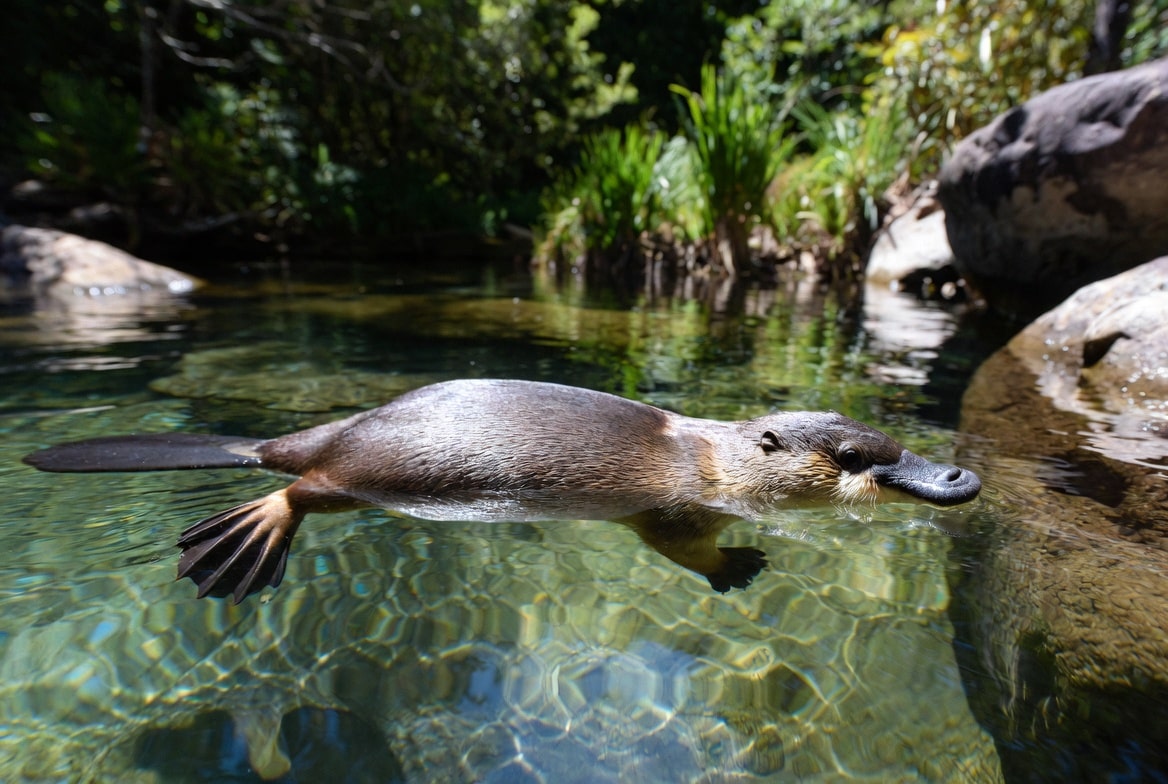
Mother Nature can have a sense of humor at times, and the platypus is living proof. A duck bill grafted onto a beaver-like body, egg-laying, venomous spurs on its feet, the ability to sense electric fields, fur that glows under black light, and a deliriously wild cocktail of ten sex chromosomes… We thought we’d seen it all. Yet, peering at the fur of this unclassifiable creature under an electron microscope, biologists have just detected yet another oddity. This Australian creature carries cellular pigments that simply should not exist in a mammal.
The Architects of Color
To grasp the significance of this discovery, recently published in the journal Biology Letters, one must delve into the very core of our fur and hair. The color of the animal world is governed by tiny cellular factories called melanosomes. These little sacs store and distribute melanin, acting as the painters of our bodies.
Until this study, the rules of biology were clear and neatly organized. In all known mammals, these melanosomes are “full,” exhibiting round or elongated shapes. In birds, however, nature has been more creative: their melanosomes can be flattened or “hollow.” This internal cavity acts as a formidable optical prism, allowing birds to flaunt iridescent reflections and vibrant colors.
The Brown Fur Paradox
That’s where the platypus comes in to turn the tables. By analyzing the inner structure of its fur, scientists have uncovered melanosomes that are both spherical and hollow. A completely unprecedented cellular architecture. Not only had hollow pockets never been observed in a mammal (not even in the echidna, its close relative that also lays eggs), but the combination “spherical and hollow” doesn’t even occur in birds. The platypus has devised its own biological recipe.
Even more puzzling: this complex structure appears utterly useless from an aesthetic standpoint. While hollow melanosomes are usually employed to produce flamboyant colors, the platypus’s fur displays a dark brown of depressingly ordinary dullness.
The anomaly extends into the animal’s inner chemistry as well. In general, the round shape of a melanosome indicates a high concentration of pheomelanin (responsible for reddish and orange hues). Yet spectroscopic analysis of the fur reveals a dominance of eumelanin (which provides black and brown). The platypus thus has the cellular form of a reddish mammal, the hollow inner structure of an iridescent bird, yet wears the color of a plain beaver.
A Bond Spanning Millions of Years
Why would nature go to such lengths to craft a nanostructure so complex if the result is merely a brown coat? The protective or thermal function of this microscopic hollow remains a total mystery today.
For evolutionary biologists, this anomaly is a genuine time machine. This hollow sphere could be an ancient heritage, a cellular vestige shared by the last common ancestor of mammals and birds before their evolutionary paths diverged. Two centuries after being wrongly labeled a hoax by early European naturalists, the platypus confirms its status as the ultimate chimera: a living bridge between species that has clearly not revealed all of its secrets.
