
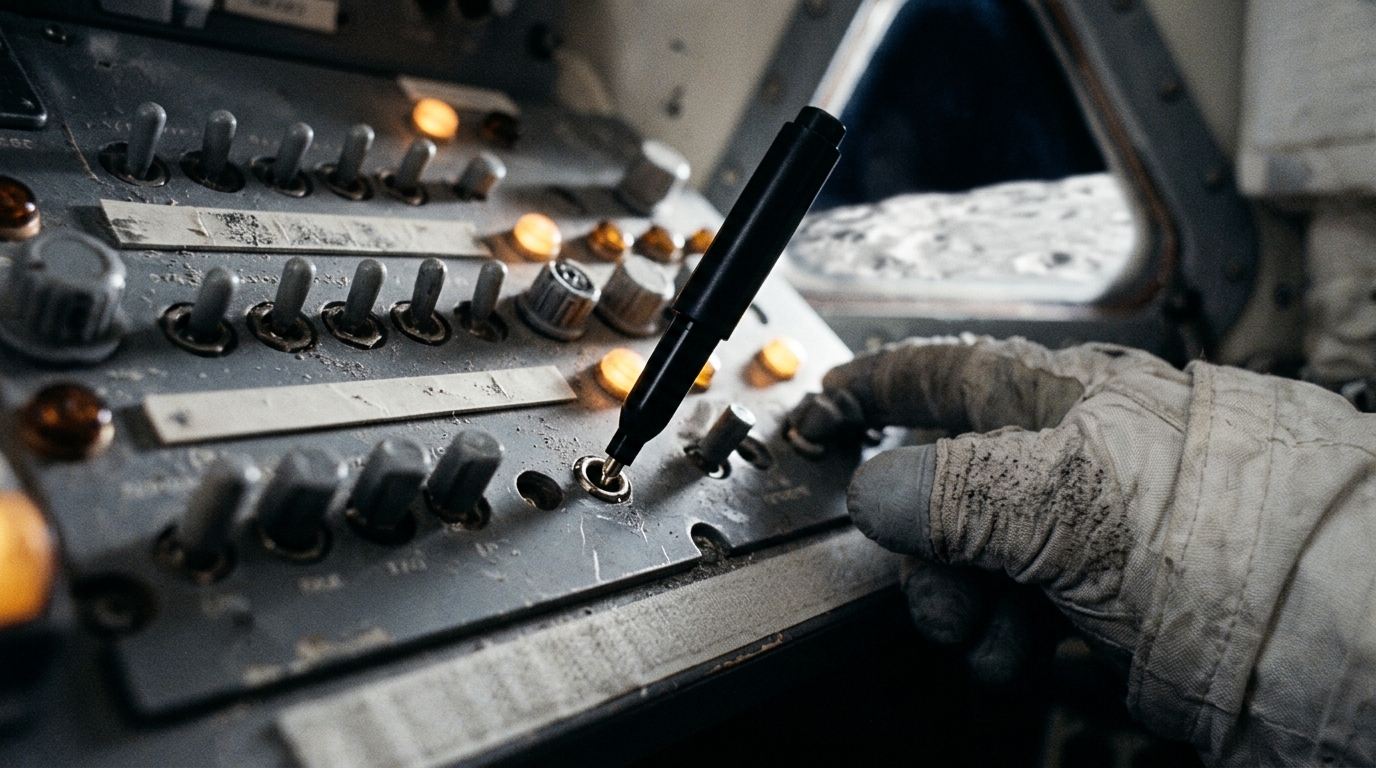
A plain marker changed hands for $857,600 at Sotheby’s, sold as the pen that saved Apollo 11. The trouble is that it wasn’t the famed NASA Space Pen, but a Duro-brand model, far humbler. The real space pen, in fact, was ordered by the American agency.
- Paul Fisher developed and financed the Space Pen on his own, investing about a million dollars without any financial support from NASA.
- NASA only purchased the pen after its invention, in 1967, for a few dollars per unit, while the USSR ordered around a hundred in 1969 with the same 40% discount.
- During Apollo 11, Buzz Aldrin used a plain Duro-brand felt-tip, not a Space Pen, to reset a circuit breaker on the lunar module, an item that sold at auction for $857,600.
- The pencil, an economical solution before the legend of the million-dollar pen
- Paul Fisher and the bold bet of a pen capable of defying gravity
- When the Soviets preferred the grease pencil to American technology
The Pencil, an Economical Solution Before the Legend of the Million-Dollar Pen
Before dreaming up pens capable of defying gravity, NASA kept things simple. The first American astronauts wrote with pencils, just as their Soviet counterparts did. A cheap solution that had proven its worth on Earth for generations.
The problem is that space has never been kind to everyday objects. A pencil lead can break, and its fragments then float freely in the cabin. And graphite conducts electricity, a detail that becomes decidedly problematic near energized control panels.
The wooden body of the pencil also raised concerns, especially after the Apollo 1 tragedy in 1967, where a cabin fire cost the lives of three astronauts. Any additional source of flammability in a cabin saturated with oxygen became unacceptable. A substitute had to be found, and quickly.
Paul Fisher and the Bold Bet of a Pen Able to Defy Gravity
That is where Paul C. Fisher, head of the Fisher Pen Company, enters the story. Contrary to a widely held belief, NASA never financed the development of the pen. Fisher invested roughly a million dollars of his own money, with not a penny coming from the space agency or from Congress.
His invention, named AG7 for Anti Gravity, rests on an ingenious principle. A nitrogen-pressurized cartridge pushes a thixotropic ink—liquid under pressure but semi-solid at rest—toward a tungsten carbide ball. The result is a pen that writes upside down, underwater, and even in outer space. The patent was filed in 1965.
NASA tested and adopted the device only afterward, in 1967, purchasing about 400 units for just a few dollars each. A detail that somewhat dispels the myth of a lucrative contract between the agency and the inventor. Fisher died in 2006 at the age of 93, and his company was inducted into the Space Technology Hall of Fame in 2021, long after his passing.
When the Soviets Preferred the Grease Pencil Over American Technology
On the Soviet side, the story followed a fairly similar trajectory. Cosmonauts also began with grease pencils, less fragile than standard wooden pencils, before turning to a more reliable alternative for Soyuz missions.
In 1969, the Soviet Union finally ordered about a hundred Space Pens accompanied by a thousand ink refills. A pragmatic choice rather than ideological, both agencies enjoying the same 40% bulk discount for a large purchase from Fisher.
The most telling anecdote remains lunar in its humor. During Apollo 11, Buzz Aldrin had to reset a circuit breaker on the ascent engine whose switch was broken; fearing electric shock from a metal object on a live circuit, he used a simple marker to push the switch, not a Space Pen as the legend has long claimed.
That marker, a Duro-brand, happened to be sold with the affected switch in a bidding war among five bidders for a final price of $857,600. A sum that far exceeded Sotheby’s initial estimate of between $800,000 and $1.2 million, according to The Guardian. The two items came from Aldrin’s personal collection, which he had owned for decades.
Between the pencil abandoned for safety reasons, the space pen born from a private bet, and the anonymous marker that became a museum piece at a princely price, the history of writing in space ends up being more about misunderstanding than a technological feat cleverly orchestrated by NASA. A fine lesson in humility, miles away from the clichés that have long circulated on the topic.
