
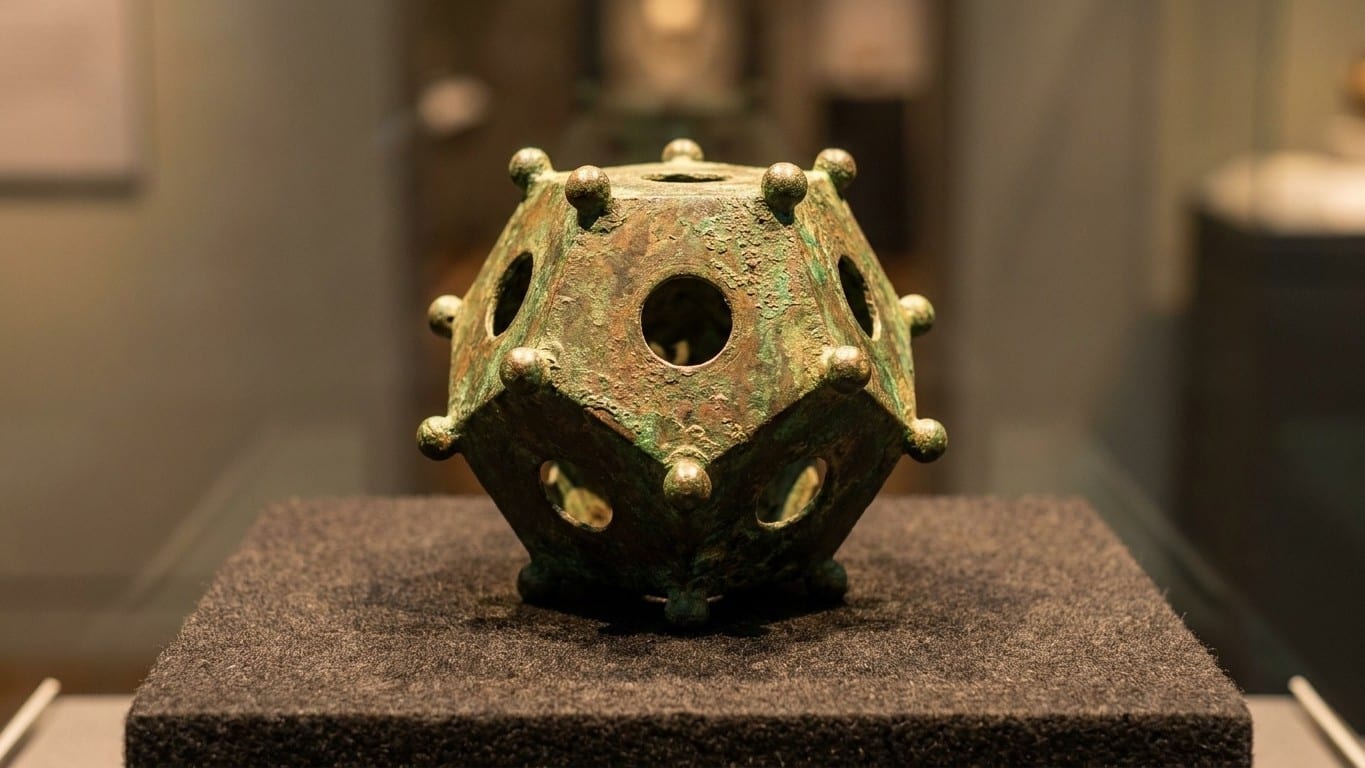
In June 2023, amateur archaeologists were digging a field in Lincolnshire, England, when, on the penultimate day of their survey, they uncovered a hollow bronze object about twelve centimeters long. Twelve pentagonal faces, each pierced by a circular hole, with small spheres at every vertex. The Norton Disney History and Archaeology Group immediately hailed their find as one of the “great enigmas of archaeology.” It was no modest boast. Since the first known specimen was recorded in 1739, more than a hundred of these objects have been unearthed, dating from the 2nd to the 4th centuries CE. Their function or meaning has been debated ever since and remains unknown.
Key takeaways
- More than a hundred enigmatic objects discovered since 1739, with no mention in any ancient texts
- From knitting to artillery: the most far‑fetched theories facing the silent dodecahedra
- A divine figurine found alongside the latest specimen hints at a forgotten religious use
An object born in the provinces, ignored by Rome
About sixty percent of the known specimens come from the Gallic and Germanic provinces, and around twenty percent from Roman Brittany. None has been found in Italy, Spain, Africa, Greece, or the eastern provinces. This geography already tells us something: these objects concern the empire’s northern margins, Celtic-Romanized regions, never the Latin heartland. A notable concentration emerges in the Rhine basin, encompassing present-day Switzerland, eastern France, southern Germany, and the Netherlands.
What strikes the eye first is the craftsmanship. One thing seemed certain to early observers: it was a precious object, since metalworking was, at the time, a painstaking operation. A high degree of technical skill was required to manufacture them, which suggests their use was of obvious importance. And yet, here lies the central paradox: these objects show little signs of wear and carry no engravings, no marks or inscriptions. A tool wears down. A jewel is ornamented. A weapon is marked. These dodecahedra, by contrast, keep their silence.
One of the most perplexing mysteries is the silence of the ancient texts. Neither Pliny the Elder, Vitruvius, nor any technical or military author mentions them. There is no description in Roman literature, and they do not appear in mosaics either. For a civilization that produced treatises on architecture, agriculture, war, and cuisine, this collective silence is vertigo-inducing.
The catalogue of hypotheses, or the embarrassment of riches
Theories about their function have swung between toys, dice, weights for weapons, slingshot stones, aiming devices for Roman artillery, and even templates for knitting gloves. In the nineteenth century, some antiquarians proposed an object as a weapon, the head of a mace, or a projectile, but other researchers argued that these hollow objects were far too light to inflict serious damage.
The knitting hypothesis deserves a particular mention for how widely it circulated. The idea: the holes of varying diameters would serve to shape the fingers of gloves, the different sizes explaining the variety of specimens. A filmmaker even tested the notion with a 3D-printed replica, inspiring other experimenters. This line of thought would explain the different sizes of the dodecahedra and the use of holes to form the glove’s fingers. Appealing, but since all the dodecahedra vary in size, the idea of standardised measurement or calibration seems unlikely.
Several dodecahedra have been found in caches containing coins, which can be read in two ways: either their owners valued them as precious objects to keep safe from theft, or their use was somehow connected to money. In 1982, one specimen appeared in a coin hoard in the Belgian Ardennes. Its presence next to gold coins suggests it was regarded as highly valuable—perhaps religious, perhaps utilitarian. In Slovakia, two fragments came from Germanic sites located barely six kilometres north of the Danube; their deliberately fragmented state suggests they were recovered to be melted down as raw material, probably after the destruction of a Roman fort. The Roman object had become barbarian scrap metal.
The enigma of context, the key to everything
Across the northwest Europe, most dodecahedra have been recovered by metal-detectorists in isolation, which makes Norton Disney’s find all the more precious: it is one of the rare instances where the object was discovered in its original archaeological context. In archaeology, context is everything. A knife found in a kitchen tells a different story from the same knife found in a tomb.
Religious use has been suggested, given that many specimens were found in temples or Gallo-Roman tombs. The Lincolnshire diggers regard the most plausible interpretation as a ritual or religious object. The Romans were highly superstitious, seeking signs to guide daily decisions. Nearby the Norton Disney dodecahedron lay a figurine of a horseman god with strong religious overtones, an indication that archaeologists deem significant.
A solid silver dodecahedron was discovered in Geneva in 1982: each of its faces bears the name of a zodiac sign. A 2025 study proposes a ritual use with Pythagorean-Druidic influences. In the Platonic tradition, the dodecahedron is one of the five solids associated with the natural elements; it would represent the Universe, symbolising harmony and cosmic perfection. This link between geometry and spirituality is not a modern fancy: some specialists think it could be an object used to test a founder’s mastery, a kind of guild masterwork, a theory grounded in the bronze’s cost and the skill required.
For the vast majority of catalogued specimens, the discovery context is unknown, the object having passed through the antiquities market. That is where the issue remains, again and again: without reliable stratigraphy or a datable archaeological layer, every theory risks projecting the present onto a mute past. Little known is the fact that smaller dodecahedra with the same features, holes and spheres, have also been found in Southeast Asia along the Silk Road, with the earliest specimens dating to the Roman era. A coincidence that widens the mystery far beyond Gaul.
Sources: dailygeekshow.com | nunc.ch
