
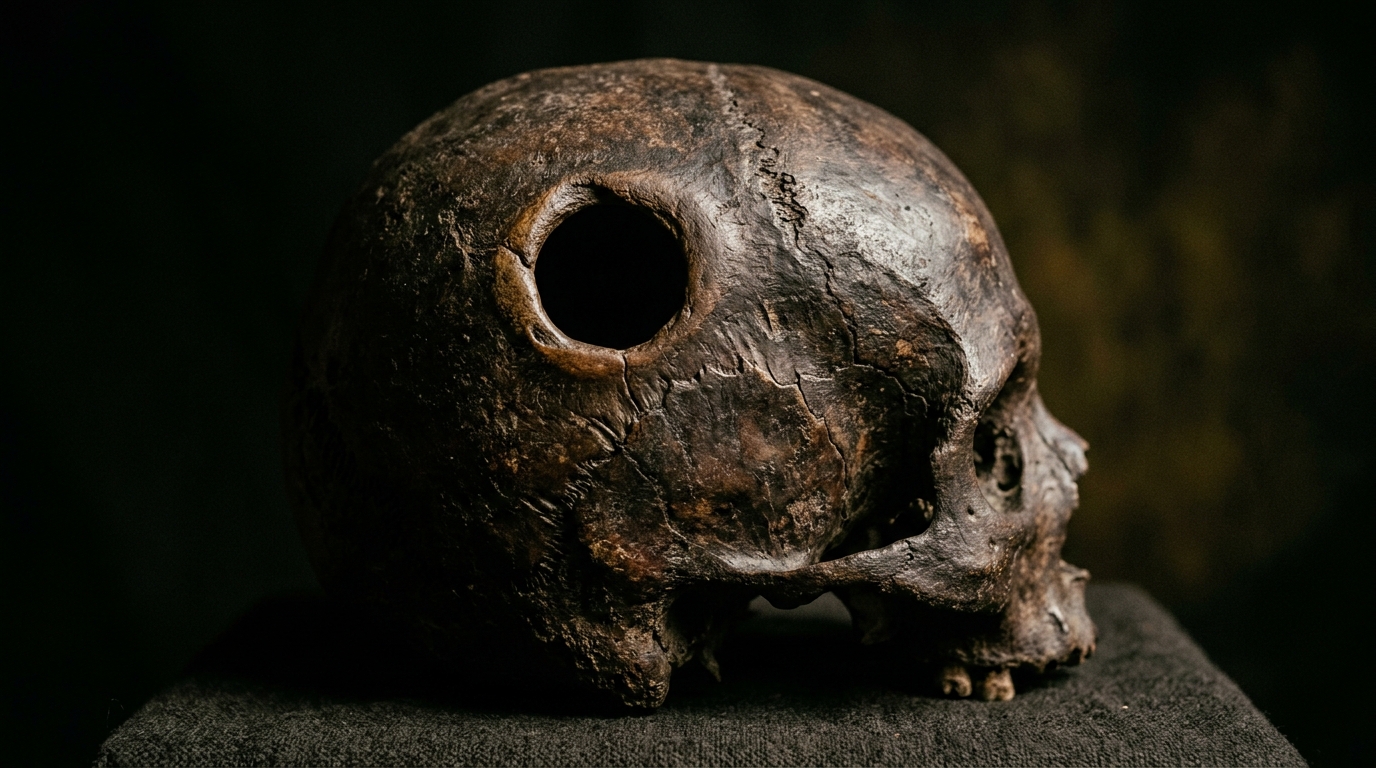
Imagine the scene: a man equipped with a carved-stone instrument is about to bore into the skull of a perfectly conscious patient, without modern anesthesia, without antibiotics, without the slightest notion of sterilization as understood today. On paper, the prognosis seems preset, and one can easily picture a fatal outcome in the vast majority of cases. Yet the meticulous study of nearly eight hundred Peruvian skulls tells a completely different story—the tale of Andean surgery capable of yielding success rates that would make some nineteenth-century Western hospitals pale. This is enough to seriously challenge our certainties about the true level of pre-Columbian medicine.
- An analysis of nearly 800 Peruvian skulls reveals, thanks to bone regrowth marking healing, survival rates from Inca trepanation exceeding 75%, and up to 91% depending on the period
- Civil War surgeons recorded mortality rates of 46 to 56% during cranial surgeries, well higher than those of Andean practitioners, due to insufficient hygiene
- The survival rate for Peruvian trepanation progressed over the centuries, rising from about 40% between 400 and 200 BCE to 75–83% during the Inca period, signaling a medical know-how refined over time
- Trepanned skulls that defy conventional wisdom
- Bone regrowth, the silent proof of an unexpected survival
- When the American Civil War proved worse than the Incas
- What these Andean skulls reveal about ancient medicine
Trepaned Skulls That Defy Conventional Wisdom
For a quarter of a century, a bioarchaeologist combed through American museum storerooms to examine hundreds of trepanned skulls unearthed from various Peruvian sites. This painstaking crusade yielded one of the largest collections of trepanation studies ever assembled, with nearly 800 skulls analyzed one by one, often with the naked eye, sometimes under a microscope. The goal was not merely to describe these striking holes carved into bone, but to understand what they truly disclosed about the patients’ fates.
And that is where the surprise lies. Far from the image of a ritual practice doomed to failure or reserved for desperate cases, trepanation appears, among the Incas, to have been a controlled and repeated surgical act. Some periods show survival rates surpassing 75%, a figure that seems almost incongruous when considering the conditions under which these operations were carried out. This finding invites a serious reconsideration of the level of skill reached by Andean practitioners long before Europeans arrived on the continent.
Bone Regrowth, the Silent Proof of an Unexpected Survival
How, centuries later, can we assert with certainty that a patient survived such a radical operation? The answer lies in a detail as discreet as it is eloquent: bone regrowth. When the skull bone begins to heal after a trepanation, a smooth, rounded edge gradually forms around the opening. This process takes time, often many months, sometimes years. A skull displaying these softened contours thus signals, almost indeclinably, that the person continued to live long after the procedure.
Conversely, a sharp, clean edge betrays a death that occurred soon after the operation, or even during it. This simple osteological observation has become the reference criterion for estimating survival rates across ages. And the results at the royal site of Ollantaytambo, in the Urubamba Valley, are striking: 75.3% of skulls show clear signs of long-term healing. Even more troubling, some individuals bear the traces of several successive interventions, with a skull revealing up to five healed trepanations on the same person. A patient who survives five skull openings clearly commands respect for the skill of these ancient surgeons.
When the American Civil War Proved Worse Than the Incas
The contrast becomes even sharper when these Andean results are set against a more recent period renowned for medical advances: the American Civil War. Between 1861 and 1865, American military surgeons performed cranial interventions as well, but with far grimmer consequences. The mortality rate hovered between 46 and 56%, meaning nearly one patient in two did not survive the operation.
How can such a discrepancy be explained in favor of a civilization that predates Western medicine by centuries? The answer rests on a single word: hygiene. Civil War surgeons often operated with non-sterilized instruments that were reused from patient to patient, and they did not hesitate to probe wounds with bare hands. The resulting infections, notably meningitis and septicemia, wreaked far more havoc than the surgical act itself. The Andean practitioners, by contrast, appear to have developed empirical practices that limited contamination risks, even without a formal understanding of the underlying biological mechanisms. There is a vertigo-inducing irony here: a centuries-old know-how surpassing, on this particular point, a Western medicine that was nonetheless equipped with more advanced anatomical knowledge.
What These Andean Skulls Reveal About Ancient Medicine
The story of Peruvian trepanation does not halt at a static snapshot in time: it chronicles a genuine progression. The earliest trepanned skulls studied, dated roughly 400 to 200 BCE on Peru’s southern coast, show a far more modest survival rate, around 40%. Then, between 1000 and 1400 CE, this rate climbs dramatically to as high as 91% according to cross-era comparisons. During the Inca period itself, between 1400 and 1500, the average rate stabilizes between 75 and 83%.
This evolution suggests a true refinement of techniques over more than a millennium, an apprenticeship passed down and perfected from one generation of healers to the next. The tools used, the gestures performed, the selection of operable cases were likely adjusted over time, shaped by observation and accumulated field experience. This synthesis, notably gathered in a 2016 reference work on the art and archaeology of trepanation in ancient Peru, sketches the portrait of a medicine far more sophisticated than previously imagined, capable of rivaling, or even surpassing, certain Western practices that emerged much later.
These discoveries remind us, in a season when we like to revisit the great mysteries of the past, how rich in unexpected lessons the history of pre-Columbian civilizations remains. Far from the clichés about primitive societies left to chance, the Incas seem to have built, through patient observation, a genuine medical knowledge transmitted and refined over centuries. And perhaps the true lesson of these pierced skulls lies not so much in technical prowess as in this universal and timeless ability to learn from one’s own mistakes in order to heal more effectively?
