
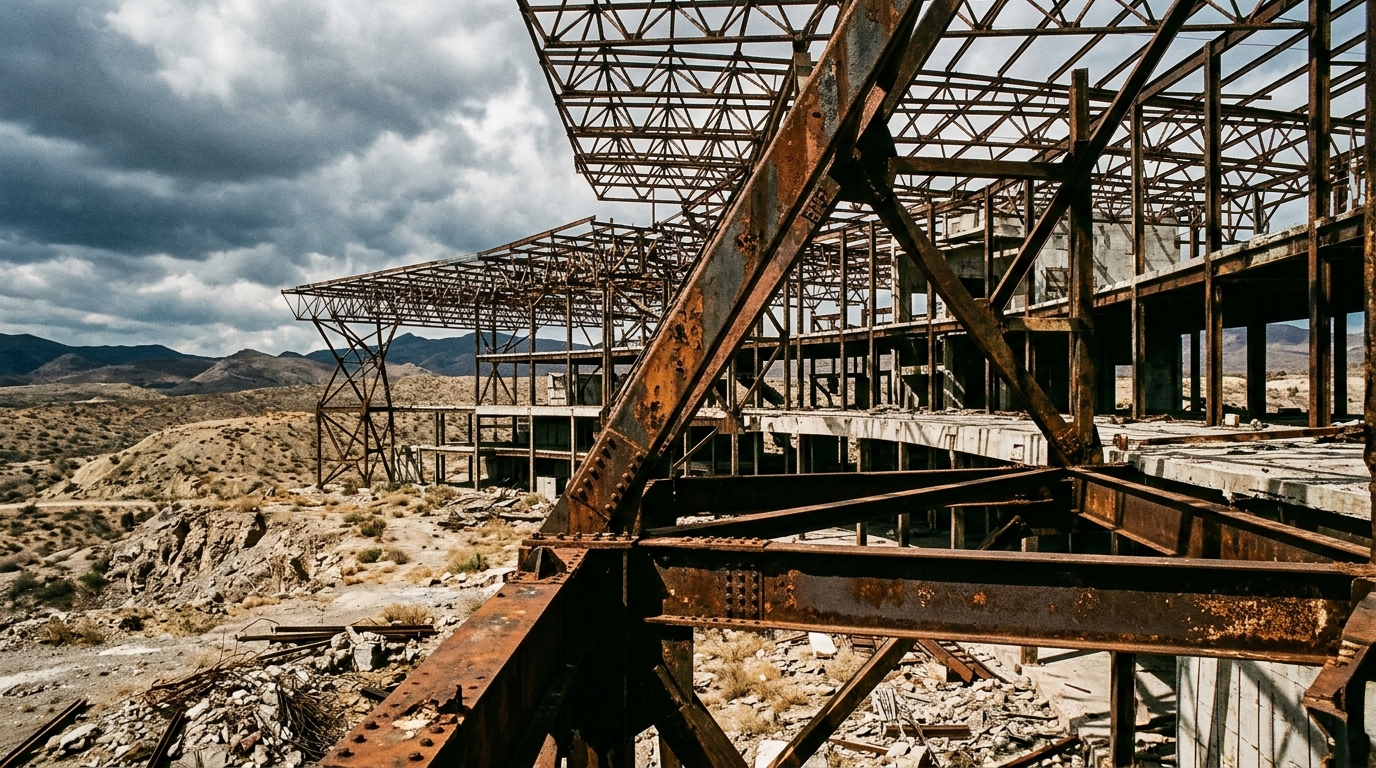
What remains when the largest airport mega-project in Latin America is abandoned in the middle of construction? In Mexico, the bill comes to tens of billions of pesos squandered into thin air. The Texcoco site, hailed as set to revolutionize the country’s air travel, never saw a single plane take off, despite colossal sums poured into concrete and contracts.
- The NAICM project was abandoned in 2018 after a public consultation, with the construction only one-third complete.
- The cancellation cost 113,327.7 million pesos according to ASF, for a total of more than 184,551 million pesos poured into the project.
- The Texcoco site has been turned into a partially flooded ecological park, while Felipe Ángeles Airport and the AICM continue to struggle to resolve air-traffic saturation.
- A colossal construction project brought to life for nothing
- 113,327.7 million pesos: the dizzying bill of abandonment
- Texcoco, the symbol of an unprecedented state waste in Mexico
A colossal construction project brought to life for nothing
In September 2014, President Enrique Peña Nieto announced the Nuevo Aeropuerto Internacional de la Ciudad de México, better known as NAICM, which was to be a landmark in the nation’s history. It was pitched as the grandest public work in a century, a locally inspired equivalent of France’s major undertakings of the past, such as Grand Paris or high-speed rail lines.
The stated ambition on paper was straightforward: relieve the overburdened Mexico City International Airport and build infrastructure capable of absorbing decades of growing air traffic. Excavators began working on the Texcoco site, a former lakebed to the east of the capital.
Then everything stopped. In 2018, a nationwide vote held in October drew more than a million participants. The result was decisive: 70% voted to abandon the project entirely. At that moment, the construction was only a third finished, with about $5 billion already spent.
Halting a project of such magnitude in the middle of construction is like demolishing a building just after pouring the foundations and raising the first floors. The money already invested cannot be reclaimed, and one must pay to shut everything down properly.
113,327.7 million pesos: the dizzying bill of abandonment
That tally triggered a flood of headlines. The Auditoría Superior de la Federación, Mexico’s equivalent of a Court of Auditors, initially announced a colossal figure: 332 billion pesos, roughly $16 billion, solely to settle the cancellation of the project.
That report was withdrawn after criticism from the sitting president, according to Reuters reporting in February 2021. The institution cited inconsistencies and a methodological flaw that led to an overestimate, and a new calculation was deemed necessary.
On May 8, 2021, the ASF announced the final figure: the NAICM cancellation had cost 113,327.7 million pesos. This amount corresponds, according to the signed official minutes between the ASF and Grupo Aeroportuario de la Ciudad de México, to the costs already invested in construction and the early termination of contracts as of December 31, 2019.
But this figure tells only part of the story. In total, the Mexican state spent more than 184,551 million pesos on this project before walking away, an amount that dwarfs the official cancellation cost and is staggering even when scaled to a country of over 125 million people.
Part of the bill was financed by borrowing. In December 2018, the buyback of bonds issued to fund the project was capped at $1.8 billion, out of $6 billion raised on the markets. That debt did not vanish with the project’s demise.
In December 2023, a state-controlled trust fund repurchased about $482 million of this debt, from the $4.2 billion still outstanding at that date. Repayment of these bonds now rests on the revenues from the use tax collected at Mexico City’s international airport, the AICM, the very airport NAICM was meant to replace.
Texcoco, the symbol of an unprecedented state waste in Mexico
What physical remnants remain of this aborted project? The 14,000-hectare site, now managed by the Comisión Nacional del Agua, was converted into an ecological park named Lago de Texcoco. The idea was to restore a wetlands area long threatened by urban development to nature’s care.
Yet even this backup plan encountered its own difficulties. In July 2025, around 1,800 hectares of the ecological park were flooded, including the area where the monumental terminal of the future airport would have risen—a stark irony for a site intended to symbolize a controlled land-use transformation.
In December 2025, the park nonetheless hosted sports facilities and is set to broaden its recreational offerings in 2026, according to authorities. This is supposed to give a modest second life to land that was once destined to bear runways.
Meanwhile, the Felipe Ángeles Airport, built to replace the NAICM on an existing military base, has produced mixed results. In 2025 it carried 7,059,000 passengers, reaching 95% of its annual target. A respectable figure, but far from solving the original saturation problem.
Mexico City’s international airport, for its part, continues to shoulder most of the traffic, recording 44.6 million passengers in 2025, down 1.7% from the previous year. In other words, the problem NAICM was meant to resolve remains unresolved years after the project was abandoned.
Ultimately, Texcoco’s saga reads like a large-scale cautionary tale about the risks of launching ambitious infrastructure projects without sufficient upfront public consultation. Billions wasted, a debt still borne by users of the existing airport, and a half-submerged landscape left behind as an inheritance. Mexico did not secure a new airport, yet it has paid—and continues to pay—for the project that never existed.
