
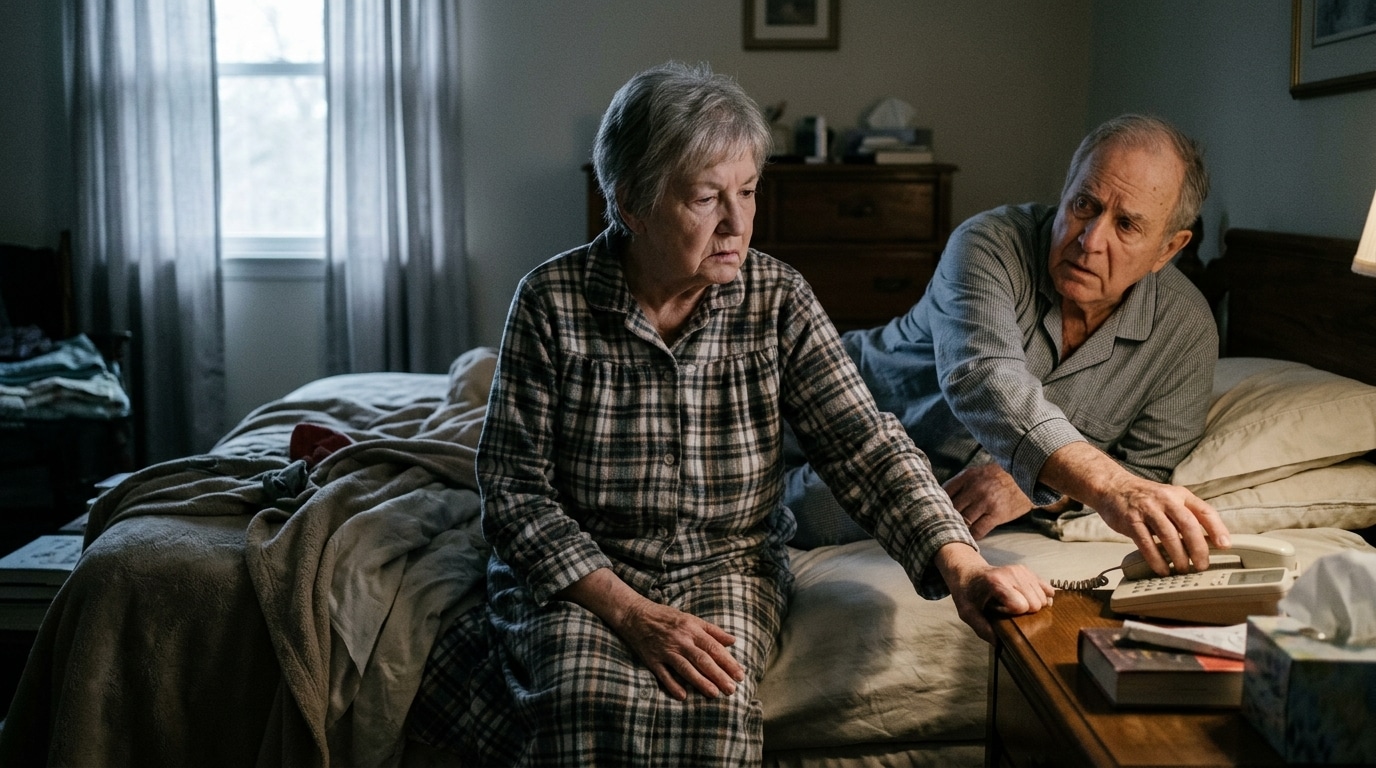
One morning like any other, someone wakes with a mouth drooping to one side, an arm that won’t respond, words tangled. Nothing alarming on the surface, just a somewhat difficult wake-up, one might think. Yet this scenario is feared by emergency physicians, because it hides a very particular challenge: pinpointing the exact onset of symptoms. About one in five strokes occur during sleep, which significantly complicates management. There then remains a question that doctors routinely ask as soon as the patient arrives, a question that does not concern the wake-up time or the moment the emergency was called, but which nonetheless changes everything for what happens next.
- About one in five strokes occur during sleep, complicating the dating of symptoms and access to thrombolysis.
- What medically matters is not the wake-up time but the last moment when the person was seen without symptoms, often the bedtime.
- When confronted with evocative signs (mouth drooping, weakness of a limb, speech or balance troubles), one should call 15 immediately, specifying that last symptom-free time.
- A Wake-Up Stroke: A Trap for Medical Timing
- Why Bedtime Takes Precedence Over Wake Time
- Signs That Should Trigger a 15 Call Without Delay
- What the 4.5-Hour Window for Thrombolysis Changes
- The Reflexes to Adopt When a Loved One Wakes Up Different
- Better Understanding for Better Response to the Morning Stroke
A Wake-Up Stroke: A Trap for Medical Timing
The situation is more common than one might imagine. A meta-analysis published in the journal Neurological Research, drawing on 37 studies and nearly 197,000 people, establishes the prevalence of wake-up strokes at 23.1%, i.e., almost one ischemic stroke out of four. In practical terms, this represents about one patient in five among those admitted for an ischemic stroke.
The problem is that these patients are typically excluded from the most effective emergency treatments because the exact moment of onset cannot be determined with certainty. A study conducted in 54 hospitals across Texas and Louisiana, published early 2026 in Frontiers in Stroke, illustrates this inequality in treatment: only 8% of wake-up stroke patients receive thrombolysis, compared with a much higher proportion among patients whose time of onset is known. A gap that raises questions, especially when one knows that solutions exist to circumvent this uncertainty.
Why Bedtime Takes Precedence Over Wake Time
Here lies the essential information, the one that many still do not grasp: what matters medically is not the time at which the person woke up with symptoms, nor the time the 15 was dialed, but the last moment when they were seen without any symptoms. In the vast majority of wake-up stroke cases, this reference point simply corresponds to bedtime.
In other words, if someone went to bed at 11 p.m. in good shape and wakes up at 7 a.m. with a drooping face, physicians take, as a precaution, that the stroke could have begun at any time within those eight hours, not necessarily at the moment of waking. This distinction, far from being a bureaucratic detail, directly shapes the therapeutic options available. That is why the first question asked of relatives, upon arrival at the emergency department, almost always concerns this last symptom-free time, far more than the moment the discomfort was observed.
Signs That Should Trigger a 15 Call Without Delay
When facing a loved one who appears different upon waking, certain signs leave no room for doubt and require calling 15 immediately, without waiting for the situation to improve on its own. They can be captured with a few simple observations, easy to spot even without medical training:
- A mouth that deviates to one side, often noticeable when the person smiles or tries to speak
- A arm or leg that suddenly loses strength, or stops responding altogether
- Confused speech, hesitant, or words that no longer make sense
- Brutal loss of balance or sudden vision troubles
Each of these signs, taken alone or together, justifies an immediate call to 15. There is no time to waste waiting to see if it passes, no detour to a general practitioner or to an online search. Every minute counts, and only emergency services can quickly steer toward appropriate care.
What the 4.5-Hour Window for Thrombolysis Changes
Thrombolysis, the treatment aimed at dissolving the clot responsible for ischemic stroke, should ideally be administered as early as possible, within a maximum of 4 h 30 after symptom onset, as health insurance reminds us. This window is calculated from the last moment the patient was seen without symptoms, which explains why many wake-up stroke patients have historically been excluded from this treatment: it could not be guaranteed that they were within that window. Fortunately, medicine has found a workaround. When the onset time is unknown or the stroke is observed upon waking, brain imaging, via MRI or perfusion CT, now allows assessment of the brain’s status and determination of whether treatment remains feasible, even beyond that theoretical window.
This is precisely what the WAKE-UP study demonstrated, published in the New England Journal of Medicine: in the presence of a certain MRI profile, called diffusion–FLAIR mismatch, thrombolysis provides a real benefit even without certainty about the exact time of onset. A Cochrane review, incorporating seven trials and nearly 980 participants, confirms the value of these approaches for wake-up strokes. The French National Authority for Health (HAS) has incorporated these advances in its updated guidelines by late 2025, with a chapter dedicated to wake-up stroke and a clinical severity threshold, measured by the NIHSS score, set at 4 or higher to guide therapeutic decisions.
The Reflexes to Adopt When a Loved One Wakes Up Different
In concrete terms, what should you do if a spouse, a parent, or a roommate seems unusual upon waking? The first reflex, and perhaps the most useful, is to call 15 without delay, describing precisely the observed symptoms. The second reflex, equally decisive, is to remember and communicate the bedtime, or more precisely the last moment when the person appeared to be well. This information, often overlooked in the stress of the moment, is however the one that will guide medical teams in deciding whether to direct the patient toward advanced imaging and, possibly, thrombolysis.
A report from the Cour des comptes published in late 2025 highlights that emergency response times in France overall remain too long, but are significantly shortened when 15 is contacted as a priority rather than routing through other channels. In short, this simple reflex—calling 15 first—can literally save precious time for the brain, an organ that does not forgive delays.
Better Understanding for Better Response to the Morning Stroke
The stakes go far beyond a medical anecdote. According to Santé publique France, the number of adults hospitalized for a stroke rose from 110,438 in 2014 to 122,422 in 2022, making the question all the more timely. Understanding that wake-up strokes follow a different timing logic—based on the last moment without symptoms rather than the wake time—helps prevent time losses that are often fatal to recovery prospects. This nuance, still poorly known by the general public, deserves broad sharing, because it could affect any household on another ordinary morning.
Keep this simple reflex in mind: call 15 without delay and specify the bedtime rather than the wake time, as it can change the course of care. A detail that, far from being trivial, sometimes weighs much more than it seems in the fight against stroke sequelae.
