
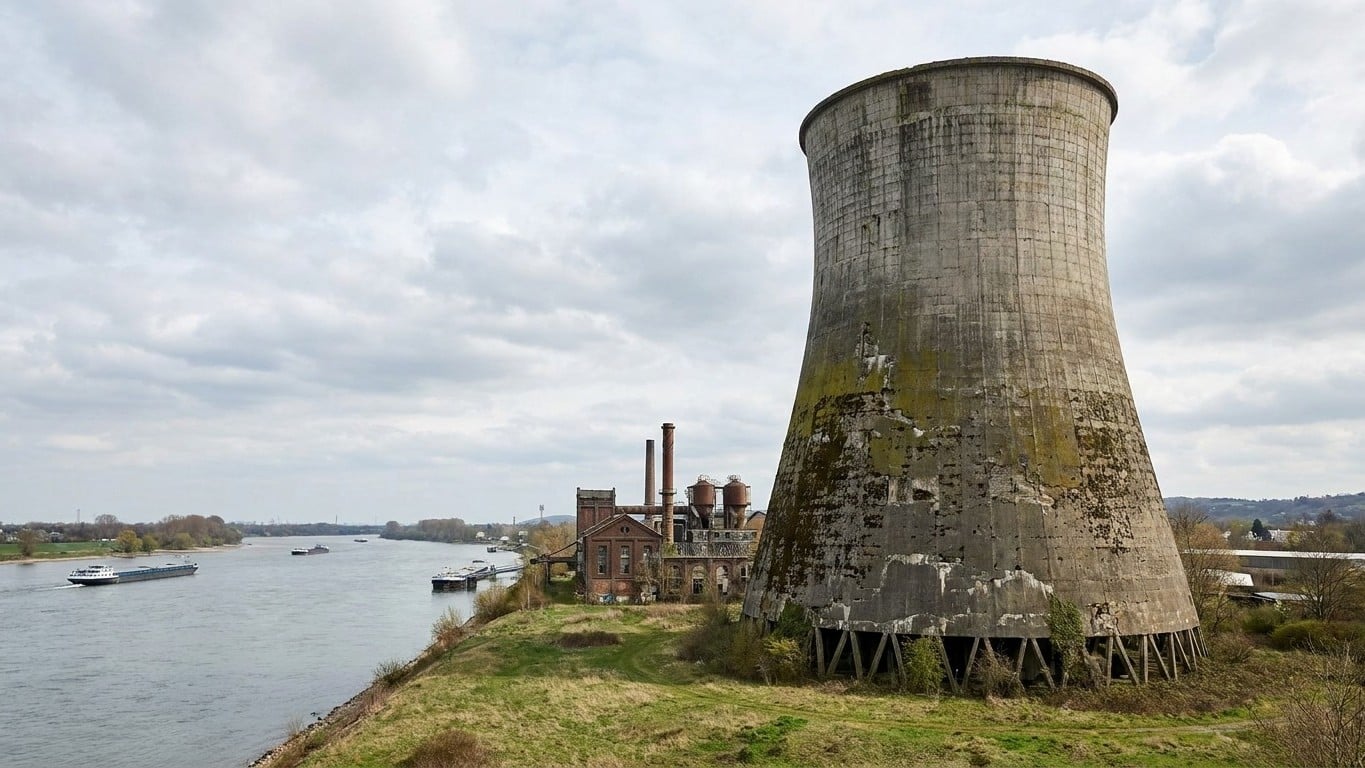
A complete, finished, and tested nuclear reactor that never received a single gram of fissile fuel. In Kalkar, a small town on the Rhine in North Rhine-Westphalia, this industrial paradox really existed. It was named SNR-300, for Schneller Natriumgekühlter Reaktor, a fast-neutron reactor cooled by sodium. This power station was intended to produce 327 MW of electricity but was halted for political reasons before it could receive nuclear fuel. Today, its cooling towers and turbine halls house amusement rides and hotel rooms. The story deserves to be told in full, as it encapsulates the dashed hopes of European nuclear power in the 1970s.
Key takeaways
- A complete and functional nuclear reactor never produced even one minute of electricity
- 40,000 protesters mobilized in 1977 against the project that sparked the German environmental movement
- Turned into an amusement park after abandonment, its cooling towers became tourist attractions
A pharaonic project started during the oil crisis
Everything begins in the wake of the first oil shock. In the 1970s, Germany, owning 68.5% of the capital, along with Belgium, the Netherlands, and the United Kingdom, decided to build in Kalkar a nuclear plant of a new kind—a “surgénérateur,” a fast-breeder reactor. The idea captivated engineers around the world: a reactor capable of producing more fissile material than it consumes, a kind of energy gambit that promised to permanently solve the uranium supply puzzle. Interatom, then a Siemens subsidiary, was entrusted with building the new reactor, and construction began at the end of 1973.
The project site was colossal. It required roughly 250,000 cubic meters of concrete and 58,000 tons of steel for its realization. To put it in perspective, that is the equivalent of twenty Eiffel Tower structures poured into the Rhineland’s bedrock. But from the first shovels, opposition began to brew. Ten thousand people mobilized against the project as early as 1974. Three years later, the movement reached a scale rarely seen: a 1977 anti-plant rally brought 40,000 people into Kalkar’s streets. These protests stand among the founding milestones of Germany’s ecological movement, to the point that anti-nuclear protests at this reactor became a defining moment in Germany’s anti-nuclear history and helped seed the party Alliance 90 / The Greens.
Chernobyl, the final blow to a project already weakened
Twelve years. That was the time it took to bring the installation from the drawing board to completion, against an originally much shorter schedule. When construction was completed in 1986, protests and the Chernobyl disaster later that same year pushed back the reactor’s commissioning. The calendar could hardly have been worse: Germany completed an experimental sodium-cooled reactor just a few weeks after the explosion at the Soviet plant. Public opinion, already scarred by years of local mobilization, no longer wanted to hear about loading the SNR-300’s core.
For five years, the plant stood idle—technically ready, but politically condemned. Maintaining safety and the facilities cost 50 million euros per year and employed 220 people. An entire team was paid to guard a reactor that would never produce a single kilowatt-hour, a situation a Belgian documentary of the time described in no uncertain terms as the “world’s least radioactive nuclear power plant.” On March 21, 1991, the final axe fell. The Minister of Research, Heinz Riesenhuber, announced the definitive shutdown of the fast breeder. The state of North Rhine-Westphalia, staunchly opposed to the project, had won after nearly two decades of political struggle with Bonn.
The bill, in short, was dizzying. The project cost roughly 7 billion Deutsche Marks, or about 3.5 billion euros, more than 4 billion dollars. Some estimates, like those cited by the energy site Enerzine, put the figure slightly higher, around 3.7 billion euros for a reactor that never ran a single minute. By comparison, France would later experience a similar fiasco with its sodium-cooled breeder, Superphénix at Creys-Mayville, which at least produced electricity, though well below expectations.
From a site under nuclear surveillance to a theme park
Four years after the final shutdown, a Dutch entrepreneur spotted a profitable opportunity. In 1995, the complex was purchased by Dutch investor Hennie van der Most and transformed into a leisure park. The terms of the deal remain murky: some sources mention a sale price of 2.5 million euros, a fraction of the billions invested, while other versions cite a dollar amount in the same ballpark. Renamed Wunderland Kalkar, the “Wonderland” park integrates existing structures rather than demolishing them. The towering 42.30-meter-high cooling tower is draped with a mural of an Alpine landscape, and its concrete wall serves as a rock-climbing barrier. Inside the chimney, a swing ride now whirls where steam would once have circulated to generate electricity.
The rest of the site is equally impressive: the turbine and reactor buildings now host hotels, restaurants, and bars. The park draws a sizable crowd—about 600,000 visitors each year—attracted both by the rides and the sheer oddity of the location. A park spokesperson summed up the situation with a touch of dark humor: “Some fear that it isn’t safe, but it’s 100% secure, because the reactor never went into service.”
Yet the heart of the reactor has not entirely disappeared from Europe’s nuclear landscape. Today, the reactors remain under state surveillance in Hanau and remain the property of RWE Power AG, which, lacking authorization to recycle enriched material containing about 35% plutonium, sends the spent fuel to the La Hague reprocessing plant. From this unused fuel will ultimately emerge MOX destined for other plants somewhere in France. An irony for a site designed to guarantee German energy independence, which ended up, in its own way, feeding a neighbor country’s nuclear fleet.
Sources : news.google.com | dailygeekshow.com
