
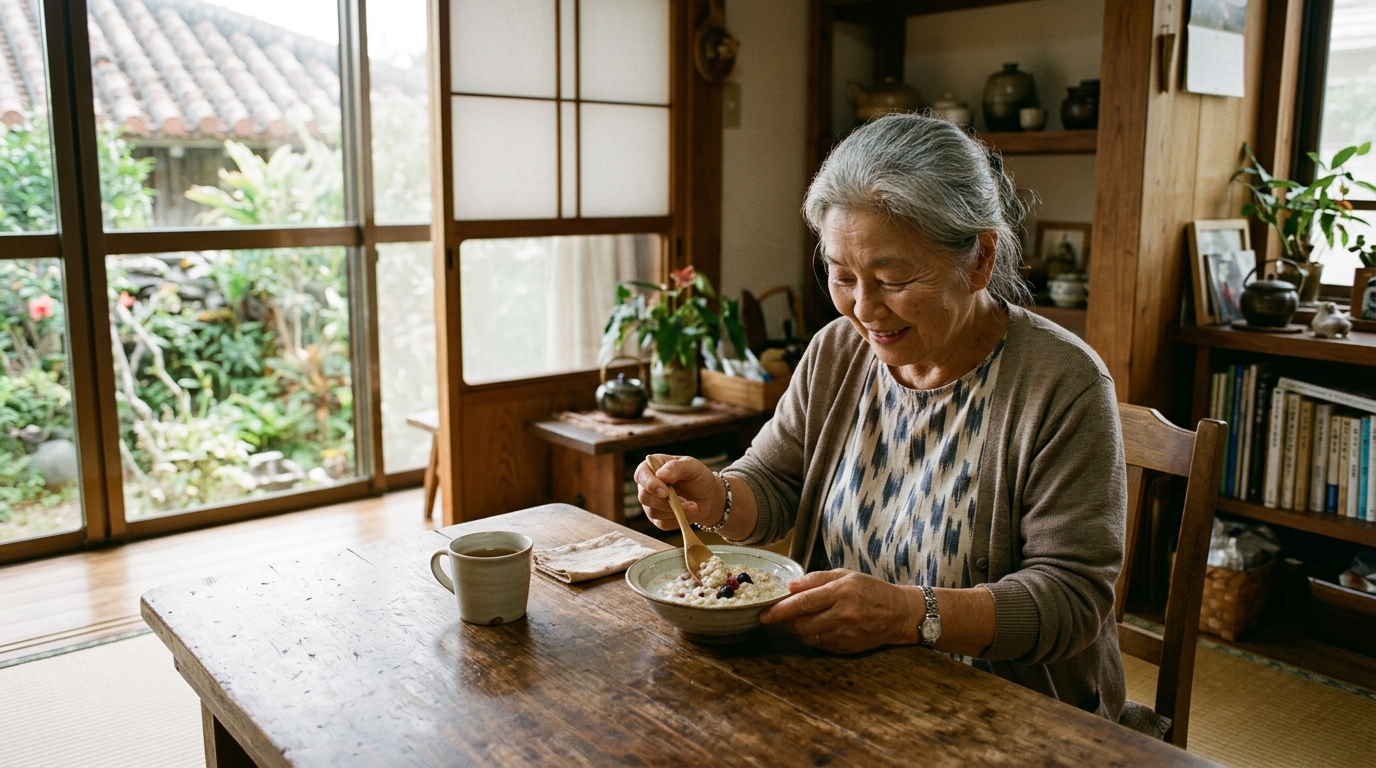
Important note: the oats mentioned here are not merely a trendy food glimpsed on social media, but an ingredient still found today in the morning routines of some of the oldest populations on the planet. In the blue zones, those regions of the world where centenarians are unusually numerous, breakfast varies from one area to another. And while autumn often prompts a rethink of eating habits, there exists a simple, inexpensive ritual that has traversed generations without ever weakening. A bowl, a warm texture, a few minutes of cooking: that is all it takes to understand why this food keeps returning in stories of longevity.
- In Loma Linda, a California blue zone famed for longevity, oats form the foundation of the traditional breakfast.
- A portion of 30 to 40 grams of oats provides manganese, vitamin B1, magnesium, phosphorus, zinc, iron, and fiber, notably beta-glucan, for under one euro.
- Beta-glucan slows nutrient absorption, stabilizes blood glucose, helps modulate cholesterol, and promotes regular transit.
- The breakfast that traverses the blue zones without ever changing
- A nutrient-dense bowl for under one euro
- The discreet ally of the heart, digestion, and the waistline
The breakfast that traverses the blue zones without ever changing
In the communities studied for exceptional longevity, a single pattern repeats at waking. In Loma Linda, California, a population known to live on average several years longer than the rest of the population favors a largely plant-based diet, where oats occupy a prominent place from the early morning. It is no accident that oats or rolled oats recur in many testimonies gathered from centenarians: they provide a simple, inexpensive, and easy-to-prepare base, particularly prevalent in Loma Linda, a region renowned for longevity. The ritual is almost always the same: slow cooking, a comforting texture, and a few natural additions such as fruit or nuts to vary pleasures without complicating the recipe. Autumn, too, invites different meals, yet this ritual endures across generations.
A nutrient-dense bowl for under one euro
What stands out is the ratio between the price of this staple and its nutritional richness. A serving of 30 to 40 grams of oats typically suffices to compose a balanced breakfast, especially when paired with a fruit, a source of protein, and a bit of healthy fat. Oats deliver manganese, vitamin B1, magnesium, phosphorus, zinc, and iron, while providing a notable amount of fiber. Among these fibers, beta-glucan holds a special place: this soluble fiber largely explains the oats’ reputation. As early as 1997, a health claim was validated across the Atlantic, linking oat consumption to a reduced risk of coronary heart disease, provided that the used flour contains at least 4% beta-glucan and 10% of total fibers. This is enough to turn a simple morning bowl into a small preventive gesture, without spending a fortune.
The discreet ally of heart health, digestion, and the waistline
This is where the real revelation lies: oats are not remarkable merely by tradition, but because they respond perfectly to today’s health concerns. Beta-glucan, forming a gel when it meets water, slows the absorption of nutrients in the intestine. Result: blood glucose rises more gradually than after a sugary breakfast or refined cereals, which helps curb mid-morning cravings. This same fiber also contributes to cholesterol modulation, a mechanism now well documented and recognized by modern dietary guidelines. Digestively, a reasonable fiber intake helps the transit function more regularly, a point often emphasized by nutrition specialists. Whole grains like oats stand out from ultra-processed products by providing steadier energy throughout the morning, a notable advantage as autumn days lengthen and demand a little more fuel.
This small morning ritual, repeated for generations, reminds us that longevity does not hinge on complex formulas but on simple actions accessible to everyone. By opting for slow cooking and a few tasty pairings, seasonal fruits or a handful of nuts, it becomes easy to draw inspiration from these ancestral habits. One simple question remains: what if the secret to good morning health has always been, all along, at the back of the pantry?
