
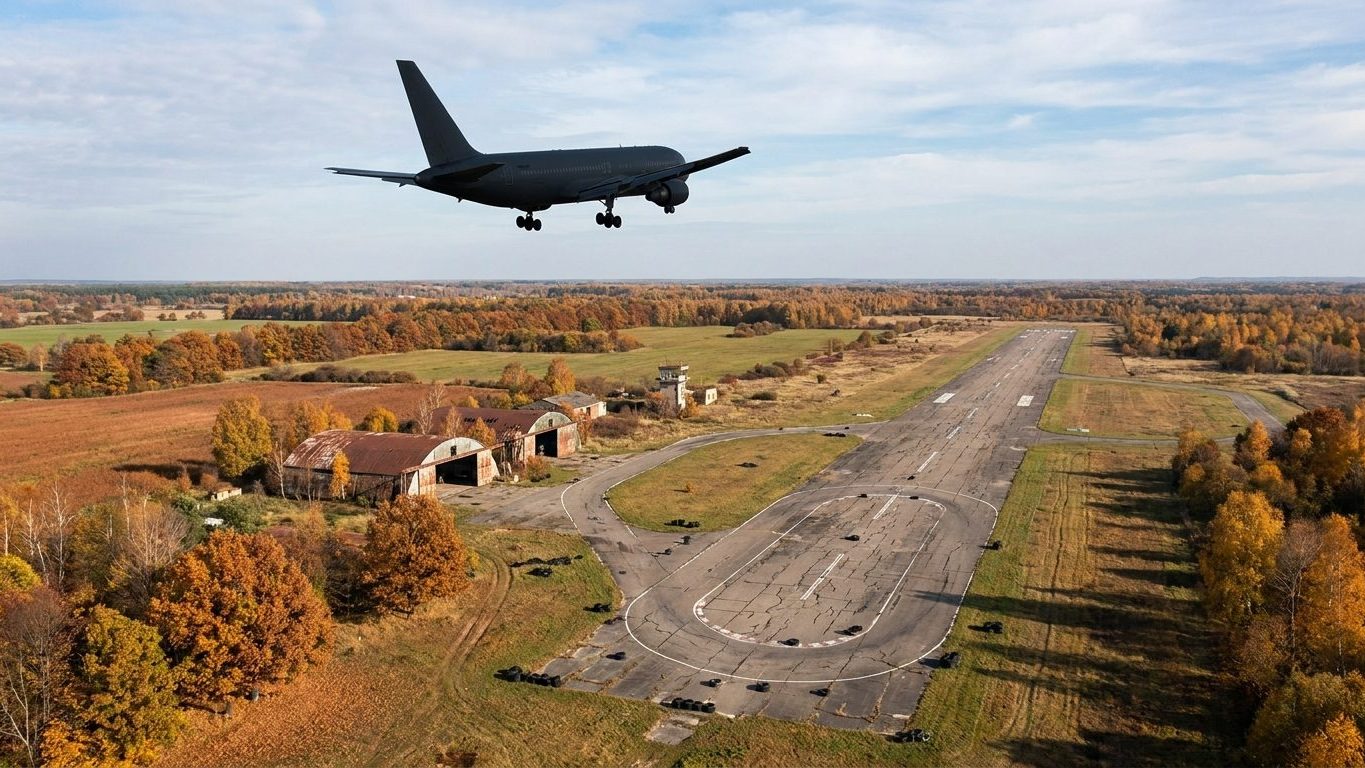
Silence is the first thing that hits you. In the cockpit of a Boeing 767 belonging to a Canadian airline, in 1983, a warning blares once, then falls quiet. A few moments later, a second signal sounds, and this time, nothing hums beneath the floorboards. The two engines have stopped, one after the other, at 12,000 meters above Canada.
No vibration. No engine roar. Just the hiss of air over the fuselage, and a modern airliner transformed into a glider weighing several tens of tons. The instruments dim in part, replaced by a minimal backup gauge. The crew realizes in a few seconds that this is no longer a single failure: it is fuel itself that is missing.
- A Boeing 767 took off with about half the fuel required due to confusion between imperial and metric units.
- Both engines stopped at an altitude of 12,000 meters above Canada in 1983.
- The captain, experienced in gliding, guided the engineless aircraft toward a former military base converted into a racetrack, saving all the passengers.
A unit conversion that makes all the difference
To understand, you have to go back a few hours, to the tarmac. The airline was undergoing a delicate transition: moving from the imperial system to the metric system. This Boeing 767 was among the fleet’s first aircraft to operate entirely in metric units, its fuel gauges displaying kilograms where almost all the other company aircraft still computed in pounds.
The problem surfaced when calculating how much fuel to load. A faulty gauge forced ground crews to measure reservoir levels manually, then convert that volume into weight to log it in the onboard system. But the conversion factor used was that of pounds, not kilograms.
The gap between the two units is about a factor of 2.2. Result: the aircraft took off with roughly half the fuel actually needed to cover the planned distance. No one, on the ground or in the cockpit, detected the error before departure.
Flying a commercial airliner without engines
A Boeing 767 is not designed to glide. Without the jets, most hydraulic and electrical systems rely on a small auxiliary wind turbine that deploys automatically and provides a minimum amount of power to operate the flight controls. It’s sufficient to steer the aircraft, not to regain altitude or compensate for any trajectory error.
The captain routinely practiced gliding as a hobby outside his professional duties. That experience proved decisive: the instincts of glider piloting, where every meter of altitude is treated as a scarce resource, allowed maintaining an optimal descent rate and estimating with unusual precision how far the aircraft could still travel without power. No commercial flight manual truly prepares you for this exercise.
The crew had to manage a landing gear that would not lock properly due to insufficient hydraulic power. Each decision took on a new dimension. There would be only one approach attempt, with no go-around possible if the aircraft was misaligned.
Touching down on a circuit in the thick of a race
The chosen runway had not functioned as an active airfield for a long time. It was a former military airbase repurposed into a motorsport circuit. That day, a sporting event was taking place there, with competitors, spectators, and vehicles lined up along the track.
Without engines, the airplane descended almost silently. This absence of the characteristic roar made the approach even harder to anticipate for those on the ground. The airplane touched down, sliding along the asphalt, and came to rest in the middle of the former base. No casualties were reported among the aircraft occupants or the circuit spectators.
The contrast is almost vertigo-inducing: a modern airliner, deprived of propulsion, finishing its run in the middle of an amateur auto racing event. The scene left a lasting mark on Canadian civil aviation, to the point of becoming one of the most studied case studies in pilot training.
What the incident changed
The subsequent investigation highlighted a chain of mistakes, rather than a single fault. The mix-up between imperial and metric units, the faulty gauge, the lack of cross-checks before takeoff: each link could have been addressed on its own. Together, they led to an under-fueled aircraft on a long domestic flight.
Procedures for fuel conversion and double-checking were strengthened as a result of the episode, with particular attention paid to transition periods between measurement systems. The story also became a classic example in aviation training, illustrating how a seemingly auxiliary skill, such as glider piloting, can make all the difference in an extreme emergency.
Forty years later, the aircraft in question continued flying for nearly another two decades after this episode, evidence that the airframe endured despite the severity of the landing. A quiet reminder that, sometimes, a tiny miscalculation is enough to turn a routine flight into a demonstration of composure under pressure.
Sources: poleposition.ca | radiohangar.com
