
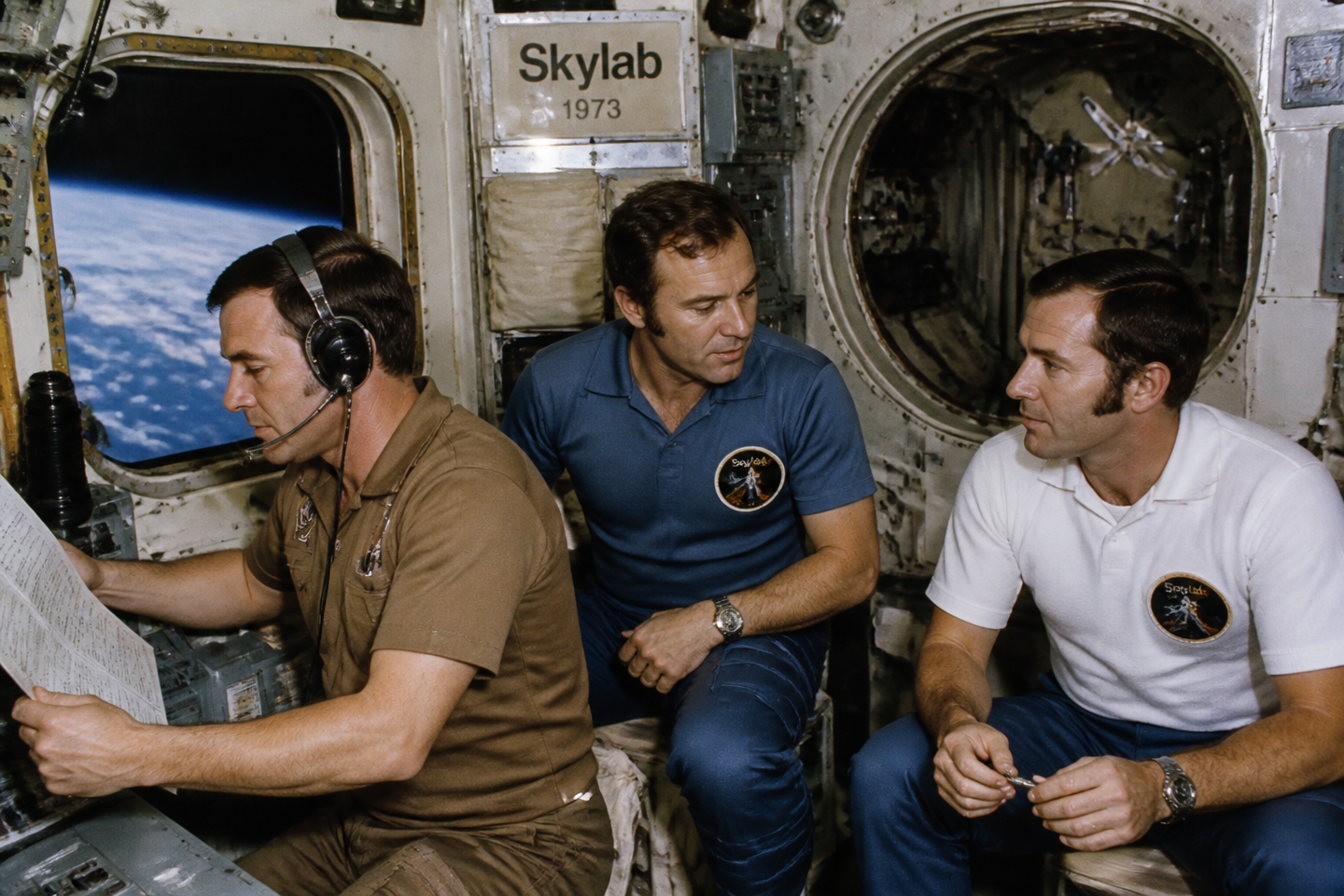
Imagine having to work sixteen hours a day, with no weekends, no real break, for nearly three months, crammed into a confined space 435 kilometers above the Earth. No union to contact, no recourse available, except the radio that connected you to the control center. This is precisely the situation three American astronauts found themselves in aboard Skylab, until the day they decided to cut the link. This episode, long obscure to the general public, reveals how even the heroes of space exploration have physical and mental limits.
When three men in orbit said stop to NASA
Skylab 4 was meant to be the most productive mission in American space history. NASA imposed sixteen-hour days on its three astronauts, relentlessly, week after week. In December 1973, Gerald Carr, William Pogue and Edward Gibson cut off communications with the ground. An improvised strike at hundreds of kilometers above Earth, one of the oddest episodes in the history of space exploration.
A schedule so tight it becomes absurd
Skylab 4 began with an overblown ambition. After Skylab 2 and Skylab 3, which had lasted 28 and 59 days respectively, the third expedition went so smoothly that NASA drew a premature conclusion: the astronauts could endure even more. The timetables were then calculated to the second, with no margin for error or rest, in a logic of maximizing every minute spent in orbit.
The three men gradually wore themselves out. Unlike the earlier crews, they had almost no time to observe the Earth, rest, or simply catch their breath between experiments. This constant pressure was added to a mood aboard the station that was already peculiar: upon their arrival, the astronauts discovered that the previous crew had left three mannequins bearing their likenesses, posed in positions that had earned lighthearted jests. A funny anecdote, but one that quickly contrasted with the atmosphere that truly settled in the station.
Fatigue built up and errors multiplied. The control center, in Texas, grew irritated by what it saw as a lack of discipline, not immediately grasping the real source of the problem: an humanly untenable tempo. Commander Gerald Carr had even radioed the flight director and the head of communications to try to clarify the origin of this unmanageable workload, without success.
Silence as the only weapon
Toward the end of December 1973, without warning, the astronauts stopped transmitting. For several hours, Houston lost all contact with the station, an unprecedented situation in the history of American manned flights. Some versions mention a cut of a little over 90 minutes, corresponding to a full orbit around the Earth, while other widely circulated accounts, later, speak of radio silence lasting nearly 24 hours. This disagreement continues to fuel debate today: a simple technical glitch or a real act of protest?
What is certain is that no sign of panic, no technical emergency was reported. The three men continued their work at their own pace, outside the imposed schedule. They also enjoyed, for the first time since their arrival, the view through the porthole, taking the time to watch the Earth glide underneath them, a luxury their schedule had never permitted before.
That radio silence, whatever its exact duration, acted as a calm, quiet form of resistance, but one with striking effectiveness in delivering a simple demand: ease off. When they reestablished contact, there was no aggression, no abrupt explanations, but a message clearly understood by the control center.
A space strike that changed the rules of the game
The return of communications comes without punishment. NASA understands the message and reevaluates its organization. A genuine negotiation then begins between the crew and the ground, culminating in an in-flight conference devoted exclusively to reorganizing work. Daily burdens are adjusted, true breaks are integrated into the schedules, and the crew’s efficiency, paradoxically, improves as a result.
This episode, long kept quiet, marked a turning point in the human management of long-duration missions. It fed later reflections on crew well-being, from the Space Shuttle era to the International Space Station, where the pace of work for astronauts now receives far more careful attention than it did during Skylab.
Skylab 4 ultimately lasted 84 days, a record at the time, with scientific objectives far surpassed. But it is this one-day interruption that remains, to this day, one of the most striking symbols of human limits when faced with scientific pressure.
More than fifty years after the events, this episode continues to provoke as much as it questions. Whether one speaks of a technical failure or a deliberate act of protest, the story of Skylab 4 underscores a reality too often forgotten in an era of perpetual performance: even in orbit, surrounded by the most advanced technologies, astronauts remain human beings, with physical limits and a sometimes vital need to simply slow down.
