
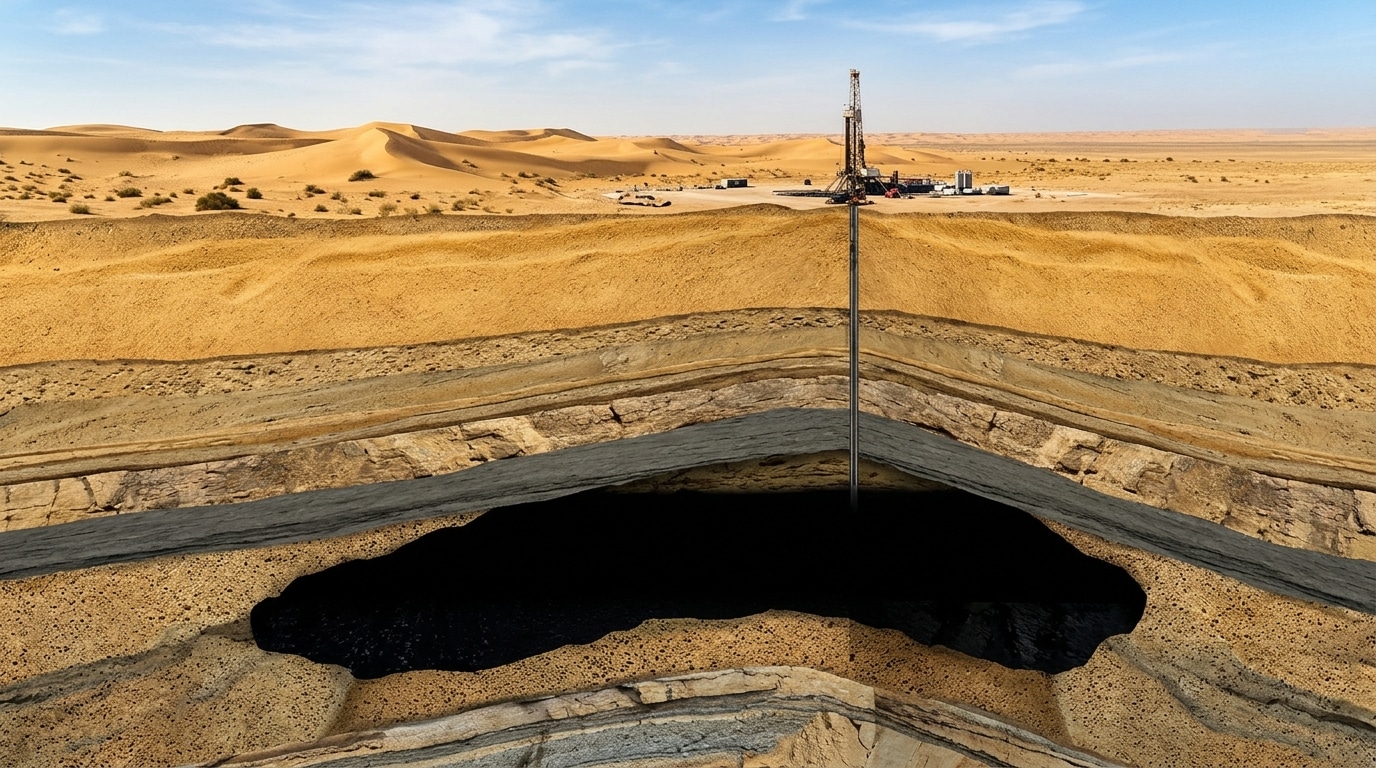
There exist scars that the Earth never fully heals. Beneath the Kuwaiti desert, just inches from a surface that appears immaculate, lies one of the greatest ecological wounds of the modern era. A frozen slick of oil, imprisoned by the sand, that no one has ever completely extracted. It has remained there since the early 1990s, silent, almost invisible, like a secret the desert refuses to reveal. This oil did not spring from an industrial accident nor from a tanker wreck. It was poured out deliberately, in an act of pure destruction, transforming an entire region into a vast chemical trap whose consequences we still measure today.
A war weapon disguised as an ecological catastrophe
When the Iraqi army retreats from Kuwait in the early 1990s, it does not merely leave. It deliberately opens the valves of the oil terminals. The aim is military, almost cynically: to make any landing by Allied forces on Kuwaiti shores impossible by flooding the coastline with a tide of crude. The oil escapes from eight tankers, a refinery, two terminals, and a storage field. This is not a leak; it is a voluntary opening of the taps, as if one were emptying a giant bathtub into the sea.
The result is beyond comprehension. According to estimates, between 4 and 11 million barrels of crude are poured into the Persian Gulf. For nearly three months, the oil continues to spill at a rate that could reach 6,000 barrels per day. Today we speak of the largest oil spill in history, not caused by bad luck or human error, but orchestrated as an act of war.
The desert that swallowed the oil and kept it
On land, the scene is equally staggering. About 300 oil lakes covered wide stretches of the Kuwaiti desert. Some burned, others did not. Those that escaped the flames faced a more insidious fate: they slowly seeped into the sand or evaporated, leaving behind vast deposits hardened into what is nicknamed the “tarcrete”. Imagine a crust of tar mixed with sand, a kind of natural black concrete, as hard as a sun-baked asphalt slab.
At the peak of the catastrophe, up to 200 km² of soil were covered with oil, forming roughly 250 lakes. In a matter of months, this surface contracted to about fifty square kilometers. But beware: it isn’t because the oil disappeared; it has simply sunk deeper, buried beneath sand blown by the wind. The desert, like a giant blotter, has swallowed a portion of the crude, shielding it from view but not from nature.
What thirty years of silence have left behind
This is where the chilling figure emerges. Among the millions of barrels spilled, it is estimated that about 1.2 million barrels of oil were trapped off Kuwait’s coast, in the gulf and beneath sediments, never recovered. Part of this mass still sleeps under a blanket of sand and tarcrete, frozen in time like an insect in amber.
The ecological toll, in turn, is read in living beings. Along the coasts, roughly 700 km of Saudi coastline—comprising sand, gravel, wetlands and mudflats—were contaminated. Nearly 100,000 shorebirds, those slender, elegant birds that probe the mud with their beaks, died either directly or indirectly. For certain species of cormorants and grebes, estimates suggest that 22 to 50% of their populations were decimated. A silent, camera-free massacre.
A toxic legacy that the sand can no longer hide
The cleanup undertaken after the conflict was estimated at about $700 million. A colossal sum, and yet far from enough to erase the traces completely. Even today, Kuwait manages unburned oils that continue to infiltrate the soil, contaminating more than 40 million tonnes of soil. The sand may cover the surface, but it serves only as a temporary lid on a much deeper problem.
What is most troubling is the near-irreversible nature of the damage to certain coastal habitats. Where mangroves and mudflats once filtered life, the oil has sealed the soil, suffocating the microorganisms that drive the entire ecosystem. The desert, for its part, keeps its fossilized lakes as mute witnesses to a human decision.
This story reminds us of a disturbing truth: some disasters cannot be repaired; they are managed, indefinitely. Beneath the sands of Kuwait, this forgotten oil continues its slow underground work, out of sight but never fully neutralized. As we hunt for fossil resources far and wide, what should we make of this toxic treasure that no one dares or wants to retrieve? Perhaps the real lesson rests there, buried beneath the desert crust, waiting for us to decide at last what to do with our most stubborn scars.
