
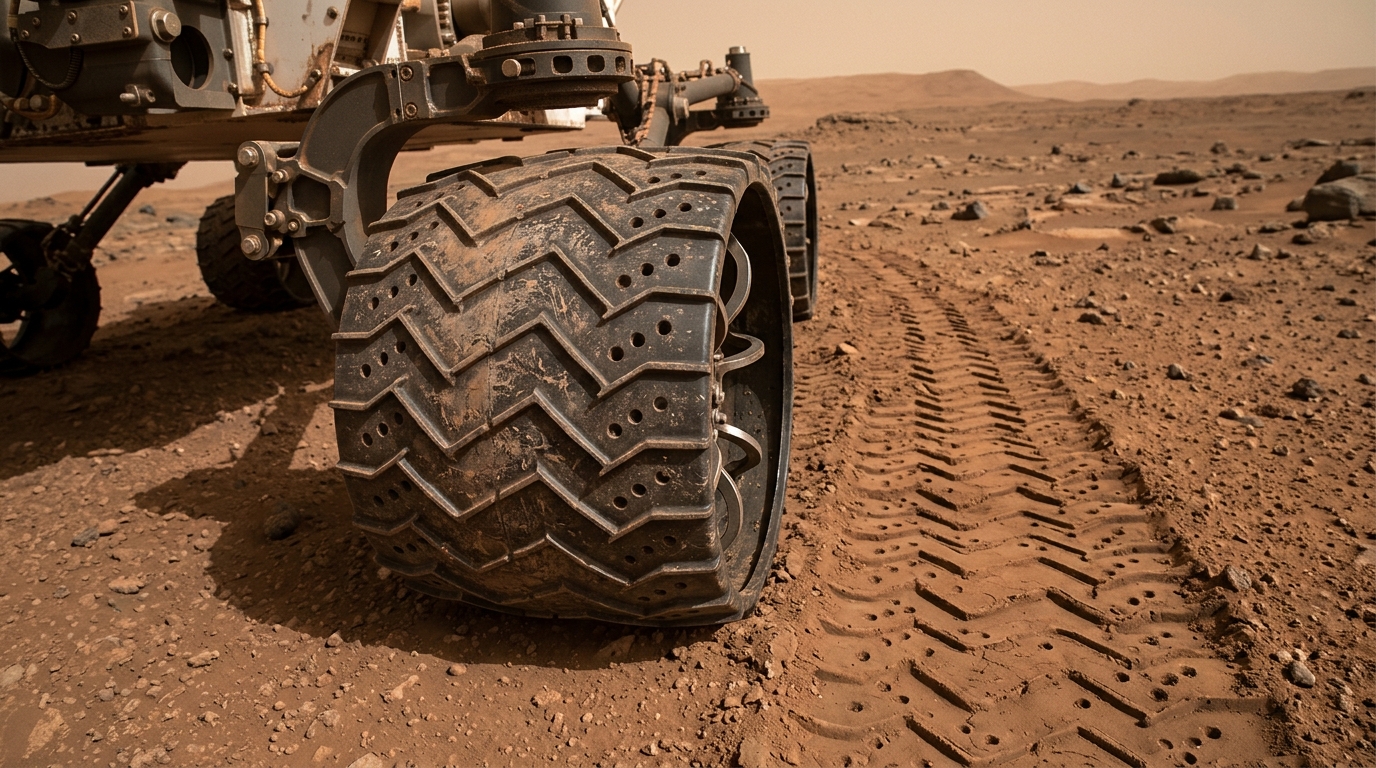
On Mars, no passerby will ever notice this detail. Not a rock, not a dune of ochre sand, not the slightest creature to decipher what Curiosity’s wheels patiently etch into the dust for more than a decade. And yet, every meter traveled by NASA’s rover carries an invisible signature, a coded message that only the engineers at the Jet Propulsion Laboratory know how to read from the photographs sent back from Martian orbit. It isn’t a matter of chance or a whim of a bored engineer: it’s an elegant technical solution to a concrete problem, that of knowing where you are when no GPS satellite watches overhead.
- The perforations in Curiosity’s wheels form the JPL sign in Morse code, used as a visual reference for visual odometry to compute the actual distance traveled despite wheel slip.
- Since the 2012 landing, the wheels have worn out faster than anticipated, forcing JPL to adjust certain traverses and rethink the wheel design for Perseverance.
- In the absence of GPS on Mars, NASA rovers rely on stereo vision and ground-pattern recognition to track and correct their navigation.
- A message etched in steel, meant for no one and for everyone at once
- Why NASA needs Mars to read Curiosity’s traces
- Morse as a calculation tool, not merely a wink
- What this detail reveals about modern space engineering
Curiosity’s six aluminum wheels measure about 50 centimeters in diameter each, and if you look closely at their surface you can spot perforations that are anything but random. Arranged in a precise pattern, they spell out the JPL symbol in Morse code, a discreet nod to the Jet Propulsion Laboratory, the California center that steers the mission for NASA. A kind of engineer’s wink, tucked there like a craftsman’s signature at the bottom of a work that no one, on Mars, will ever be able to admire.
But reducing this detail to a mere technical flourish would miss the point. For this metal motif serves a much more tangible function: it acts as a fixed visual reference, exploited by the rover’s cameras to monitor its own progress across terrain where conventional sensors quickly prove their limits.
Why NASA Needs Mars to Read Curiosity’s Traces
On Earth, a vehicle that wants to know its position relies on a network of satellites in orbit. On Mars, that option simply does not exist. The rover must manage on its own, blending several methods to estimate its path across kilometers. One of the most reliable is visual odometry, a technique that compares successive images of the Martian ground to calculate the rover’s true movement between two frames.
This approach proves especially valuable in zones where the wheels slip, such as loose sand or near a slope. In these conditions, wheel rotation sensors may indicate that the rover is advancing normally, while it is actually sliding in place. Only a visual analysis of the ground can reveal this offset. That is where the perforations come into play: appearing regularly in images captured by the on-board cameras, they provide a stable reference point, a kind of mechanical yardstick that the navigation software can track to determine the distance actually traveled.
Morse as a Calculation Tool, Not Just a Wink
What makes this tale especially delicious is that the Morse code was never conceived as a tribute to the JPL alone. From the outset, the engineers designed this marking as a practical calibration aid, a simple and inexpensive way to give the rover a motif that is easy to recognize among all others, carved directly into the wheel structure rather than added as an external, fragile accessory.
Since Curiosity landed in Gale Crater in August 2012, the motif has endured through more than a decade of Martian exploration. And the accumulated experience has allowed the JPL team to notice something unexpected: the wheels wear out much faster than anticipated, with tears and additional holes appearing that hadn’t been foreseen in the original design. This accelerated aging has led engineers to rethink certain traverses, avoiding terrains that are too harsh for the structure. A valuable lesson that directly influenced the wheel design of the newer rover Perseverance, landed in 2021 in Jezero Crater with a revised design to curb this kind of wear.
What This Detail Reveals About Modern Space Engineering
Beyond the anecdote, this Morse signature embodies a philosophy common to JPL engineers: turning a constraint into an asset. Rather than adding an extra device for navigation, they transformed a need for visual identification into an onboard calculation tool—efficient in resources and proven robust after years of use on hostile terrain.
More broadly, NASA’s Martian rovers rely on stereo vision and ground-pattern recognition to continuously correct their navigation in the absence of any satellite landmark. Keeping track of Curiosity’s wheel wear remains an ongoing concern for the JPL teams, with images transmitted from Mars regularly used to evaluate wear progression as the distance traveled increases. A painstaking, ant-like effort conducted millions of kilometers away, reminding us how space exploration often hinges on seemingly trivial details.
Thus, behind those tiny perforations in the aluminum lies far more than a discreet sigil: an inventive method of turning a piece of metal into a measuring instrument, and a way to give the rover the means to gauge its own progress on a world that offers no external aid. The next time an image of Mars shows the imprint of a Curiosity wheel, odds are a portion of that motif—hidden to the untrained eye—will continue quietly performing its role as a reference. And might there be other subtle details waiting to be noticed on the machines venturing through the solar system?
