
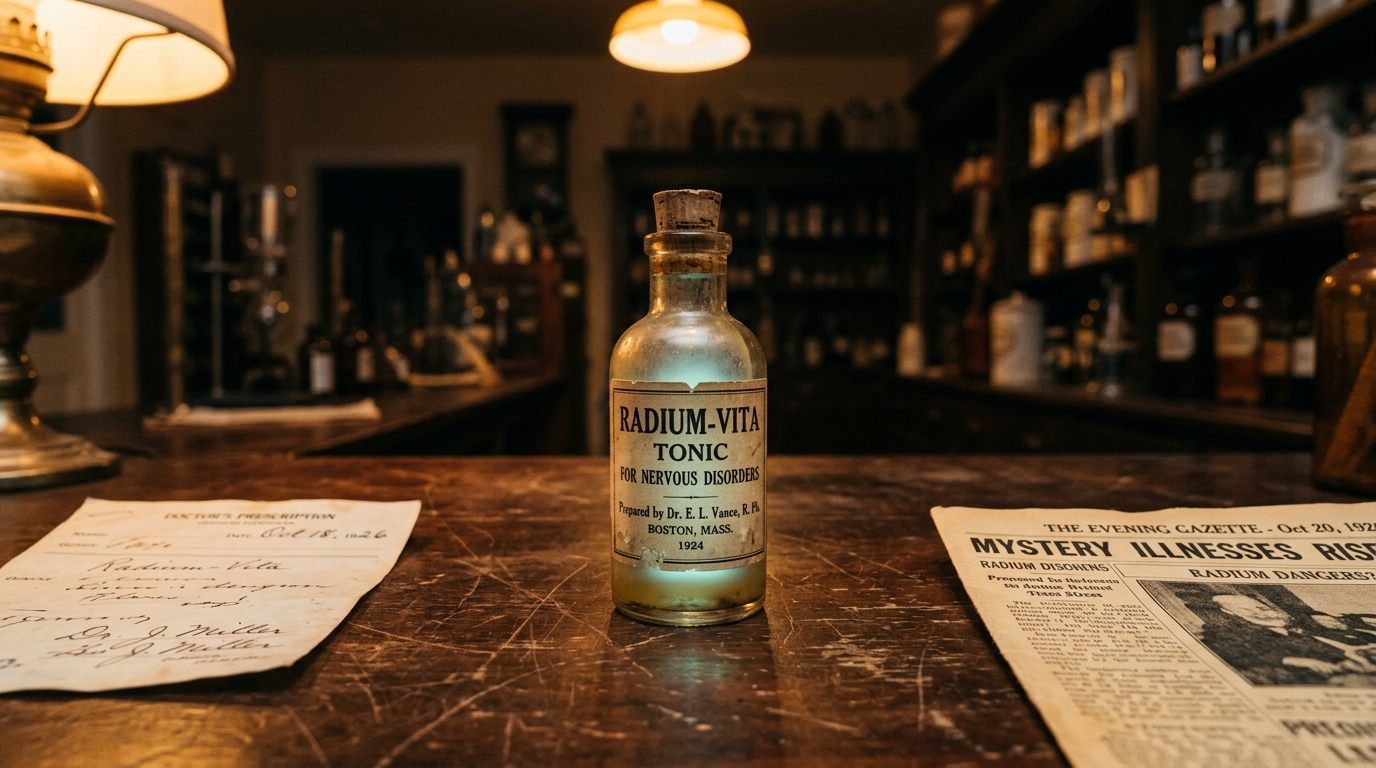
How can a man literally watch his jaw disintegrate simply by trying to treat an old pain in his arm? This dizzying question is posed by the tragic fate of Eben Byers, a wealthy American industrialist of the early twentieth century, convinced he had found in a small bottle of radioactive water the key to eternal vitality. His story, as fascinating as it is chilling, illustrates how misunderstood science can become a silent poison, and it forever changed how medicines are regulated in the United States.
- Radium, chemically close to calcium, lodges permanently in the bones and releases destructive alpha radiation from within.
- Eben Byers died in 1932 of bone cancer after consuming Radithor for years, a remedy based on radium and mesothorium.
- This scandal led the FTC and later the FDA to ban, as early as 1931-1932, most proprietary medicines containing radioactive substances.
- An American industrialist convinced he had found the fountain of youth
- Radium, this cousin of calcium that settles in the skeleton for life
- When Eben Byers’ face begins to literally collapse
- The Radithor scandal that forever changed American regulation
An American industrialist convinced he had found the fountain of youth
In the 1920s, radium fascinated as much as it reassured. Discovered a few decades earlier, this radioactive element was then praised by parts of the medical profession and by an industry eager to push it as a miracle. It is in this context that Eben Byers, a wealthy businessman and accomplished athlete, injures his arm in 1927. On the advice of his physician, Dr. C.C. Moyer, he begins consuming a preparation called Radithor, sold as a miracle remedy capable of stimulating the body and relieving pain.
Byers does not settle for a modest course. Convinced of the liquid’s benefits, he starts taking up to three bottles a day, claiming to feel renewed energy and an overall sense of well-being. In total, he would ingest nearly 1,400 bottles of this elixir over a few years, never suspecting that he was systematically poisoning himself, sip by sip.
Radium, this cousin of calcium that settles in the skeleton for life
To understand the drama playing out inside Byers’ body, one must examine radium’s chemistry. This element has an atomic structure very close to calcium, which means the body treats it exactly as if it were the mineral essential for bone strength. The result: instead of being eliminated, ingested radium becomes permanently fixed in the skeleton, incorporating into bone tissue as if it had always belonged there.
The problem, however, is that radium emits alpha radiation. While it remains outside the body, this radiation is relatively harmless, blocked by the simple barrier of the skin. But once ingested and embedded at the very heart of the bones, it releases its energy directly to the surrounding cells, with no protection. It’s a bit like quietly replacing the bricks of a house with time bombs: from the outside, nothing changes, but from within, the structure degrades slowly, invisibly and irreversibly.
The Radithor formula, developed by William J.A. Bailey, paired radium with dissolved mesothorium in distilled water. A tonic-sounding cocktail that, in reality, turned every steady consumer into a true little radioactive ambulant source.
When Eben Byers’ face begins to literally collapse
The first alarming signs appear in 1930, when Byers’ teeth begin to loosen and then fall out one after another. What started as a cosmetic nuisance soon proves to be the visible symptom of a catastrophe far deeper. The radium accumulated for years in his jaws gnaws away at the bone structure from the inside, triggering cascading necroses.
In 1931, a lawyer from the Federal Trade Commission, investigating Byers’ case, describes a nightmare scene: almost all of the industrialist’s upper and lower jaws had to be surgically removed, and real holes begin to form in his skull. The man who hoped to strengthen his skeleton saw his face crumble, piece by piece, under the radiation he had absorbed in small doses for years.
Eben Byers dies on March 31, 1932, officially of bone cancer attributed to this radioactive poisoning. His ordeal does not end with his death: because his remains still emitted extremely high levels of radioactivity, he is buried in a lead-lined coffin, the only way to contain the radiation continuing to emanate from his skeleton. When his body is exhumed in 1965 for study by researchers, thirty-three years after his death, it still shows an activity measured at 225,000 becquerels, a chilling proof of the persistence of radium in bone tissue.
The Radithor scandal that forever changed American regulation
The dramatic and widely publicized death of Eben Byers exploded like a bomb in American public opinion. Until then, remedies based on radioactive substances circulated freely, backed by a pseudo-scientific discourse praising their supposed energizing virtues. The Byers case abruptly reminded everyone that these products, far from harmless, could destroy a human body from the inside, with a slow and inexorable pace.
On December 19, 1931, the Federal Trade Commission ordered an immediate halt to any therapeutic claims regarding Radithor. This case, coupled with the equally tragic story of the Radium Girls (workers poisoned by painting watch dials with radioactive paint), pushes health authorities to harden their stance considerably. In 1932, the FDA ultimately banned the vast majority of proprietary medicines containing radioactive substances, thus putting an end to a therapeutic craze as popular as it was dangerous.
Eben Byers’ story continues to be taught today as a striking example of the excesses that can occur when enthusiasm for a recent scientific discovery outruns elementary caution. The radium, fixed in his bones as if it were calcium, literally carved out his own end, vertebra after vertebra, tooth after tooth.
Nearly a century later, as autumn repeatedly reminds us how fragile our relationship with health and miracle cures remains in the face of shifting trends, the story of Eben Byers still resonates. It invites us to ask how many present-day promises of well-being, pitched as revolutionary, may also hide dangers that only time will reveal.
