
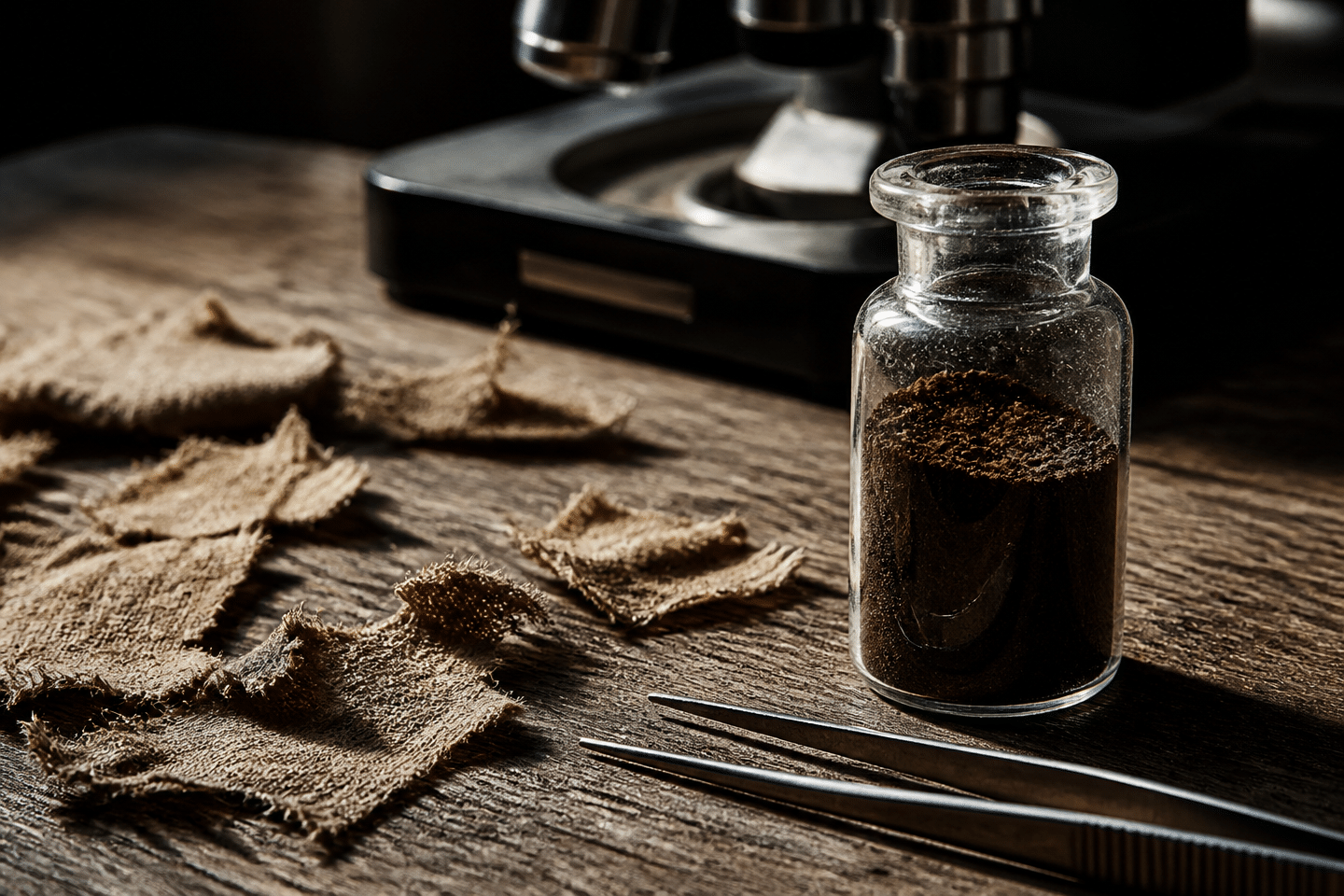
For centuries, European apothecaries and doctors prescribed mummy powder as a miracle cure. A team of researchers has just analyzed 24 samples from museum collections. The result: behind this mysterious substance lie mostly tree resin, an Egyptian word finally deciphered, and a genuine effect on cells infected by influenza.
- Analysis of 24 samples of Mumia vera reveals it chiefly consisted of aged conifer resin used in the embalming process
- The detection of Aloe-derived compounds sheds light on an Egyptian term remaining misunderstood for 3500 years and enables identifying a mummified head by its molecular signature
- A historical extract of Mumia vera modestly protected influenza-infected cells, although its major compound tested alone proved inactive
- When mummy powder contained mostly… tree resin
- The mystery of a 3,500-year-old Egyptian word finally solved thanks to a mummified head
- Influenza-infected cells better protected by a remedy centuries old
When mummy powder contained mostly… tree resin
Mumia vera aegyptiaca is not a myth. This remedy, made from Egyptian mummies, was indeed sold in European pharmacies from the medieval period through modern times. It was marketed as a universal treatment, able to cure all sorts of ailments.
To understand what this powder truly contained, a team of researchers combined Egyptology, the history of pharmacology, and a cutting-edge technique called metabolomics LC-MS/MS. In practice, this method identifies the molecules present in a sample, much like listing the ingredients of a dish that has been cooked for centuries.
The scientists screened 24 objects from university collections and pharmacy museums. Among them: historical products sold as Mumia vera, mummified body parts, embalming residues, bandages, and even two mummified skulls. A heterogeneous collection, reflecting the variety the trade produced over centuries.
The verdict is unequivocal: materials labeled Mumia vera vary tremendously from sample to sample. Yet a molecular signature recurs, namely aged conifer resins. These compounds, abietane-type diterpenoids that have undergone oxidation, betray the vast presence of tree resin used during embalming, later recovered centuries hence to craft the famous remedy.
The mystery of a 3,500-year-old Egyptian word finally solved thanks to a mummified head
The analysis also revealed a surprise that does not concern medieval apothecaries, but directly the Egyptians of antiquity. Several samples contain metabolites associated with Aloe, notably aloeresin A and D, and compounds related to aloins. These molecules suggest that exudates from Aloe spp. were used in ancient Egyptian embalming practices.
This discovery sheds new light on a long-standing puzzle in Egyptology. An Egyptian term dating from the second millennium BCE had remained unresolved by scholars. The current hypothesis is that this word referred precisely to Aloe or a derivative product derived from it.
metabolomics also enabled a small museum feat. By comparing molecular signatures, the researchers linked an unidentified powder to a specific mummified head preserved in a collection. This curator-driven association had not been securely documented until now: chemistry did the work that archiving had not managed to accomplish.
Influenza-infected cells better protected by a remedy centuries old
The most intriguing question remains: did this ancient remedy have a genuine biological effect? To verify, the researchers tested an historical extract of Mumia vera aegyptiaca on MDCK cells, a cell line commonly used to study the influenza virus.
The extract modestly protected these cells against the cytopathic effects of the virus, i.e., the damage that influenza typically inflicts on them. In other words, cells exposed to the extract fared better against infection than those that were not treated.
The researchers then aimed to isolate the compound responsible for this effect. They selected 7-oxodehydroabiétic acid, the major constituent in the extract. But when tested alone, it proved inactive. This nuance is important: it does not directly validate the historical medicinal uses of mummy powder.
All the data generated by this study, derived from LC-MS/MS analysis, have been deposited on the GNPS-MASSIVE platform, enabling other research teams to consult and re-examine them.
Published in PNAS, this study illustrates how modern science can reinterpret ancient practices long deemed to be mere superstition. Mummy powder was neither magical nor completely inert: it was primarily a complex blend of resins, plant extracts, and human remains, some components of which could legitimately interact with virus-infected cells. New research indicates that compounds derived from mummy materials could indeed extend the survival of cells infected by certain viruses, a finding that invites continued exploration of these forgotten remedies rather than definitively consigning them to the realm of historical curiosities.
