
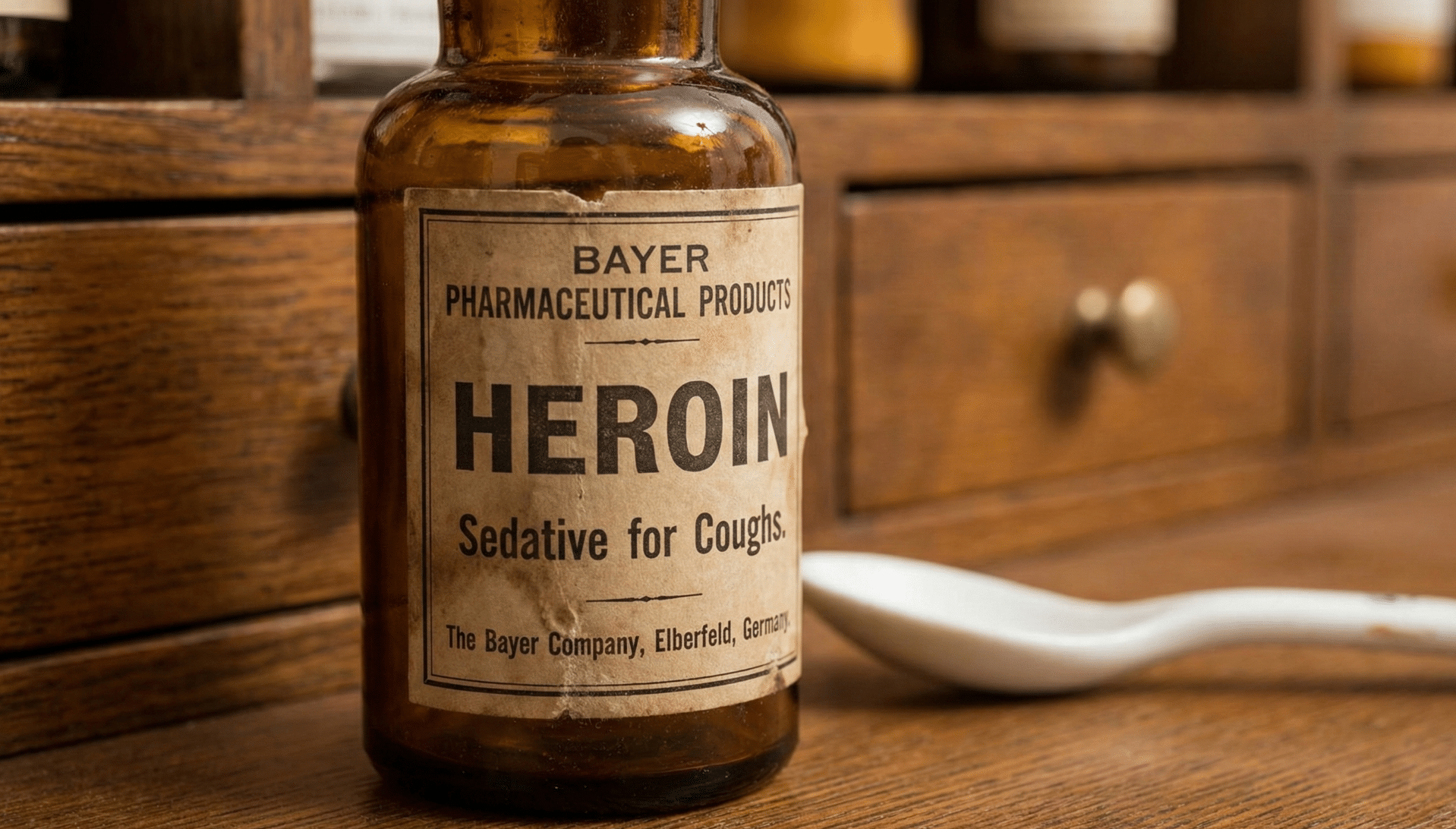
We are living in an era defined by the opioid crisis, where these substances symbolize destruction, addiction, and lives shattered. It is therefore hard for our modern minds to imagine the following scene: a caring mother in 1900 going to the pharmacy to buy a bottle of heroin to treat her baby’s small cold. This is not dystopian alternate history, nor fake news. For more than a decade, heroin was a publicly available over‑the‑counter medicine, marketed by one of the world’s most respectable companies.
In the Shadow of Aspirin
It all begins in 1897, at Bayer’s laboratories in Germany. The company is buzzing with energy. A young chemist named Felix Hoffmann has achieved a double feat. In the span of two weeks, he synthesizes two molecules that will go down in history. The first is acetylsalicylic acid, which the world will know as Aspirin. The second is diacetylmorphine.
At the time, tuberculosis and pneumonia were ravaging Europe and the United States. Coughing was not a mere nuisance, it was a killer. Physicians were desperately seeking a powerful antitussive that would not be as addictive as morphine, which was already widely used. When Bayer tested Hoffmann’s new molecule on its employees, the results were spectacular. Subjects reported that their cough disappeared instantly and, more importantly, that they felt “heroic” (heroisch in German), flooded by a sense of power and euphoria. The commercial name was instantly chosen: heroin.
The Marketing Lie of the Century
Bayer launched the product in 1898 with a marketing campaign unusually aggressive for the era. The main selling point is astonishing in hindsight: heroin was presented as a safe and “non-addictive” alternative to morphine. Worse still, it was marketed as a remedy to cure morphine addicts of their dependence.
The medicine came in every form imaginable: lozenges, powders, elixirs, and syrups. It was prescribed for everything: asthma, bronchitis, dry cough, and even menstrual pains. Advertisements targeted children specifically. Vintage posters show mothers giving a spoonful to toddlers, or children reaching for the miraculous bottle to ease teething pains. Doctors were enthusiastic: patients stopped coughing, slept well, and maintained a steady mood. And for good reason: they were under the constant influence of a pure opioid.
A Biological Time Bomb
It took a decade for physiological reality to catch up with the marketing narrative. What Bayer’s scientists had not anticipated (or had chosen to ignore) was the drug’s metabolism.
Once ingested, heroin travels to the liver where it is metabolized… into morphine. But thanks to its chemical structure (the acetylation), it crosses the blood-brain barrier much more rapidly than plain morphine. In short, Bayer was not selling a substitute for morphine, but a super-morphine with rapid action. At the start of the 1900s, American and European hospitals began to see a new category of patients: ordinary people, with no criminal past, completely dependent on their “cough syrup.”
The End of Innocence
Facing mounting evidence and the rise in crime linked to dependence, public opinion shifted. Bayer eventually ceased production in 1913, quietly removing heroin from its catalog to focus on its other baby, Aspirin. In the United States, it would take until 1924 for all manufacture and sale of heroin to be completely banned.
This anecdote remains one of the sharpest reminders in the history of medicine. It teaches us that the “established science” of one era can become the health scandal of the next, and that the line between a miracle cure and a deadly poison is sometimes a matter of time.
