
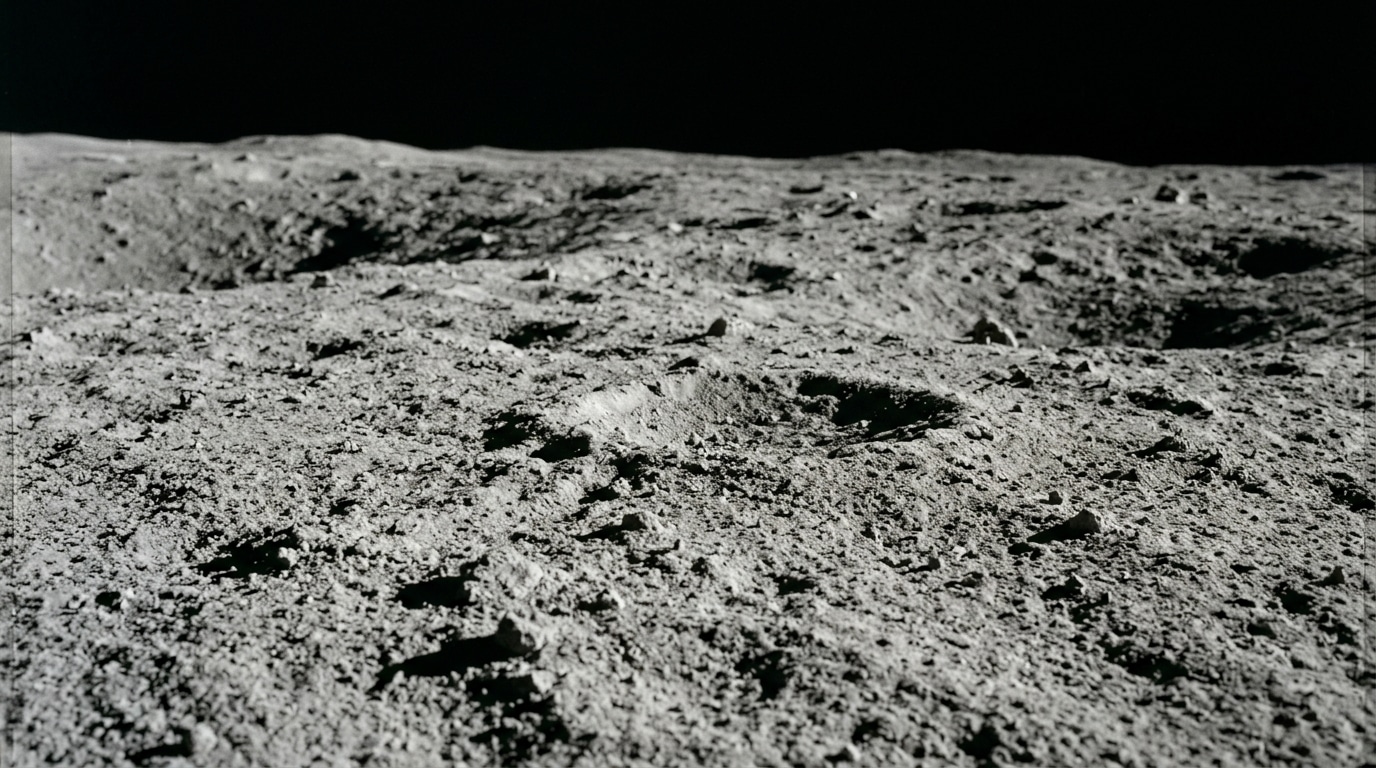
Imagine for a moment that you place your foot on the Moon. Your boots sink a little, and a gray powder clings instantly to your suit, wends its way into the tiniest joints, sticks to your gloves like powdered sugar on damp fingers. This dust, the astronauts of the Apollo missions detested. And yet it stands as one of the most striking testimonies to the violent history of our satellite. For here lies the paradox: on the Moon there is neither heavy rain nor gusts of wind, none of those agents that on Earth flatten rocks into sand and dust. So how can the entire surface be draped with a layer so fine, lighter still than the flour we sift in bakeries? The answer lies in one word: the regolith. Let us plunge together into this mystery.
On the Moon, no rain or wind: so where does this dust come from?
On our planet, dust is the product of a long process of wear. Water runs, freezes, and splits rocks; the wind carries grains; plants crack stone with their roots. This is what geologists call erosion. Yet the Moon is a frozen world, without a proper atmosphere, without oceans, without rivers. No breath sweeps its plains, no droplet falls on its reliefs. Logically, its surface should remain bare, mineral, intact.
And yet, the opposite is true. The Moon is entirely enveloped in a mantle of dust, sometimes several meters thick. This gray carpet even has a perplexing texture: the grains are exceedingly fine, with an average size ranging between 40 and 800 micrometers, often finer than the flour particles we sift in kitchens. The question then arises on its own: if neither water nor wind are responsible, who could have ground the lunar rock into such powder?
The Moon’s true sculptor is named meteorite
The answer comes from the heavens. Lacking a protective atmosphere, the Moon endures a relentless bombardment from meteoroids and micrometeoroids. On Earth, the vast majority of these projectiles burn up as they pass through the air, drawing the shooting stars we admire on summer evenings. But on the Moon, nothing slows them down. They crash at tremendous speeds, sometimes at tens of kilometers per second.
Each impact acts like a tiny cosmic hammer blow. For billions of years, these repeated shocks fragment, pulverize, and churn the surface rock without respite. To this wear are added the solar wind, that flux of particles emitted by our star, as well as cosmic radiation, which gradually alter the material. All of these phenomena go by the name of space weathering. It is this process, not terrestrial erosion, that has patiently shaped the layer of regolith. In other words, lunar dust is the scar, etched into the ground, of billions of years of collisions.
When rock melts, breaks, and fuses back into dust
The most fascinating aspect is the intimate mechanism of this transformation. When a meteorite strikes the Moon, the energy of the impact is so great that the rock does not simply crack: it can locally melt, then solidify into glassy fragments. One witnesses an odd ballet of matter, where the stone breaks apart, partly vaporizes, and then reassembles into new particles.
This is what explains the mosaic nature of the regolith. In examining it, one finds fragments of rocks and minerals, but also breccias (chunks welded together by heat), glass beads and the agglutinates, these curious masses where grains and vitreous shards are fused together. The lunar dust is thus not mere sand: it is a geological patchwork, a memory of an uninterrupted downpour of impacts. Here is the secret finally revealed: the regolith is born from meteorite collisions that relentlessly fragment and vitrify the rock, reducing it to ultra-fine grains.
This dust that astronauts fear: the key takeaways
On paper, this powder may seem harmless. In reality, it has given explorers quite a run for their money. In the absence of wear, its grains remain angular and sharp, almost like crushed glass. Worse still, they carry static electricity and cling to anything they touch. During Apollo, this dust proved a nightmare: it blurred vision, clogged equipment, wore down surfaces, and compromised the seals of the suits. Brought aboard the confined modules, it triggered sneezing, irritated eyes, and inflamed throats.
Today, this much-dreaded material nonetheless fascinates engineers. Some aim to transform it into naturally tinted glass to forge solar cells resistant to radiation. Others use it to reinforce composites or to extract silicon destined for high-efficiency panels. As humanity plans a sustainable return to the Moon, mastering the regolith is no longer optional but essential.
Thus, this gray carpet that covers our satellite is neither a whim of nature nor the product of an invisible wind: it is the tangible trace of billions of years of cosmic bombardment. Once an enemy, perhaps an ally tomorrow, this dust finer than flour could well become the Moon’s builders’ first resource. And if the future of our presence in space hinges on, indeed, a single grain of dust?
