
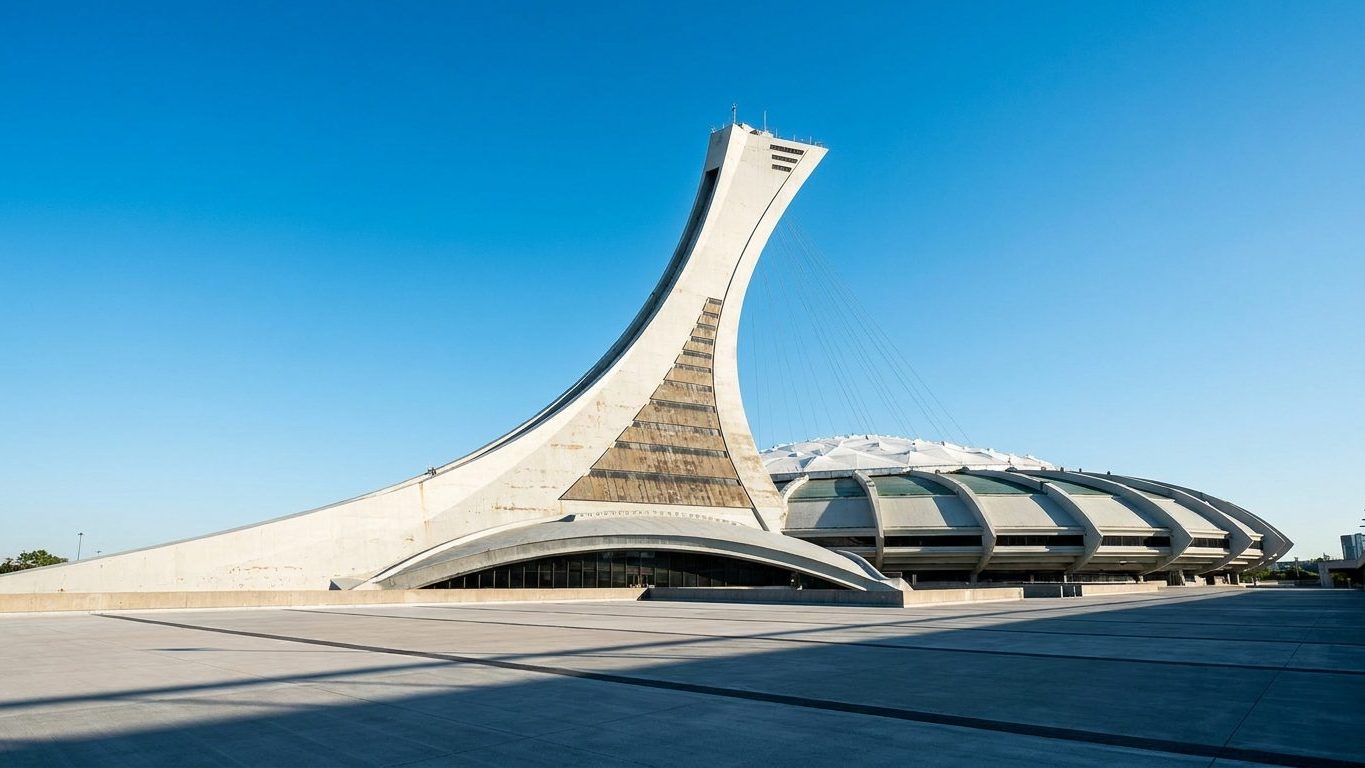
Montreal’s Olympic Stadium is facing a fresh bill, coming nearly twenty years after the last one was settled. Quebec plans to invest 870 million dollars to replace both the roof and the technical ring of the Montreal Olympic Stadium, which has reached the end of its useful life. This astronomical sum arrives at a moment when the original debt from the 1976 Games had only been fully paid off on August 20, 2006, after Quebecers had to shell out 2.402 billion dollars to close the file.
- Quebec is investing 870 million dollars to replace the roof and the technical ring of the Olympic Stadium.
- The original roof, designed as retractable, has suffered more than 20,000 tears since its 1976 construction.
- The new roof will be a fixed steel-elastomer structure with an estimated 50-year lifespan.
A stadium built for the Summer of 1976, never quite finished
The Organizing Committee for the Olympic Games claimed it could cap the installations at 190 million dollars, with the stadium itself costing 71 million. The project was entrusted to French architect Roger Taillibert. He proposed a bold vision: a building shaped like a giant seashell, open at the center, sheltered by a removable roof. Above it rose a 165-meter-tall habitable tower, tilted, intended to hold the roof cables.
The construction faced numerous problems: strikes, corruption, and significant delays. When the Games opened in 1976, the Stadium lacked a roof, and the tower was not even completed.
It would take twelve more years to see the leaning tower completed.
The roof that never kept its promises
A suspended roof hung from a tilted tower brings multiple vulnerabilities. The cables continuously bear the load of the membrane, whatever the weather. The fabric ages under ultraviolet rays, expands in summer, contracts in winter, and ends up accumulating rainwater or snow rather than shedding it.
Tears began appearing as early as 1991, so that by 1993 the Régie des installations olympiques abandoned the idea of retractability, and the fabric became fixed until its replacement, in May 1998, by a new version.
This second fabric did not fare any better. On January 18, 1999, a snow collapse left a gaping hole in the stadium’s fabric.
Before the government’s first decision to dismantle the roof, in 2017, nearly 7,500 tears had to be repaired since the structure’s construction. The figure kept rising. By 2024, the roof was torn in more than 20,000 places and threatened to force the site’s closure.
870 million later, the Olympic bill restarts
The 870-million-dollar project was officially announced on February 4, 2024 by the government of François Legault. Quebec ultimately chooses a fixed, rigid structure with an estimated 50-year lifespan, definitively turning away from the retractable-roof concept.
The central portion of the roof, composed of steel and elastomer, will be supported 75% by the stadium mast and 25% by the 38 consoles that make up the existing structure. Its broad edge, made of translucent glass, will allow daylight to enter. The concrete technical ring will be replaced by a steel tube with a curved cladding to harmonize with the stadium’s architecture.
The fabric that covered the Olympic Stadium spanned 27,000 square meters. Its removal, along with the cables and supporting structures, mobilized up to 300 workers.
Quebec taxpayers thus find themselves financing a second time a project whose initial debt took thirty years to extinguish. And the bill could yet grow: the list of ongoing infrastructure projects in the government includes other investments related to the stadium not included in the 870 million budget, notably 20 million for replacing the sound equipment and 28.6 million for the electrical system.
Sources: quebec.ca | ici.radio-canada.ca | tourismexpress.com
