
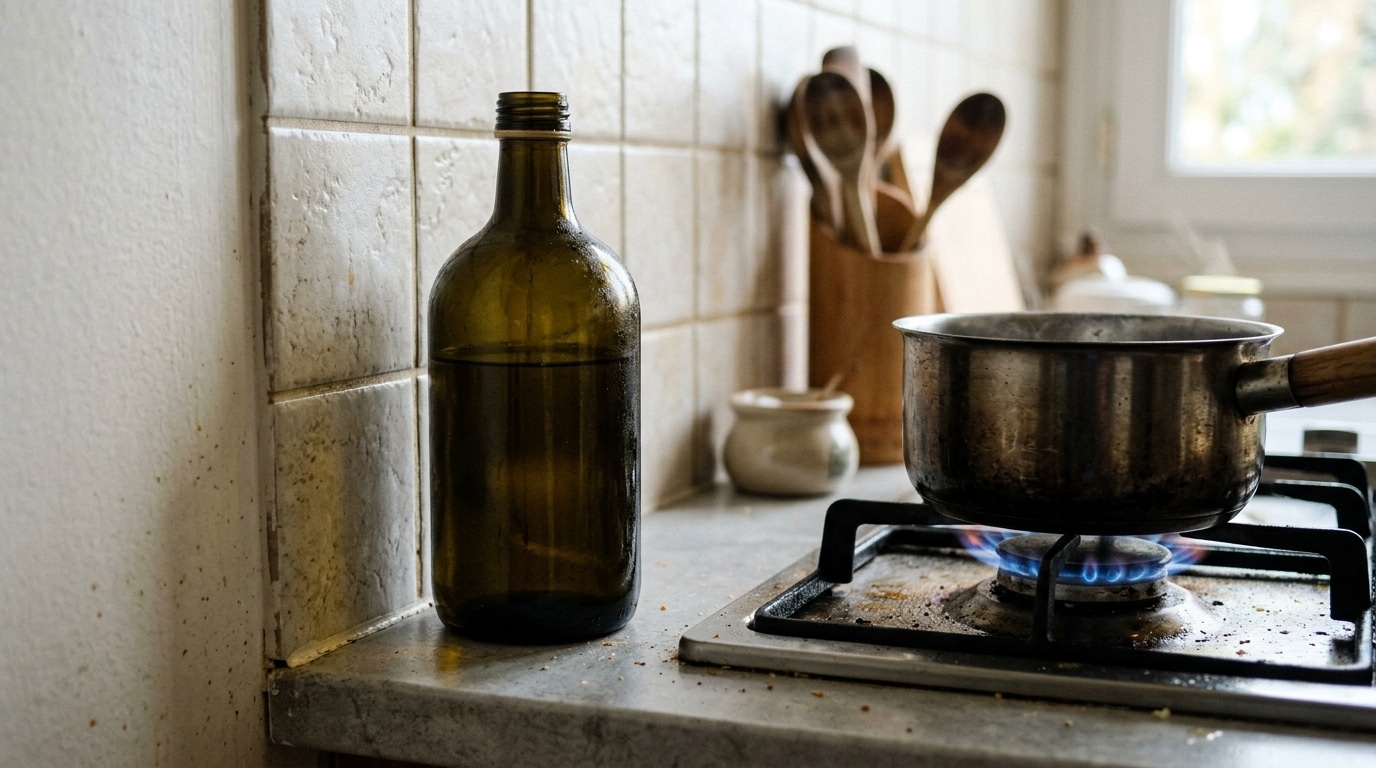
The French consume around 110,000 tonnes of olive oil every year, a figure that speaks volumes about the role this golden bottle plays in our kitchens. Cold-pressed and praised for its cardiovascular and anti-inflammatory properties, it has become the symbol of a healthy diet, almost a wellness totem proudly resting on the work surface. But here’s the catch: this seemingly natural act—placing the bottle right next to the stove so it’s always at hand—could be quietly sabotaging everything that gives it nutritional value. A banal, almost decorative habit that actually hides a real invisible waste.
- Heat, light, and oxygen gradually degrade olive oil’s polyphenols, with losses ranging from 349 mg/kg to as low as 118 mg/kg depending on storage conditions.
- These polyphenols (oleocanthal, hydroxytyrosol) underlie the oil’s anti-inflammatory and protective properties, recognized by the European Food Safety Authority as a health claim at a threshold of 5 mg per day.
- To preserve their benefits, store the oil in an opaque, tightly closed bottle, away from heat and light, and prefer consuming it raw.
- Why heat and light are the oil’s worst enemies
- The polyphenols, these fragile compounds that make all the difference
- The right actions to preserve your olive oil’s benefits in daily life
Why heat and light are the oil’s worst enemies
Extra-virgin olive oil isn’t a inert product quietly sitting in its cupboard. It’s a living substance, rich in sensitive compounds that react to its environment. Exposed to the heat generated by the burners or to daylight filtering through a window, it begins a gradual oxidation process. The polyphenols are indeed prone to degrade under the combined influence of light, heat and oxygen—three factors perpetually present in the cooking zone of a typical kitchen. In other words, the bottle that seems convenient at hand gradually becomes a small degradation factory. The polyphenol content then declines progressively during storage, especially when the oil is exposed to these unfavorable conditions. A paradox for a product often purchased precisely for its benefits.
This fragility isn’t merely theoretical. Comparative analyses among olive oil varieties illustrate the magnitude of the phenomenon: a well-preserved bottle of the Bouteillan variety shows a total phenol content of 349 mg per kilogram, while a Salonenque oil that has undergone significant oxidation drops to only 118 mg per kilogram. Almost three times fewer protective compounds, simply because of storage conditions. Quite enough to seriously reconsider the bottle’s placement on the worktop.
The polyphenols, these fragile compounds that make all the difference
If extra-virgin olive oil enjoys such a sterling reputation, it’s largely thanks to these famous polyphenols: oleocanthal, hydroxytyrosol, oleacein and tyrosol. Oleocanthal, in particular, is responsible for that tingly sensation at the back of the throat when tasting a good oil; its anti-inflammatory action would be comparable to ibuprofen, with an added brain-protective effect. Hydroxytyrosol is the most studied phenolic alcohol and forms the basis of a health claim: the European Food Safety Authority permits the statement that olive oil polyphenols contribute to protecting blood lipids from oxidative stress, provided one consumes at least 5 milligrams per day. European regulation also uses a daily reference intake of 20 grams of olive oil, roughly two tablespoons, to enjoy these effects.
The problem is that these benefits assume the oil remains rich in polyphenols by the time it reaches the plate. Between purchase and the last drop, several months can pass, often under unfavorable conditions. An oil that has lost most of its active compounds remains edible and pleasant on the palate, but it offers little more than ordinary fat. The whole point is that olive oil is not magical on its own; its benefits depend largely on its freshness and on how it has been stored from production to kitchen.
To make matters worse, another issue is less known by the general public: the actual quality of bottles sold on shelves is not always guaranteed. In a survey conducted across 211 outlets and 130 products, more than one-third of the stores inspected showed anomalies. The misclassification of virgin oils sold as extra virgin is among the frauds most frequently detected, as are mislabeling of origin. A European report even ranks oils and fats among the continent’s most falsified products. In short, an oil already fragile at purchase has little chance to endure if stored haphazardly afterward.
The right actions to preserve your olive oil’s benefits in daily life
Good news: preserving the advantages of olive oil does not demand special effort or costly investments, just a few simple habits. The golden rule can be summed up in one sentence: keep it tightly closed in an opaque bottle, stored in a cupboard, away from heat and from the window, to limit the oxidation that destroys its polyphenols and vitamin E. Concretely, that means bidding farewell to the pretty transparent bottle resting beside the burners, however aesthetically pleasing it may be on a sunlit shelf.
- Prefer an opaque or dark container
- Store the oil in a closed cabinet, away from direct light
- Keep the bottle away from the burners and any source of heat
- Always reseal the cap after use to limit contact with oxygen
- Reserve extra-virgin olive oil for raw use, as a dressing, to fully enjoy its polyphenols
As for cooking, olive oil tolerates moderate heat fairly well, with a smoke point between 190 and 210 degrees Celsius, suitable for gentle to medium cooking. Frying is, however, strongly discouraged. But to truly benefit from its anti-inflammatory properties, nothing beats a cold drizzle over a salad or over a dish that has just been cooked, where the polyphenols remain intact and fully active. From an economic standpoint, this careful approach to storage is not negligible: while extra-virgin oil traded around €9 per kilogram at its peak in 2024, it now trades around €3.10 to €3.20 at origin, representing a substantial loss of value that makes it all the more regrettable to let a high-quality oil degrade due to a simple shift in habits.
Ultimately, it’s only a move of a few tens of centimeters in the kitchen, but the effect on the olive oil’s nutritional quality can be substantial. A small, nearly invisible gesture that keeps intact the properties for which this oil has been chosen for generations.
