
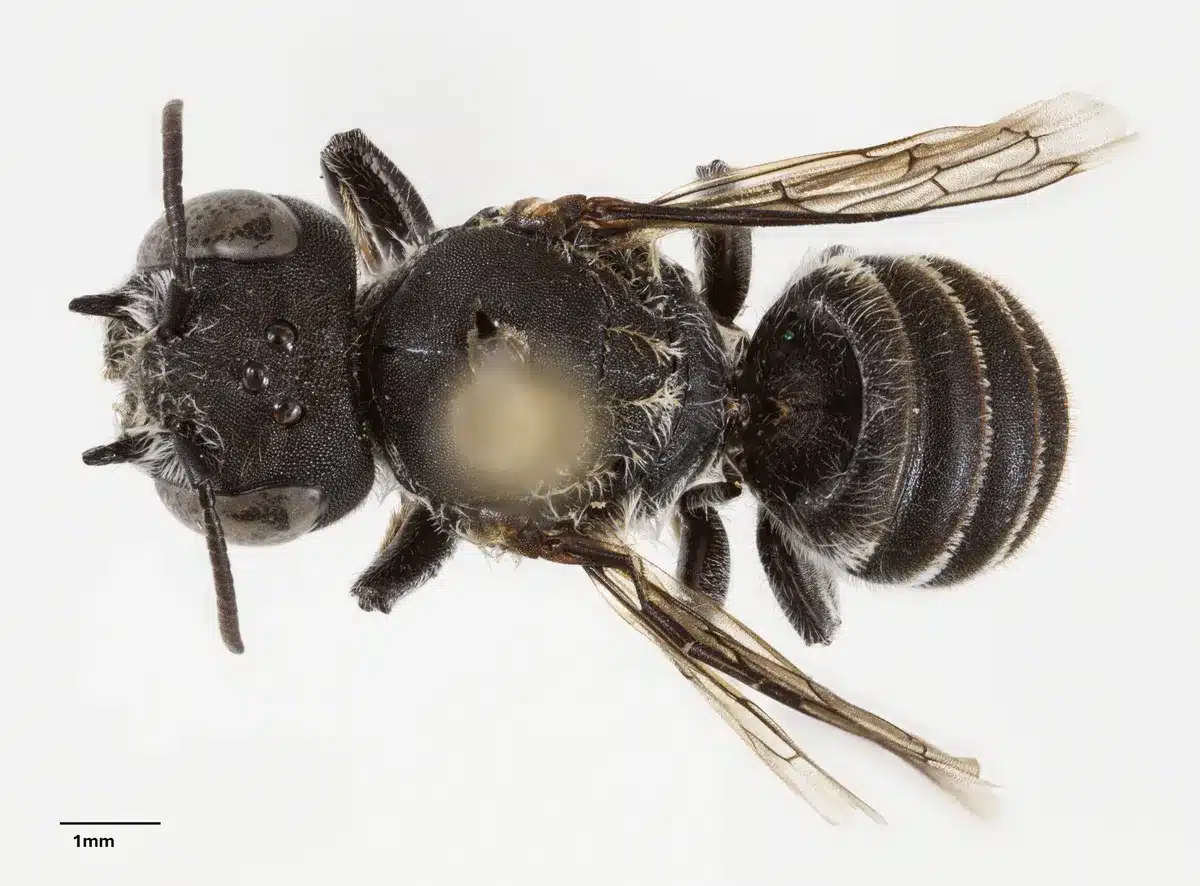
A small Australian bee has just made waves in the scientific world. Named Megachile (Hackeriapis) lucifer, this new species attracts attention as much for its intriguing name as for its remarkable characteristics. But behind this intriguing label lies a far more serious message about biodiversity and the preservation of threatened ecosystems.
An Intriguing Discovery That Captivates
Megachile lucifer was identified during a survey of threatened wildflowers in Western Australia, in the Goldfields region. What immediately struck the researcher Kit Prendergast, lead author of the study, were the small horns on the faces of the females, a trait unique among local bees. These horns, which do not appear to be linked to male competition, could help the insects access flowers, build their nests, or defend their habitat, but the question remains open.
The choice of the name “lucifer” is not incidental. Inspired by the television series Lucifer that Prendergast was watching while drafting the scientific description, it echoes the almost “diabolical” aspect of these horns. The label draws attention while providing a mnemonic aid to remember this rare species. Beyond the anecdote, this bee represents a concrete example of the still little-known diversity of pollinating insects, even in regions studied for a long time.
A Symbol of the Fragility of Ecosystems
The discovery of Megachile lucifer is not merely a scientific event: it is also a warning signal about the state of Australian ecosystems. The Goldfields region is heavily exploited for mining and pastoral activities, which directly threaten native plants and insects. As Prendergast notes, many companies do not inventory local bees, increasing the risk of extinction for species that are still unknown even before identification.
This situation illustrates a fundamental principle in ecology: pollinators and plants are deeply interconnected, and the loss of one leads to the loss of the other. Megachile lucifer, by visiting rare and threatened plants, plays a crucial role in maintaining these ecosystems. Its existence reminds us that biodiversity is not limited to large animals or spectacular landscapes; it can be hidden in tiny, unobtrusive creatures that are nevertheless essential to the natural balance.
Why This Discovery Is Important
Describing this species marks the first time in its group for more than 20 years, underscoring how much life remains to be discovered even in regions that have been studied for a long time. It also serves as a reminder that modern science is not limited to observing; it must also protect: without meticulous surveying and targeted conservation, key species could vanish before we understand their role.
By choosing a striking name and ensuring the publication is accessible, the researchers hope to raise awareness among the public and decision-makers about the importance of cataloging native bees and the necessity of protecting their habitat. Megachile lucifer thus becomes both a subject of scientific curiosity and a symbol of biodiversity’s fragility.
This small bee, with its horns and evocative name, reminds us that scientific discovery can astonish, inform, and alert all at once, and that even the tiniest creatures have a vital role to play on our planet.
The study is published in the Journal of Hymenoptera Research.
