
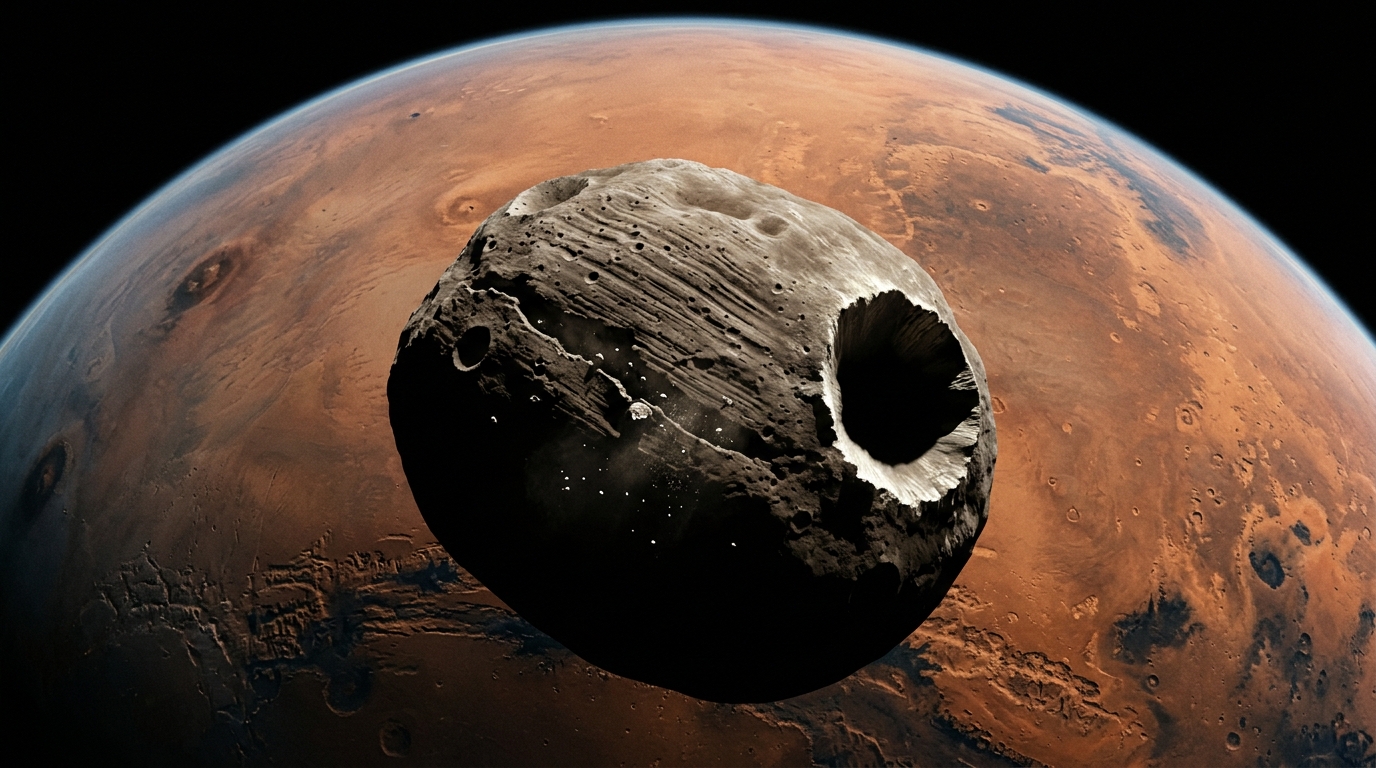
The long parallel grooves of Phobos, Mars’ largest moon, could be the first signs of its slow disintegration. This is the interpretation of a team at NASA’s Goddard Space Flight Center, presented in 2015 based on tidal-stress models. It remains debated. The Japanese MMX spacecraft, launched on October 20, 2026, is expected to return samples from Phobos in 2031 to better understand this small moon.
A moon moving closer to Mars by about 2 meters per century
Phobos is a small irregular body roughly 26 × 22 × 18 kilometers. It orbits at about 6,000 kilometers from the surface of Mars, closer to its planet than any other moon in the Solar System. Unlike our Moon, which is receding from Earth, Phobos is approaching Mars: according to NASA, its orbit tightens by about 2 meters every century.
This rate may seem negligible on human timescales, but it accumulates over millions of years. Researchers estimate that in 30 to 50 million years, Phobos will be torn apart by Mars’ gravity. This deadline is short on the timescale of the Solar System’s history, long for human civilization.
The mechanism at play is tidal forces: Mars’ gravity pulls harder on the face of Phobos that is toward it than on the opposite face, which stretches the satellite. The closer it gets, the greater this stretching becomes. If the moon’s interior is poorly cohesive, it may ultimately yield. This is the scenario tested by Terry Hurford’s team at NASA’s Goddard Center.
Grooves: a NASA hypothesis, not a consensus
In November 2015, Hurford and colleagues presented at the annual meeting of the American Astronomical Society’s Division for Planetary Sciences a numerical simulation of the stresses Phobos would experience. So these are not direct measurements, but models. According to these calculations, the grooves would resemble “creases”: fractures resulting from the moon’s deformation due to tides. “We think Phobos has already begun to yield, and the first sign of this rupture is the production of these grooves,” Hurford summarized. The interior would be a jumble of barely coherent blocks, covered by a regolith layer of about 100 meters.
This explanation has not silenced the debate. The grooves were initially attributed to the impact that formed the Stickney crater, then to secondary impacts of material ejected from Mars, or to blocks rolling in from Stickney. In 2016, a study published in Nature Communications observed that many alignments do not fit any tidal-stress model. According to this study, some crater chains resemble ejecta impacts that fall back onto the moon.
MMX: launched in October 2026, sample return in 2031
The MMX mission from JAXA lifted off on October 20, 2026 at 04:41 (Japan time) aboard an H3 rocket, and the spacecraft separated from the launcher about 71 minutes later. The launch had been planned for 2024, but was delayed by two years due to issues with the H3. The launcher had suffered two failures, on its inaugural flight in 2023 and in December 2025, the latter attributed by JAXA to a fairing separation anomaly.
The probe is set to reach Mars in August 2027, before rendezvousing with Phobos about a month later. It will remain there for three years, observe Phobos, then overfly Deimos. The Franco-German rover Idefix, around 25 kilograms, developed by CNES and DLR, is to be landed on Phobos around late 2028 or early 2029, for at least 100 days of operation. Later, MMX will collect at least 10 grams of material, returned to Earth in 2031. This will be the first sample return from the Martian system.
The mission primarily aims to understand the origin of Phobos and Deimos: captured asteroids by Mars, or another origin. The samples will tell what this moon is made of. They will not, on their own, decide who is right about the grooves: this question remains open.
Sources :
- Mars’ moon Phobos is slowly falling apart – NASA Goddard (ScienceDaily, Nov 10, 2015)
- Mars’ moon Phobos is slowly falling apart – Astronomy.com
- Phobos is Slowly Being Torn Apart by Mars – Sci.News
- How the Mars Moon Phobos Got Its Grooves – Live Science
- Sesquinary catenae on the Martian satellite Phobos – Nature Communications, 2016
- Mission japonaise MMX: en route for the exploration of Mars’ moons – CNES (Oct 20, 2026)
- Launch schedule of MMX aboard H3 F10 – JAXA (Aug 20, 2026)
- MMX lifts off to Mars’s moon Phobos – ESA (Oct 2026)
- Off to the moons of Mars: MMX and the Idefix rover – DLR (Sept 1, 2026)
- JAXA traces H3 Flight 8 failure to fairing separation anomaly – SatNews (Jan 26, 2026)
Article prepared with the help of AI · Our approach
