
Snow can look eternal from a distance, but up close it’s a restless architecture—always moving, always settling. In the late 1950s, American engineers followed that motion into the white and built a strange, ambitious experiment: a living network of tunnels cut into Greenland’s ice sheet. “Build a home where nothing is alive,” they dared, “and see what survives.” What they created below the wind was part laboratory, part frontier myth—and, as the climate warms, a time capsule with consequences.
A city beneath the snow
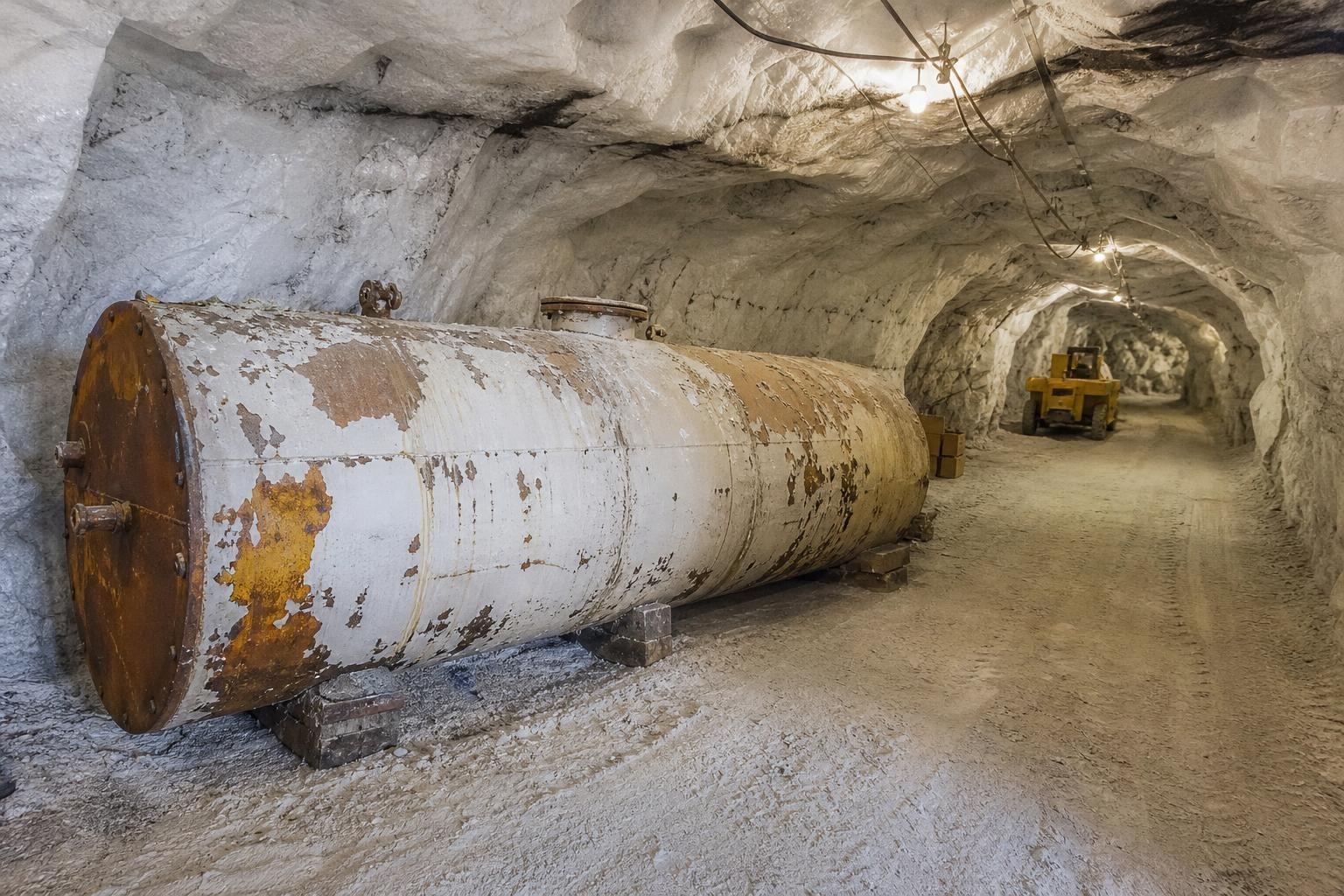
The camp rose in 1959 as a grid of trenches, roofed with snow and laced with steel arches. Inside, the Army set up a barber chair, a kitchen, a theater, bunks, labs—an underground town with plowed streets made of ice. Cranes and snowcats fed the tunnels like arteries, while workers learned to read the creaks that meant a wall was creeping. “It felt like noon at midnight,” one could say, because the work was bright and the sun, above the ice, almost never set.
Nuclear heat in a frozen world
At the heart of the camp, a compact reactor hummed. The PM-2A—portable, modular, and shipped in sections—turned uranium into steady power and precious heat. In an era of mid-century confidence, it was the perfect symbol: clean lights glowing under snow, coffee steaming in a mess hall while the polar wind screamed outside. Most nuclear materials were eventually removed, but the camp’s broader footprint—fuel residues, chemicals, and everyday waste—was left to the mercy of the accumulating ice.
The hidden blueprint
Publicly, this was a research station. Privately, it held the outline of something bolder: a plan to test whether miles of tunnels could hide mobile missiles beneath the ice. The idea, codenamed Project Iceworm, never ripened into an operational system. The ice moved too fast, crushing arches, twisting galleries, and turning straight corridors crooked. Nature vetoed in slow motion, reminding planners that a glacier is a factory of pressure, not a harmless white void.
What the ice is keeping
When the camp closed in the 1960s, engineers assumed snowfall would bury its leftovers forever. That bet fit the climate logic of the day: ice accumulates, waste stays entombed. Today, the archive under the surface is thought to include:
- Structural debris and metal
- Diesel and other fuel residues
- Sewage and greywater frozen in place
- Building materials containing PCBs
- Trace contamination linked to the reactor’s operations
No one expects a glowing core to emerge—the reactor and spent fuel were taken home—but “low-level” doesn’t always mean harmless when mixed with meltwater pathways, delicate ecosystems, and long-range pollutant travel.
When warming rewrites the plan
Fast-forward to a hotter century, and the premise of permanent burial looks fragile. Summer melt is licking higher into the interior, and models project zones once reliably cold could see seasonal thaw. A 2016 scientific study warned that future melting might mobilize the camp’s wastes—turning ice-stored pollutants into moving problems. What was once locked could join meltwater streams, travel through firn and fractures, and eventually enter wider systems of snow, rivers, and the sea.
Law, legacy, and the line of responsibility
Here the story leaves engineering and enters politics. Who cleans a buried mess if the vault was the ice itself—and the key has melted on a warming world? Greenland is autonomous within the Kingdom of Denmark, while the United States built the camp. Agreements from that era didn’t imagine remobilized waste, and jurisdiction over contaminants on or within an ice sheet can be murky. “Ownership of the past,” as one policy analyst quipped, “becomes stewardship of the future.”
Science in the tunnels, science in the air
It’s easy to see only the geopolitical angle, but the camp also seeded real knowledge. Researchers sampled ancient snow, tested polar logistics, and learned—sometimes painfully—how ice deforms around human structures. Today’s cryosphere science, satellite mapping, and borehole work all carry that dual legacy: fascination with ice as an archive, humility before ice as an active machine. The tunnels collapsed, but the questions they raised still stand upright.
Lessons etched in blue and white
There’s a particular irony here. A project built to master a frozen landscape may return, decades later, as a cleanup challenge because that landscape is no longer as frozen. The real artifact isn’t just the debris; it’s the mindset that assumed ice was static, that burial was forever. “Nothing disappears,” the Arctic seems to say, “it only waits.” In that waiting lies a gentle but urgent prompt: design for change, plan for melt, and treat cold places as living, not still.
