
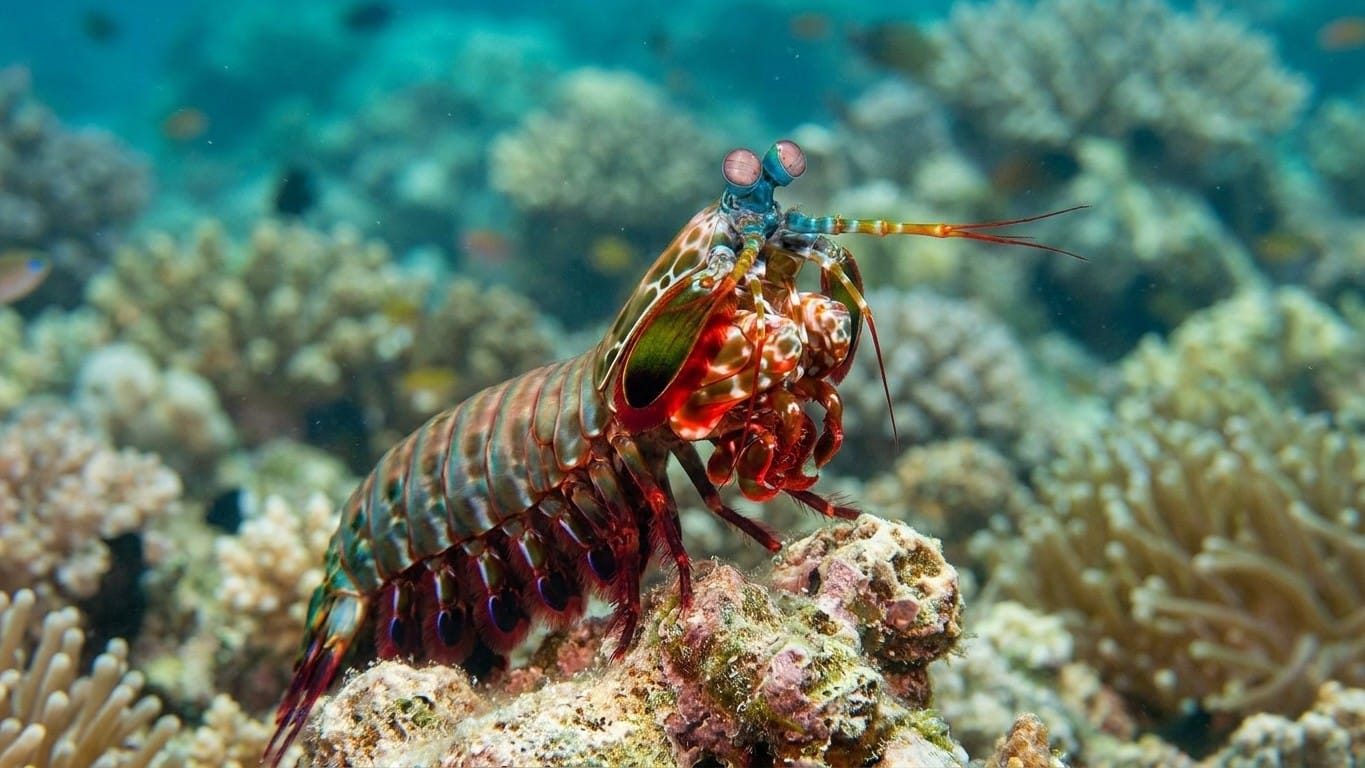
A punch capable of cracking a 20-millimeter-thick pane, delivered in barely two milliseconds by an animal that fits in the palm of a hand: the mantis shrimp, also known as the spearer shrimp, is far from an ordinary crustacean. With a force reaching up to 1,500 newtons—more than a thousand times its own weight—it can pierce the shells of its prey and even shatter the glass of an aquarium. And yet, not a trace of injury on the creature after impact. It is precisely this paradox that has intrigued researchers for years.
To remember
- A club that accelerates faster than a rifle bullet in under one millisecond
- The secondary shockwave created by cavitation strikes twice in a single strike
- The exoskeleton acts as an invisible phonon shield to protect the animal
A Club Faster Than a Rifle Bullet
The mantis shrimp possesses two folded appendages beneath its head, like miniature mantis arms. In the so-called “smashers” species, these arms terminate in a formidable calcareous club. The appendage is held in place by a locking system, tensioned against an exoskeletal spring, and a four-bar mechanism amplifies the force released at trigger. The animal arms its strike as if drawing a crossbow, then releases everything in a fraction of a second.
The outcome surpasses comprehension for an animal of this size. The club’s acceleration exceeds 80 km/h in less than one millisecond, an acceleration comparable to that of a .22-caliber bullet. In some cases, the strike speed climbs to 23 meters per second. To put the feat in perspective: if a human arm were to reproduce this motion at a proportionate scale, it would be powerful enough to launch a baseball out of a stadium. The mantis shrimp does this to break a whelk shell.
The Strike Within the Strike: When Water Itself Becomes a Weapon
What makes the mantis shrimp’s strike truly singular is not only its speed. It is what happens immediately after impact. The impact is so rapid and violent that it vaporizes the water directly in front of the club, creating a phenomenon known as cavitation: the formation of a low-pressure bubble that then collapses violently. This bubble exists only for a fraction of a second. But its implosion releases a second shock wave, nearly as destructive as the strike itself.
Thus, the prey is struck twice in a single attack: first by the club, then by the implosion of cavitation bubbles that follows immediately. Sheila Patek, a Duke University biologist and pioneer in stomatopod studies, even detailed the distribution of this double force in an article published by Pour la Science. The phenomenon produces a sharp crack and, under certain conditions, a brief emission of light: sonoluminescence. An unexpected consequence: even when the mantis shrimp misses its target, the shock wave generated can stun or kill nearby prey.
The Mystery of a Body That Endures Without Breaking
How can an organism so delicate endure thousands of repetitions of such a shock without its own arms giving way? This question has long puzzled biomechanists. A team from Northwestern University in Illinois, led by researcher Horacio Espinosa, has recently offered a piece of the answer. “To be able to perform high-impact strikes repeatedly, the mantis shrimp’s club must possess a robust protective mechanism to avoid self-destruction,” explains the researcher.
The answer lies not merely in brute material strength. The mantis shrimp’s armor would act as a phonon shield, filtering high-frequency stress waves to prevent destructive vibrations from propagating through the limb and the body. Concretely, the club is organized in successive layers of mineralized chitin, somewhat like natural plywood, capable of deflecting and absorbing energy rather than letting it travel through the organism. The outer layer is even coated with a hydroxyapatite shell about 70 micrometers thick, a material reminiscent of human enamel. To reach this conclusion, researchers used two cutting-edge techniques: transient-state spectroscopy and picosecond laser ultrasounds applied directly to cross-sections of the mantis shrimp’s peacock mantis (Odontodactylus scyllarus) exoskeleton.
A Creature Dreaded Even in Aquarium Tanks
This combination of raw power and tailor-made resilience explains why the mantis shrimp has a reputation as a menace among aquarium enthusiasts. Accidentally introduced into a tank with live sand or live rocks, it can quietly decimate the entire population of fish and crustaceans before anyone notices. And as it grows, glass is no longer safe either: there are documented reports of panes fissuring or shattering from adult specimens. Even professional divers exercise caution in the field, knowing they might become the target of an attack if they get too close to a burrow.
This natural architecture also attracts the attention of materials scientists. Teams in biomimetic research draw inspiration from it to design lighter, more impact-resistant composite armors by reproducing the spiral arrangement of the chitine fibers observed in the club. It’s worth noting, too, that the mantis shrimp perceives the world in a way almost no other animal does, with eyes capable of detecting polarized light and a color spectrum broader than ours. A reminder that a creature a few centimeters in size, lurking on the seabed of a coral reef, can still harbor surprises that science takes decades to fully decode.
Sources: fr.news.yahoo.com | slate.fr
