
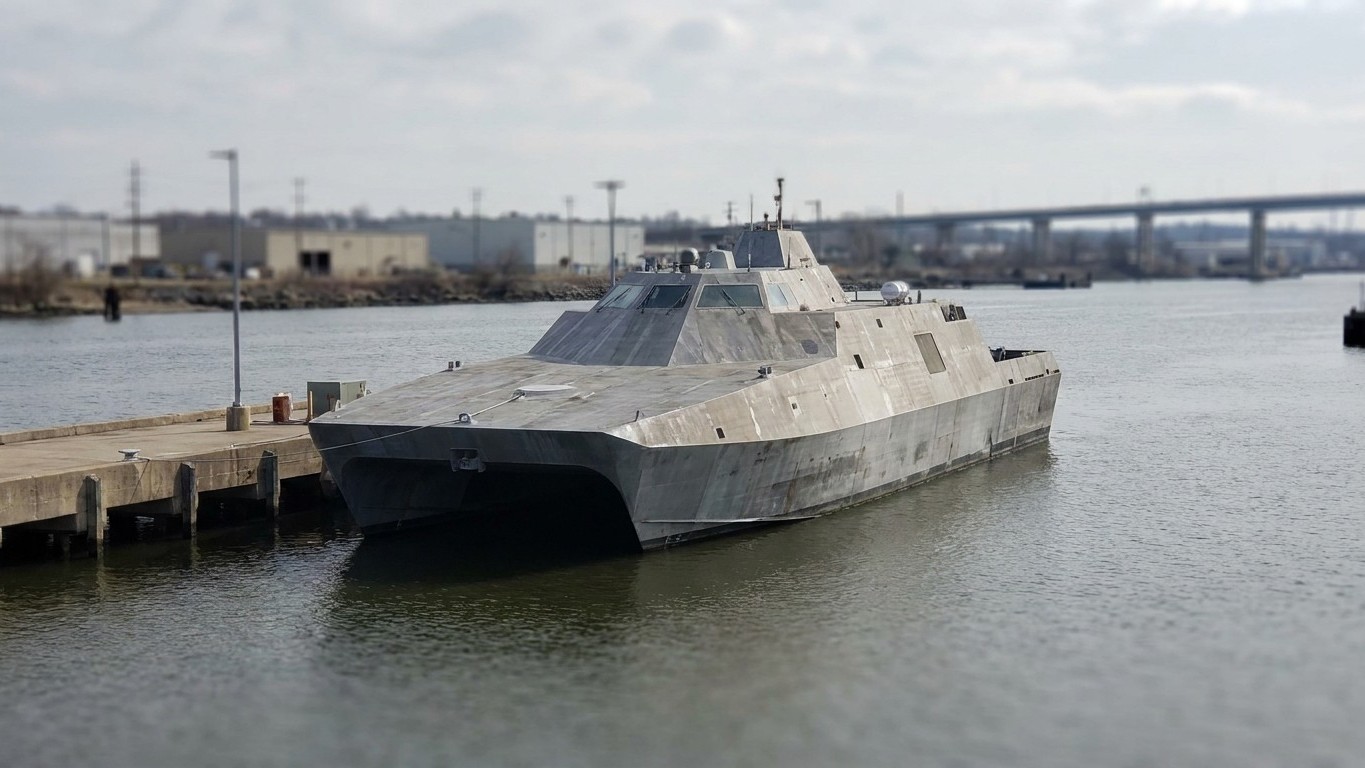
Two thousand five hundred dollars per ton. That was roughly the price a California scrap dealer paid in 2012 to reacquire one of the most secretive ventures in American naval history: the Sea Shadow, Lockheed’s stealthy ship that the U.S. Navy never managed to hand off to a museum. The Sea Shadow and its accompanying barge, the Hughes Mining Barge (HMB-1), were sold for scrap in early July 2012 to Bay Ship & Yacht Co. for $2.5 million, and dismantling was completed by November 30, 2012. A quiet ending for a machine that had cost a fortune and fascinated generations of engineers.
Key takeaways
- A groundbreaking, secret project, built covertly inside a barge for years
- More than $100,000 in upkeep and five years of searching for a museum—without success
- A bureaucratic clause requiring the entire barge to be displayed scared off every potential bidder
A ship designed to disappear, literally
The Sea Shadow (IX-529) was an experimental stealth vessel built by Lockheed for the US Navy, intended to explore how to achieve a minimal radar profile and to test hull configurations that favored stability at sea. The idea did not spring from a conventional design studio. According to Lockheed Martin, engineer Ben Rich, head of the Skunk Works, noticed that the radar-absorbent coatings used on the F-117 disrupted sonar measurement instruments, and he conceived the possibility of applying the same approach to a ship to render it undetectable to sonar. From that insight emerged a vessel with a jagged, almost unreal silhouette, engineered to absorb sound waves rather than bounce them back.
The secrecy surrounding the project was such that even the construction itself had to be hidden. Sea Shadow was developed and assembled at Lockheed’s facilities in Redwood City, California, inside the Hughes Mining Barge (HMB-1), which served as a floating dry dock during construction and testing. A barge concealing a ship to build another—such a method would astonish, yet it allowed the project to stay out of sight for years, right in the heart of San Francisco Bay.
Completed in 1985 by the Defense Advanced Research Projects Agency (DARPA) and Lockheed Martin, it represented the American Navy’s first experimental stealth vessel. Its sea outings occurred only at night, shielded from observation satellites, a caution that stretched for years before the public became aware of its existence. The ship remained a secret until it made its public debut in 1993. Inside, there was none of the luxury one might expect for a multi-hundred-million-dollar undertaking: Sea Shadow offered just 12 berths, a small microwave oven, a refrigerator, and a table. A minimalist interior for a technological gem.
The condition that drove away all museums
Retired from active duty on August 22, 2006, the vessel was towed along with its barge to Suisun Bay for storage, awaiting a potential donation to a museum. On paper, the arrangement looked straightforward: present a free piece of military history to a cultural institution. In practice, the administrative and logistical burden proved prohibitive.
The federal rule required the donor to preserve the ex-Sea Shadow as a static museum or memorial in a state deemed satisfactory by the Secretary of the Navy. In practical terms, this meant maintaining not only the ship, but the entire arrangement: the recipient would also have to assume the Hughes Mining Barge and display the Sea Shadow inside that barge. It was effectively impossible to retrieve only the sleek hull for a pier installation; the buyer would have to manage a massive industrial barge with all the attendant safety and maintenance demands.
Applicants for the donation were also required to submit a comprehensive dossier detailing their ability to bear the financial, technical, environmental, and curator duties associated with the gifted military vessels. In other words, a bureaucratic wall that most smaller museums, already strapped for funds to maintain their own floating collections, found insurmountable. The consequences were swift. After five years of pursuit and more than $100,000 spent on maintenance since the initiative began, the Navy abandoned the search for a museum, noting that only one organization had submitted a dossier, and it was judged unviable.
A Navy spokesman captured the sentiment of the moment: “a ship that pristine costs too much to maintain for most applicants.” The paradox is harsh: the better the condition of the object, the less likely it is to find a buyer, because the long-term upkeep becomes unaffordable for most institutions.
From the secret relic to the scrap metal
Facing this stalemate, the authorities shifted gears. In 2006, the Navy attempted to sell Sea Shadow to the highest bidder; when interest was lacking at the initial sale, it was placed on gsaauctions.gov for a dismantling sale, with the stipulation that the buyer would not relaunch the vessel and would be required to scrap it. A drastic clause, yet consistent with the project’s history: letting a hull designed for radar invisibility go to sea under private flag would pose troubling questions about the spread of technology.
Would-be museums ultimately declined due to the prohibitive costs of upkeep, transport, and security tied to this specialized craft and its still-classified components. The barge and ship ultimately crossed the auction block together, heading to Alameda, where Sea Shadow was dismantled in 2012 by Bay Ship & Yacht Company. The curtain fell on a project that had nonetheless left a lasting imprint on popular culture, even serving as the model for the villain’s stealth vessel in a famous James Bond film released in 1997.
One irony worth noting: the technology intended to render this ship invisible to radar did not prevent its most visible fate—a heap of scrap photographed and commented on by enthusiasts right up to the final day of demolition. Some devotees, present at the site during the junking, documented the process hour by hour, refusing to let the disappearance of a one-off object in naval history go undocumented. Today, what remains of the Sea Shadow are photographs, a handful of 1:144 scale models sold commercially, and memories of a vessel the Navy never managed to entrust to anyone because no institution was rich enough to shoulder the burden of its secret.
Sources: federalregister.gov | thevintagenews.com
